
|     |
|
| |

REVIEW / REPORTSwayamvar through Magadh gaze- Kasturika Mishrae-mail: kasturikafeministpoetry@gmail.com May 26, 2026 Nowhere in the world we see so much emphasis on passing of legacy as in India encompassing its cultural traditions. Mulling over years of subjective thinking and adaptive learning, dancers have tried to preserve their wholesome personalities in the vocabulary they learnt from their gurus. Gauri Diwakar and her group of dancers / disciples are a mix of such talented souls who have devoted their lives to learning an art from which they absolutely can't earn anything substantial all their life. But the doggedness that their guru possesses is a uniform trait in each one of them. One felt in the Gauri Diwakar Sanskriti Foundation's latest production 'Magadh' this cohesive common thread flowing in each being on stage. 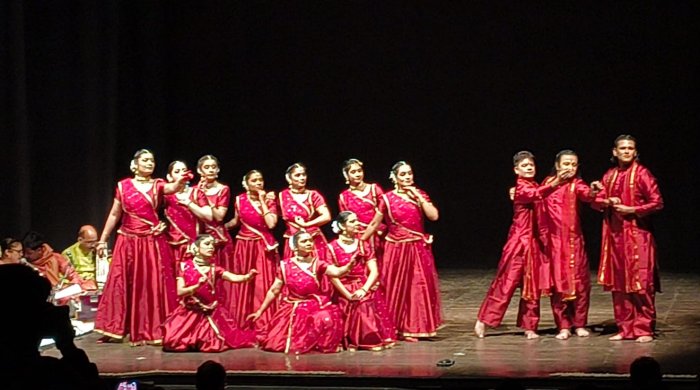 On May 18 at the Shri Ram Centre, New Delhi, Gauri's entire brood was present at the hall starting with the Ganesh vandana by the beginner batch serenading the entire stage in an elephant herd. The pretty young girls were stumbling to remember their place on the stage but aware of the fact that they have to listen to the beats of their guru all the while. Vakratunda mahakaya sloka was a bit difficult for them to emote but it was sweetly camouflaged by the solidarity the little dancers possessed. Gauri narrated the popular Ganesh story of who is the most powerful amongst Lord Shiva's sons. Later the scene was enacted beautifully. Vinay Tiwari, the choreographer who composed the entire story, used all the dancers in bunches of dramatic spots. As Ganesh encircles his parents and proves his intelligence, he is showered with handmade garlands and the group ends the segment with Jai Ganesh Jai Ganesh song and the 1 tali, 2 tali, 3 tali, preliminary avartan (cyclical beat of a taal). For the next segment the invocation "Om Aim Hrim Klim Chamundaye Vichche", Vinay Tiwari used the feminine and aggressive sides to Durga ma with aplomb. Lit by some great light work by Milind Srivastava, nine senior dancers moved in a chakkardar (revolving steps) and built the scene to a zenith of slaying Mahishasura. Alternatively, they moved in a getting up and sitting posture to give an impression of a swastik sign. Cleverly using the rectangular stage in Shri Ram Centre, Vinay Tiwari concentrated the dancers Tanuja Bora, Ganya Sethi, Kriti Chawla, Khushboo Kukreja, Aheylee Saha, Aashima Dhingra, Ananya Dhingra, Trisha Chakraborty, Radhika Berry in red costume to Bhavani Ashtakam. The highest point of the scene building was when Ma Durga indulges in sword fight, goes through the bed of fire over the army and then drinking blood and killing Mahishasura in a nowhere space neither in ground nor in the sacred space. Peace is restored upon the world while the eulogy "Aigiri nandini" is played in the background. The tallest students of GDSF shone in this piece to excellent accompaniment by Yogesh Gangani on tabla, Ashish Gangani on pakhawaj, Jayawardhan Dadheech on vocal and harmonium, Anil Mishra on sarangi and Umakant Singh on sitar. Sita was venerated in Mithila, her father's dominion as the most celebrated daughter. She is worshipped widely in Mithila, her family narratives feature a lot in Madhubani painting style of the land, in the folklore and the general attitude towards girls in a family. Vinay Tiwari demonstrated how a swayamvar sabha is arranged for Sita. Ladies using the herbal blend of powdered paste, prepare garlands in gajra whorls, three male dancers keep the ladies engaged in celebratory dance playing the cymbals, danced on beats of dholak, manjira, shehnai and gracefully let Sita decide her fate and give her a grand send off. 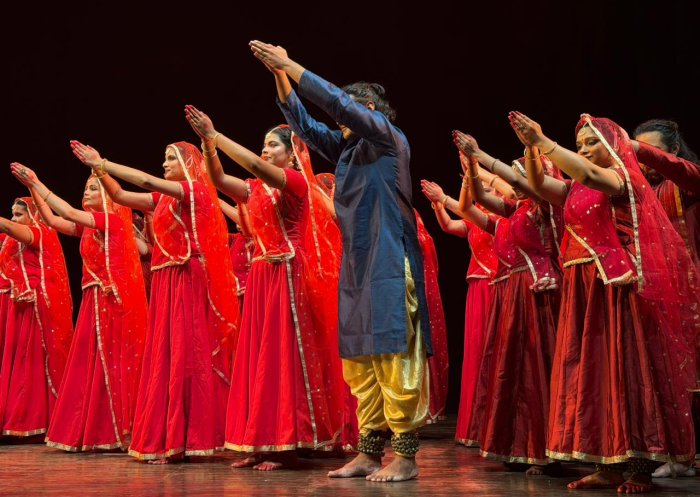 Vinay and Gauri systematically used the basic patterns of Kathak within the storytelling narrative to keep the audience engaged and also educating the young crowd about the utility of arts in education. The next segment of Mithila theme was on heritage quality of Nalanda University which gave Bihar its identity as centre of knowledge and spirituality. Nalanda curriculum of bhumi pranam, yoga classes, archery lessons, sitar classes were all demonstrated by the students. The motifs of fish, rivers, borders of Mithila paintings and the spirit of ekam nrtyam vimala vachanam was also covered. But one wonders why the costumes were in orange. As the concluding piece, Chathh puja of Bihar was danced in a docu drama style. The group of married women are seen offering new wheat and rice for the prayers. On the kharna day, kheer and roti are offered at dusk time after fasting for 36 hours. The dancer group essentially sang the popular chath songs. कांच ही बांस के बहंगिया, बहंगी लचकत जाय बहंगी लचकत जाय होई ना देवर जी कहरिया, बहंगी घाटे पहुंचाय बहंगी घाटे पहुंचाय And रूनकी-झुनकी बेटी मांगीला, पढ़ल पंडितावा दामाद, हे छठी मईया दर्शन दीही ना अपान And recreated the three days of festive atmosphere praying for a boon of a girl child from the Sun god. A welcome feature of the entire production was the English and Hindi narration of the segments by senior students of the Gauri Diwakar Sanskriti Foundation. Vinay Tiwari along with Gauri Diwakar in the end presented the feline character of the vahan of Ma Durga as represented in mithila murals, sculpture, and wall paintings. Vinay Tiwari matched the gait of the lion to near perfection. One could watch in awe the young dancer's imaginative prowess. The performance was blessed by the presence of senior veterans Aditi Mangaldas and Shovana Narayan. May the light of creativity be alive for years to come for the foundation.  @Kasturika Mishra is a poet, writer, and dance critic. |
