
|     |
|
| |

 Sampratti- Tapati Chowdhuriee-mail: tapatichow@yahoo.co.in Photos: Sujoy Kundu May 20, 2026 On 7th April '26, Priti Patel of Anjika arranged her unique seminar 'Sampratti', confluence of legacies. The programme made an excellent start with child artist Gunachenbi's tuneful singing of the shloka "Guru Brahma, Gurur Vishnu...." and then breaking into the devotional Rabindrasangeet "Mono jago mangala loke" in raga Ramkeli and taal teentaal. Manipuri exponent Darshana Jhaveri, who is one of the well-known "Jhaveri Sisters" was invited to speak of her journey in Manipuri dance under the legendary Guru Bipin Singh. From the 1940s, the Jhaveri sisters have been associated with their revered Manipuri teacher. Darshana Jhaveri is well versed in ancient and Vaishnavite shastras and is known for having correlated the oral tradition of Raas and Sankirtan with the shastras. 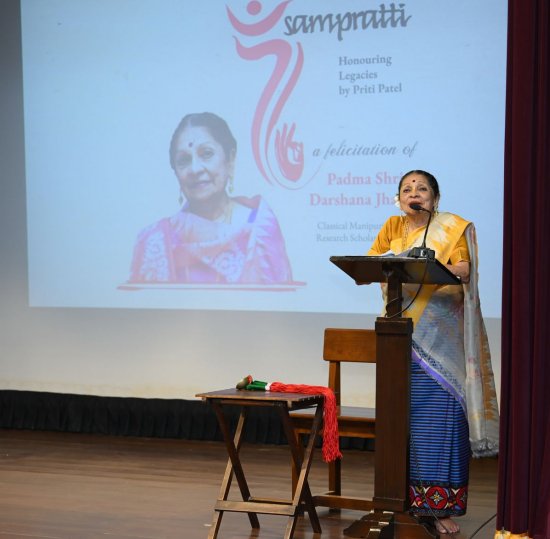 Darshana Jhaveri In the seminar held in the morning, she enlightened the audience with Guru Bipin Singh's vast knowledge of the tradition of Raas and Sankirtan, whose creative genius enabled him to bring traditional and classical dances of Manipur from the temples to the theatre without polluting its original form and spirit. In her lecture-cum-demonstration, she provided a brief glimpse of Guru Bipin Singh's unparalleled contribution in widening the horizon of classical Manipuri dance through the style of Guru Amudon Sharma, bringing to light the complexities, subtleties, and technicalities of Manipuri dance. At Darshana Jhaveri's behest, Vinita Singha, an ardent follower of the style, showcased the two main divisions of Lasya - the feminine style - and Tandava the male oriented style, which brought out Guru Bipin Singh's belief that body movements should follow the stress and rhythm of the bols and swaras. Guru Bipin Singh, she said, had a variety of rhythm patterns and body movements that synchronized with intricate rhythm patterns in all his compositions. Darshana Jhaveri reiterated that Guru Bipin Singh's main contribution was to make Krishna Tandav more forceful and decorative. He drew inspiration from Pung Cholom and Kartal Cholom movements. Poushali Chatterjee, also a disciple of Guru Bipin Singh, aptly demonstrated movements taken from Pung Cholom, composed by Guru Bipin Singh in Krishna's dance. Bimbavati Devi demonstrated a beautiful portion from Mridu Uddhava Krishna Nartan, a beautiful composition by her father Guru Bipin Singh inspired by Pung Cholom, showing the soft and forceful dance of Lord Krishna. Darshana Jhaveri spoke about how Guru Bipin Singh followed the individual system of Talas developed by the gurus of Manipur and showed how gurus were in the habit of using Meitei terminology for certain systems and how Guru Bipin Singh had correlated them with Sanskrit terms in the shastras. Darshana Jhaveri awed the audience by performing the unique piece "Manini Radhe", which drew its inspiration from the 64 divisions of Nayikabheda, performed in Sankirtan and Basak performances. Whatever her guru had composed for stage performance owed its roots to the tradition of Raas and Sankirtan, she said. The presentation was rounded off with a unique Mridang Vadan. Poushali, Malavi, and Vinita played the Pung - Guru Bipin Singh believed that girls should also be well versed in playing the Pung. Listening to Darshana Jhaveri's journey was a helpful insight into the art of Manipuri as envisioned by Guru Bipin Singh. 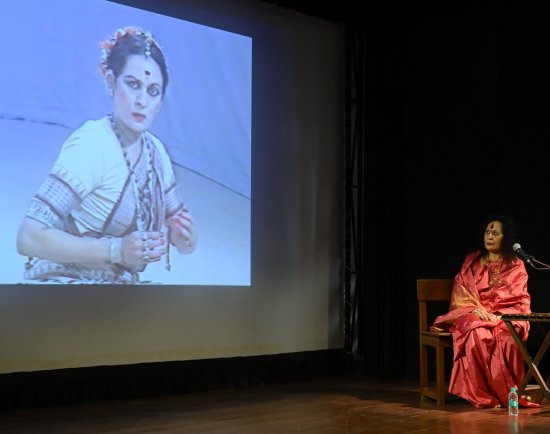 Sonal Mansingh The next speaker of the morning was Sonal Mansingh, a stalwart in the field of Bharatanatyam, who is primarily known for her mastery over Odissi. Besides, she is also well versed in Manipuri, Kuchipudi, and other forms of Indian traditional dances too. She is an established versatile performer, choreographer, teacher, and social activist. She recalled her association with Odissi Guru Kelucharan Mohapatra, who has composed many a piece exclusively for her. Her life's journey was a source of inspiration to young and aspiring dancers present. She made quite a mark showing video clips to explain Nayika Bhedas. Her penchant for vocabulary gave her quite an edge. She was a great success with the young audience as much as she was with veterans, with her work often linking philosophy, literature, and mythology to dance. 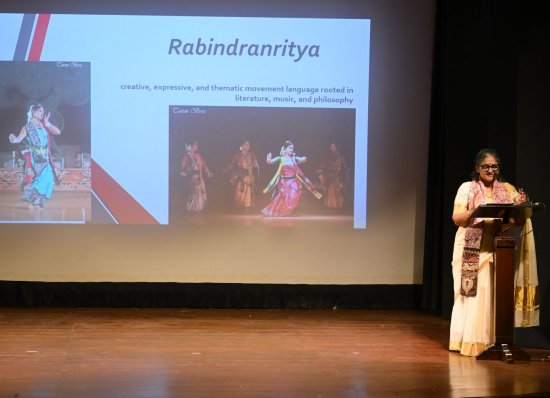 Dr. Sruti Bandopadhay Prof. Dr. Sruti Bandopadhay, Sangeet Natak Akademi Awardee, and a Fulbright Fellow, a Professor of Manipuri Dance, Sangit Bhavana, Visva Bharati University, was the first speaker after lunch break. She left no stone unturned to acquaint herself with Rabindranath Tagore's contribution to Indian dance, which represents a profound shift in how movement, music, and expression are understood within the performing arts. Her talk on Rabindranritya and its modernity was quite impactful. She said that unlike the codified structures of classical traditions, his dance idiom - often called Rabindra Nritya - emerged as a fluid, expressive, and deeply philosophical form. Through this approach, Rabindranath Tagore redefined dance not merely as a technical discipline but as a living medium of emotional, spiritual, and artistic experience. At the heart of Tagore's dance philosophy lies the idea that art must arise from within. He rejected rigid formalism and instead emphasized bhava, or inner feeling, as the true source of movement. In his view, the dancer is not simply executing learned steps but becomes a vessel through which emotion, meaning, and poetic imagery are revealed. This emphasis on inner sensitivity ensured that dance was not reduced to ornamentation but elevated into a deeply communicative and human act. Closely intertwined with Rabindrasangeet, his dance idiom reflects a natural unity where music and movement grow organically from a shared emotional core. One of the defining features of Tagore's legacy is his ability to balance discipline and freedom. He did not dismiss the importance of technique; rather, he reinterpreted it as a supportive framework rather than a restrictive force. Discipline, for Tagore, meant cultivating bodily awareness, rhythm, and coordination, as well as sensitivity to musical timing and group harmony. However, this discipline was meant to be internalized, allowing movements to flow naturally rather than appear mechanical. Freedom, on the other hand, was the soul of artistic expression - the space where emotion could shape gesture, and where individual interpretation could flourish within a shared structure. In this balance, Tagore created a form that was both structured and alive. 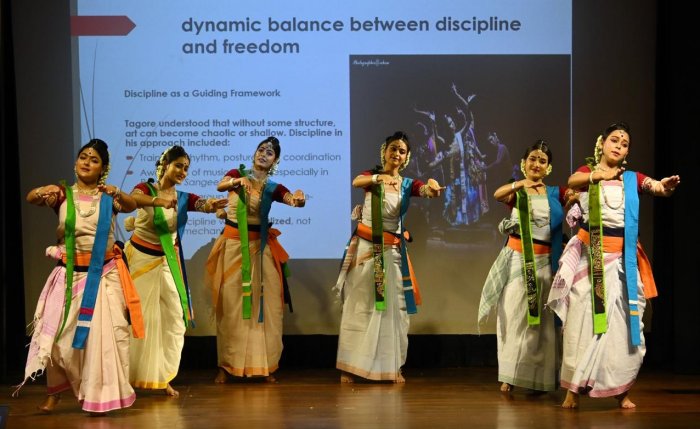 Rabindranritya Tagore's openness to experimentation also led him to reject rigid codification. Unlike classical dance systems that rely on fixed vocabularies and prescribed gestures, his style encouraged innovation, improvisation, and the blending of diverse influences. This is evident in his incorporation of Manipuri dance, whose grace and devotional quality deeply inspired him. By introducing Manipuri dance into the curriculum at Visva Bharati, he not only preserved the tradition but also expanded its reach beyond regional boundaries. His dance-dramas, such as Chitrangada and Chandalika, exemplify this synthesis, blending classical elements with expressive storytelling and psychological depth. Equally significant is Tagore's educational philosophy, which positioned the arts as an integral part of holistic learning. At Santiniketan, dance was not taught in isolation but in close relationship with nature, poetry, and music. Students were encouraged to observe the rhythms of the natural world, engage deeply with literary meaning, and explore their own creative responses. In this environment, artistic training became a process of self-discovery and connection rather than mere skill acquisition. Tagore believed that true artistic excellence lies not only in mastery of technique but in cultivating empathy, awareness, and a sense of harmony with the world. The enduring legacy of Tagore's dance idiom lies in its humanistic and universal vision. By dissolving the boundaries between different art forms and emphasizing authenticity over virtuosity, he created a movement language that remains relevant even today. His work continues to be performed and reinterpreted, particularly in Bengal, where his dance-dramas live on as evolving traditions. At the same time, his ideas resonate strongly with contemporary educational frameworks that advocate integrated, experiential learning. Ultimately, Rabindranath Tagore's influence on dance extends far beyond choreography. He transformed it into a medium of inner expression, cultural dialogue, and spiritual exploration. His legacy reminds us that dance is not just an art to be performed, but a way of understanding life itself - where discipline provides structure, freedom gives vitality, and inner feeling imparts meaning. 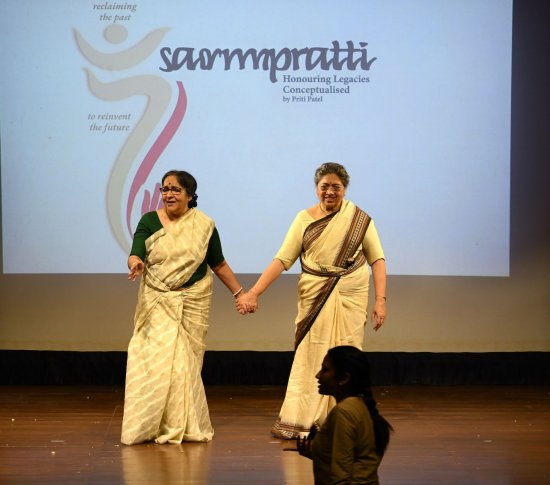 The Shankars Though Mamata Shankar and Tanusree Shankar - both disciples of Amala Shankar, the wife of the great Uday Shankar as well as his dance partner - took the stage late in the afternoon, the Shankar daughter and sister-in-law were quite a hit with the young audience. They performed with great excellence. It was a double treat when we got to hear the duo dance to a composition by the musical genius Ananda Shankar. The evening session at G.D. Birla Sabhaghar (Kolkata) witnessed a presentation composed and choreographed by Bharatanatyam exponent Rajdeep Banerjee, based on the devotional composition "Sri Jagadeeshwari Durga Mata," set in raga Ahir Bhairavi and adi talam, performed by Priti Patel's Anjika ensemble along with practitioners of different styles. The presentation was structured around the idea of invoking the divine feminine and understanding its deeper philosophical significance. The thematic focus of the performance centered on the celebration of womanhood as a universal principle, emphasizing that Shakti, or divine energy, exists within every individual. The concept extended beyond a singular form of the Goddess and highlighted that womanhood, in all its forms, embodies qualities such as strength, compassion, creation, and transformation. The presentation conveyed the idea that every manifestation of the feminine is powerful and worthy of reverence, thereby presenting womanhood as an essential and sustaining force of life. 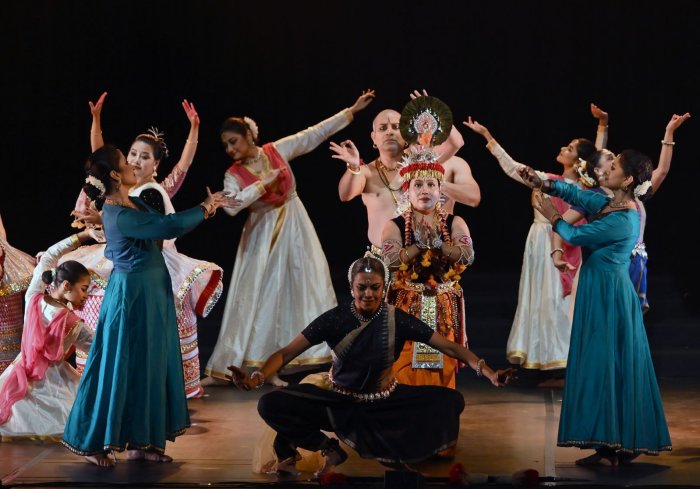 Sri Jagadeeshwari Durga Drawing from the meaning of the composition, the Goddess was represented as Jagadeeshwari, the supreme ruler of the universe, and as the force behind creation, preservation, and dissolution. She was also depicted as the remover of fear and negativity and as the protector of righteousness. The philosophical aspect of Vishwaroopini - the universal form - suggested that the divine is present in all existence, reinforcing the idea of unity between the devotee and the divine. An important conceptual element in the presentation was the idea that, to a worshipper of Goddess Durga, the divine feminine reveals itself in multiple forms and manifestations. This cyclical and continuous presence was reflected in the progression of the performance, indicating that the experience of Shakti is not linear but recurring and ever-evolving, much like the cycles of life itself. The musical accompaniment included vocals by Akash Mukherjee, with support from Kaliswaran Pillai (talam and nattuvangam), K. Dakshinamurti, Anantharaman Ravi, and Rupak Mukherjee, forming the musical framework for the presentation. Overall, the piece presented a thematic interpretation of the devotional composition, focusing on the philosophical and symbolic dimensions of the divine feminine, the universality of Shakti, and the cyclical manifestation of the Goddess in various forms as experienced by the devotee. 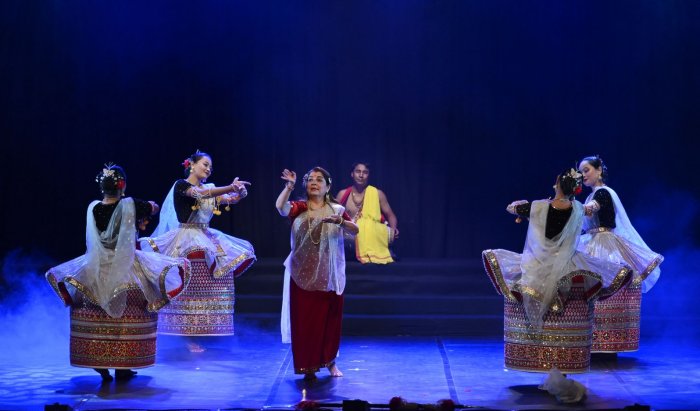 Priti Patel and Anjika ensemble Priti Patel brought together Bharatanatyam, Kathak, Odissi, Manipuri, Sankirtan and Thang-ta in a collage in this piece to create patterns. The concept was excellent and was highly appreciated for its unity in diversity. The chosen performers were the very best in displaying their unique style. However, it would be worthwhile to remember that the audience would have a problem focusing on performers executing their dances together, each with their different movements in all corners of the stage. The compere Sadhana Srivastava was matchless.  Tapati Chowdhurie trained under Guru Gopinath in Madras and was briefly with International Centre for Kathakali in New Delhi. Presently, she is a freelance writer on the performing arts. She is the author of 'Guru Gopinath: The Making of a Legend.' |
