|     |
|
| |

 Dance Conversations: Five decades. One living tradition- Ketu H Katrake-mail: khkatrak@uci.edu Photos courtesy: Subathra Photography May 18, 2026 "Dance Conversations" organized by the Irvine-based Ektaa Center along with Bharatnatyam dancer and teacher Ramya Harishankar took place at the Lakeview Senior Center in Irvine, California on May 2, 2026. This much-anticipated event featured six renowned Bharatanatyam teachers and performers based in the US - Ramya Harishankar, Viji Prakash of Southern California, Katherine Kunhiraman, Mythili Kumar of Northern California, Rathna Kumar of Houston, Texas, and Hema Rajapogapalan of Chicago. These prize-winning artists collectively represent five decades of pedagogy, artistic practice, and service as cultural ambassadors in their US communities. 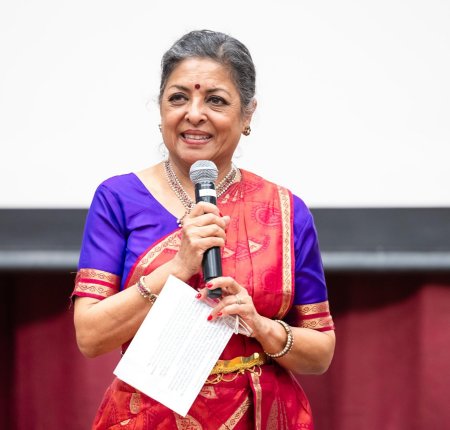 Ramya Harishankar 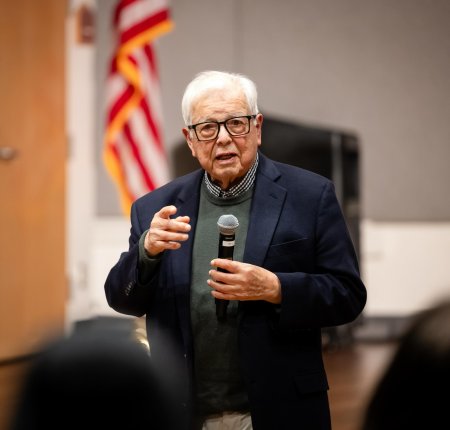 Dr. Robert Garfias Ramya Harishakar opened the event by welcoming the diaspora-based artists along with speakers, Dr. Robert Garfias and Professor Jennnifer Fisher. Ramya extended a special welcome to local Bharatanatyam teachers and dancers in the audience to this "landmark" gathering. Five artists, first-generation Indian Americans who had grown up, were trained in India, and had performed extensively there before they travelled to the US after marriage. Conspicuously absent was the second generation of Bharatanatyam dancers. Each artist was told to take 15 minutes "to present a short solo performance [and] a personal narrative reflecting on their artistic journey." This was a tall order! Dancers took longer than their allotted time, hence the final panel with the artists chaired by University of California Irvine's Professor of Dance, Jennifer Fisher had to be cut short. The most fascinating aspect of each artist's presentation was a short padam or a javeli that showcased their abhinaya via mobile facial and eye expressions. 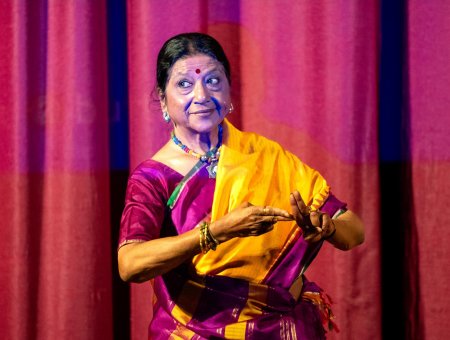 Hema Rajagopalan 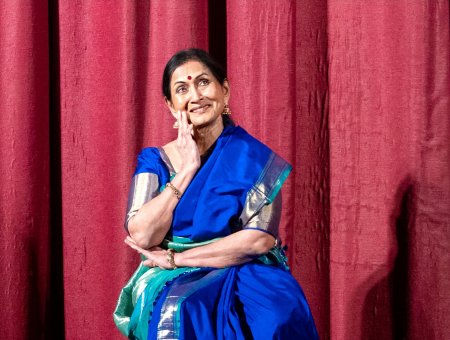 Mythili Kumar Each artist narrated her personal dance story, and screened clips - solo, group, collaborative--of their schools' performances: Since 1975, Katherine Kunhiraman's Kalanjali School of Dance (Berkeley, California); since 1975, Dr. Rathna Kumar's Anjali School for Performing Arts (Houston, Texas); since 1974/75 Hema Rajagopalan's Natya Dance Theatre (Chicago, Illinois); since 1980, Mythili Kumar's Abhinaya Dance Company of San Jose (Northern California); since 1977, Viji Prakash's Shakti School of Bharatanatyam; and since 1982, Ramya Harishankar's Arpana Dance Company and School (Irvine, California). There was more showing via video of these Schools' accomplishments than any discussion with the audience. 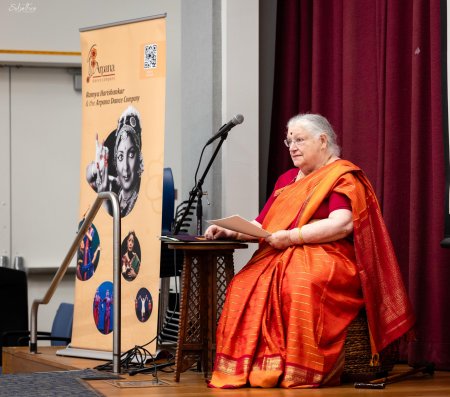 Katherine Kunhiraman Katherine Kunhiraman had participated in 1978 at the first San Francisco Ethnic Dance Festival. Katherine noted that in the 1970s when performing across the US, audiences were not as knowledgeable as they are today about India. This sentiment of not having as many Indian Americans as now was echoed by Hema Rajagopalan. Hema was the only Indian classical dancer who, based in Chicago, fulfilled pioneering Contemporary Indian dancer, Astad Deboo's life-long wish to collaborate with an Indian dancer (as I have written in my book, Astad Deboo: An Icon of Contemporary Indian Dance). Mythili Kumar commented on including local musicians and prop makers in her thematic productions, and her collaborations with Taiko drumming. Kumar drew attention to the dancers' aging bodies as did Viji Prakash who after screening clips of her own dancing, marked by tremendous speed, remarked wisely that she continues to feel the fire of dancing even today along with the advantage of age and experience. Ramya Harishankar sang for Viji's short item, and then herself danced to Krishna nee begane baro that created a bridge to introducing musicologist Dr. Robert Garfias, now 93, who spoke of his memories of Balasaraswati and her family. 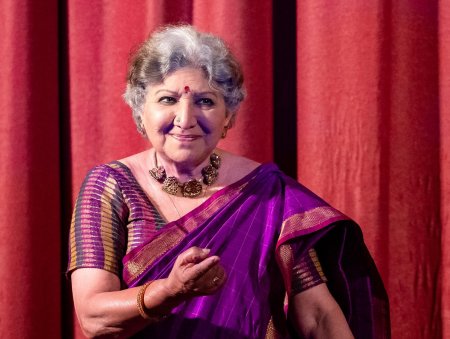 Rathna Kumar 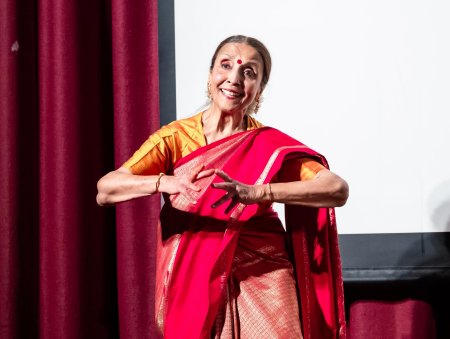 Viji Prakash This was followed by the final Panel moderated by Professor Fisher who asked about tradition and innovation in the diaspora. What is new in diaspora, that perhaps the artists would not have done in India? Hema shared that collaborations work in the US. Viji noted her collaboration with Flamenco dancers; Viji further indicated that growing up in Bombay she was exposed to many art forms, and her guru Kalyanasundaram welcomed different musical compositions including in Gujarati. Rathna Kumar remarked that in India she danced solo, whereas in the US group choreography is common; additionally, she is involved with art and education via workshops, has collaborated with an Ethiopian theater actor; and mounted a multicultural Ramayana with Sri Lankan and Thai dancers. Rathna thoughtfully asked what collaboration means and how each artist must understand another's journey to work together. Professor Fisher had another useful question: what has changed the most during the time that the dancers have been here in diaspora? Variety of responses followed such as the huge influence of Bollywood dance, the changing demographics of parents and students. Of course, challenges to teaching Bharatanatyam exist even in India--the influence of social media and Bollywood. Our attention spans have shrunk; hence shorter dance programs are key to holding an audience. Katherine Kunhiraman surmised that since she began her School in 1975, technique in dance has become more polished and elegant. Ramya Harishankar noted that dancers and teachers adapt to changing times. Dance forms never stand still, and "tradition" is not fixed. There was no time for questions from the audience. Key questions that merited further discussion--challenges of teaching Bharatanatyam to children and youth growing up in California, Houston, or Chicago. How teachers inspire this population whose daily lives do not include India's ambience, its music, and daily life, visiting a bazaar or a temple? What is an accomplished student's journey post-arangetram? How many students elect dance as a profession? How can teachers enable their students to professionalize? What opportunities exist for them in the diaspora? What is the experience of the second generation - daughters of these artists who often teach and perform in their mothers' schools? Overall, a laudable goal of Dance Conversations--to present Bharatanatyam "as a living classical art form" along with "honoring, documenting and preserving the history and evolution of the form in the US" was fulfilled. We look forward to further Dance Conversations. 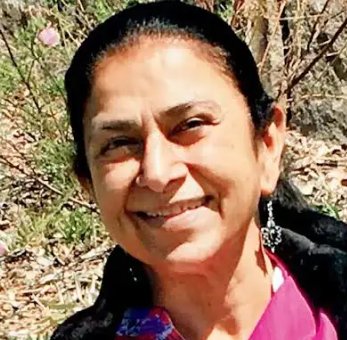 Ketu H. Katrak is Professor Emerita of Research, Department of Drama, University of California, Irvine. |
