
|     |
|
| |

REVIEW / REPORTThe blue god- Kasturika Mishrae-mail: kasturikafeministpoetry@gmail.com Photos: Subrangshu Chakraborty May 16, 2026 Krishna, the eternal lover, and Krishna leela has always been a favorite topic for Kathak dancers. But the traditional combination of bol, baant and use of Krishna kavitt is no longer palatable for a modern audience. The emergence of new mythological writers in the block, intermingling of vocabularies of Krishna from other dance forms, use of language apart from Awadhi, Sanskrit and Bhojpuri to a more common language as English in introduction has slayed the old practices and made way for novel interpretations. 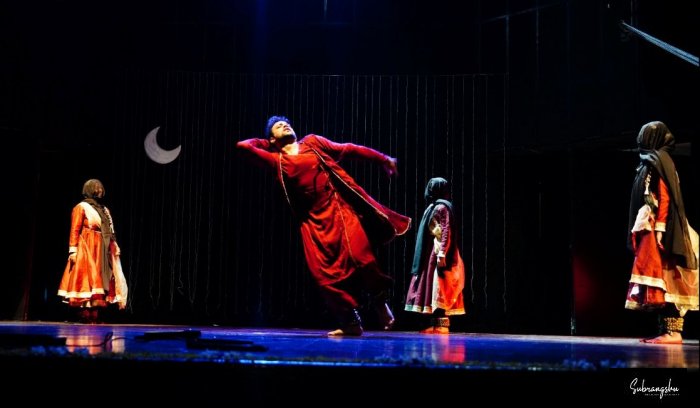 Such is the production of new age Kathak dancer Sudip Chakraborty. His four accompanying dancers articulated the main protagonists with a stern voice of body movements and acting. They opened the evening with Krishnaastakam. भजे व्रजैकमण्डनं समस्तपापखण्डनं स्वभक्तचित्तरञ्जनं सदैव नन्दनन्दनम् । सुपिच्छगुच्छमस्तकं सुनादवेणुहस्तकं अनङ्गरङ्गसागरं नमामि कृष्णनागरम् ॥ १ The opening invocation had a Bharatanatyam base for the musical composition. Jaideep excelled in using various Indian classical ragas to the various segments of the performance. For the segment on Poothana, he dexterously used raag Bhimpalasi to catch the mood of the languid sleeping Krishna and the motherly instinct of Poothana, the demoness sister of Kamsa, a babysitter and feeding mother by profession. She is enamoured by the gentle smiling Krishna sleeping in the cradle. She adores Madhava who is sleeping quietly in the inner chamber of Yashoda's palace. Sudip singing the lullaby "Hamari nagari mein basath hai nand ke lal" forces the guards standing outside to allow her inside the house. After a lot of imploring the guards allow her. Sudip cleverly uses a black and red costume for the demoness using Kathak steps in teental while emoting on tingling the soles, waking the boy and cuddling him in her lap. At first instance, she discards her wish to kill her own nephew. But then she grew up with an alternative fate. She rubs poison on her breasts and right at that note we see Jaideep oscillating from the sombre Bhimpalasi to Megh raag. The crescendo of death while holding the child Krishna in her arms, anguish, pain and sudden fall to death was an arresting moment. Aptly acted out, it pushed the audience to the edge. 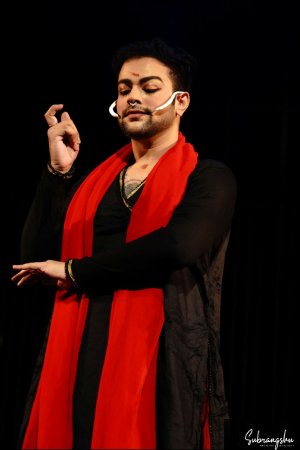 Sudip Chakraborty Next segment was on Bansuri, the flute instrument played by Lord Krishna. To give a background, the introduction note mentioned in Ganga Samhita and Padma Purana, the Krishna devotee Devavrat was cursed by a sage that he will reincarnate as a bamboo stem in the groves of Vrindavan for being arrogant. From that stem, bansuri will be recreated and it will touch Krishna's lips again and again when he will play it in trance. In the next segment we see Krishna playing with his friends with a rope ball which falls into the Yamuna river near the Kadamba tree. Jaideep playfully introduces the raga Shuddh Sarang in aalap while Bala Govind is hovering around Radha. Bansuri reminds Krishna at this juncture that while it's Radha that he loves, it is bansuri who has the good fortune of drinking the nectar of love. For the next segment, Sudip employed the much used theatrical plot of chess game of Mahabharat where Yudhisthir lost Draupadi as bait. Endearingly also referred to as Krishna, Draupadi part was the highpoint of Sudip’s performance. One can't help but notice him changing characters of the evil Duryodhan verses Yudhisthir effortlessly. Set to Bilaskhani Todi, the mood was the melancholic thread of existence of Draupadi crying out for her five husbands to save her from falling grace. Barun Kar’s lighting kept the spot alive with red and green color shades symbolising hatred and deceit. The concluding piece was the traditional thumri "Nadia byer bhayi" chiefly centering Radha, the eternal lover of Krishna. Emoting as Radha for one moment, one felt as if a lady was serenading her love. She got up, swept her room and courtyard, adorned it with flowers and almost packed her bags to look for her lover, burns her fingers in lighting the ceremonial pooja and diya, applies eyes burning kajal. The minimalistic use of stage craft of paper boats tied to a light, thick threads mesh background and crescentic moon delivered the artistes and their prowess in totality. Sudip concluded the evening with a Bhairavi tarana with his disciples he lovingly referred to as trainees. For a first performance, well done ladies, Anika, Mandovi, Tasmia, Rizwana! The presentation took place at the Stein auditorium, New Delhi, on May 12, 2026.  @Kasturika Mishra is a poet, writer, and dance critic. |
