
|     |
|
| |

REVIEW / REPORTKathak in its traditional spirit: Dr. Nandkishore Kapote in performance- Kiran Javae-mail: kiran@kiranjava.com Photos courtesy: Archives, Dr. Kapote May 12, 2026 Dr. Nandkishore Kapote opened his Kathak performance with a gem penned by the ocean of arts, his guru Pt. Birju Maharaj. The composition titled "Ek anek roop main dekhoun" or 'I see you in many forms,' extols the Supreme Being. It provides the perfect opportunity to paint a myriad of images of Govinda through movement. Dr. Kapote embraced this opportunity to the fullest on the evening of 25th April at 'Abhivyakti', a program organized by Sanskar Bharati at Ga.Di. Madgulkar Natyagruh, Pimpri, Pune. His hastaks or hand gestures, refined through over fifty years of riyaz in the tradition of the Lucknow Gharana, brought to life scenes of Krishna's birth, his mother Yashoda carrying him lovingly in her arms, little Rama walking across the stage, the mischievous Krishna stealing butter, and abhinaya depicting the lifting of the mountain, Govardhan. 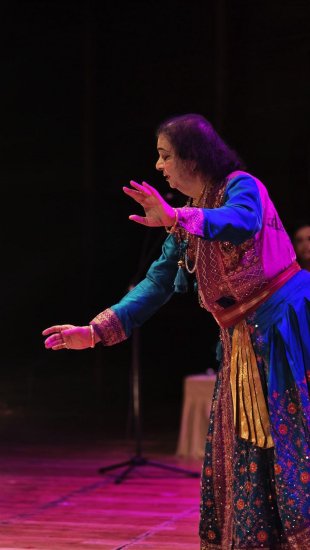 Graceful 'hastak' hand gestures The visual that particularly enchanted me was the sketch of Vitthala, a form revered in Maharashtra. The sacred story of Vitthala originated when Govinda visited his disciple Pundalik in Pandharpur. Pundalik, busy serving his parents, had made Krishna wait on a brick. On stage, it truly seemed as though Dr. Kapote held that brick in his hand, gracefully threw it on the ground, and before the eyes of the audience, stepped on the brick to transform into Vitthala. The abhinaya piece with delicate movements was followed by the intrinsic footwork and rapid spins that Kathak is known for. His smile was radiant through it all. These were the storytelling sketches that are intrinsic to Kathak and as long as dancers such as Dr. Kapote grace the proscenium stage or temple courtyards they will be told again and again much to the immense joy of audiences who appreciate storytelling. Much in the same Kathak style, Dr. Kapote continued with the next devotional song titled "Baaje re muraliya". The lyrics opened with 'The flute plays, resting on the lips of Mohan (Krishna), His lips are adorned by magic, the flute is made with the greenest bamboo, touched by delicate fingers. Those clever fingers are adorned with golden rings and the flute plays on'. It was magical to watch Dr. Kapote break a bamboo branch and skillfully carve it into a flute, then proudly display the golden rings on his fingers before beginning to play it with an almost divine absorption. The rasas of shringar / beauty, wonder and shanta / peace were portrayed with equal elan leaving the audience spellbound. 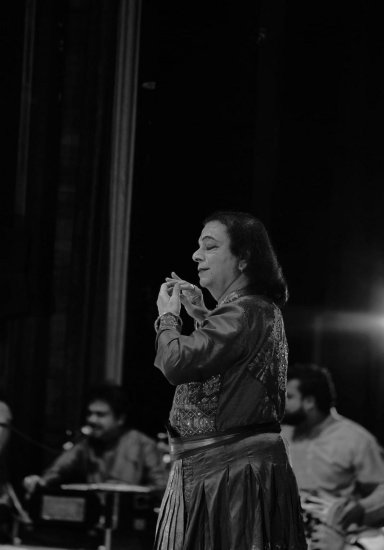 The flute plays on Once he had made the 'unseen seen', Dr. Kapote weaved in Kathak essentials like the 'Tihai' (a rhythmic phrase in Indian classical music played three times in succession, ending on the sum), the 'Toda' (rhythmic dance compositions spanning 3 or 4 time cycles) with Kathak bol-syllables showcasing his precise footwork and technical skill. He was accompanied by the expert tabla player Dr. Mukundraj Deo from Mumbai who trained under Brijraj Mishra of the Banaras Gharana. I remember Guru Birju Maharaj would often say that this was how it was in the older days, that whenever the dancer of the Lucknow Gharana has danced, the tabla player of the Banaras Gharana has accompanied the dancer. And here tradition was repeating itself. Dr. Deo came to play for Dr. Kapote after a gap of over 20 years and the camaraderie between the two was playful yet of mutual respect. 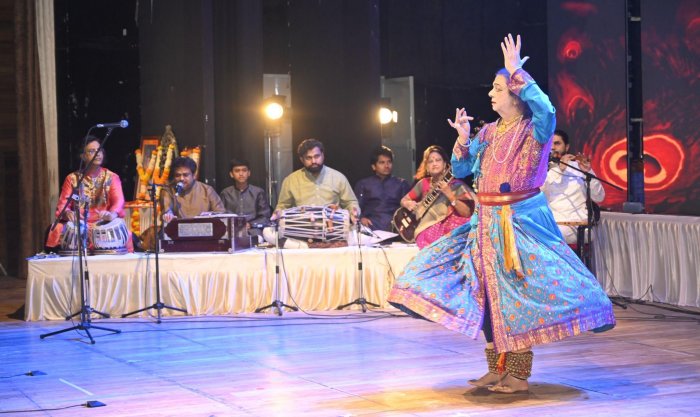 Quintessential art of expression in Kathak classical dance With such an expert accompanist in Dr. Deo, Dr. Kapote was able to present the Jugalbandi Haar Jeet as a spirited rhythmic duel of victory and challenge. Dr. Kapote had first learned this item from his guru for a performance in Russia. Now on stage, both dancer and tabla exponent shared an unspoken dialogue through the common language of rhythm, each responding instinctively to the other. Dr. Kapote performed the 'Paanch Ghungat', a rare rhythm and abhinaya based presentation that is seldom seen and is no longer commonly included in the contemporary Kathak repertoire. It is a 'bhav-ang' presentation that explores five types of characters and emotions through symbolic veils while maintaining a melodic rhythm throughout. Suddenly, I was reminded of the photos I have seen of Dr. Kapote's younger days when he used to act as the Nat Samrat Balgandharva known for his ability to portray female characters with grace and realism. While that was a literal transformation in full costume, the dance was a 'natya dharmi abhinaya' of a gender transcending portrayal. All in all, a complete homage to the female impersonation tradition of Marathi music and drama but in the quintessential language of Kathak classical dance. The strains of the devotional song played again and Dr. Kapote slowly eased from a technical piece and returned to the "Baaje re muraliya baaje" composition. The song was beautifully rendered by vocalist Sanjay Garud of the Kirana Gharana in the lineage of the esteemed performer Bhimsen Joshi. The other accompanying musicians, Alka Gujar on the sitar, Azharuddin Shaikh on the flute, Dnyanesh Kokate on the pakhawaj, and Yash Kamble on padhant (recitation of dance syllables) brought their sensitive yet technical expertise to create an immersive musical atmosphere. Following the next segment of dance, Dr. Kapote unveiled another dazzling technical composition. Accompanied by his tabla player, he evoked the thunderous rhythm of Maratha horse hooves galloping along rugged paths, interwoven with the sounds of nature such as rolling thunder, drizzle, and pouring rain. 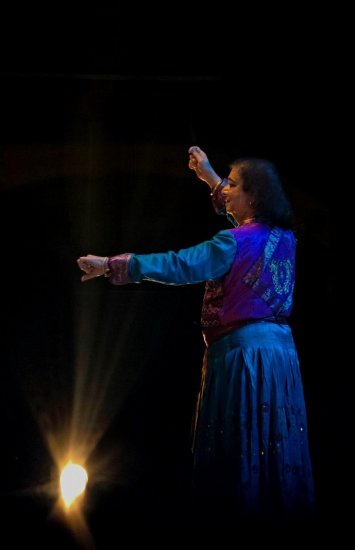 Thrilling sounds of the Maratha horse hoofs Through delicate and expressive hand movements, he brought drifting clouds to life. He then performed a variation of the technical piece 'Dha Taka Thunga', a favourite composition of Birju Maharaj before returning to the last segment of the devotional song. This seemed to be Dr. Kapote's signature style of interweaving devotional songs with more technical pieces and light audience banter. He doesn't have a nomenclature for his style but his peers call it the old 'mandir parampara'. Dr. Kapote has remained deeply committed to the traditional form he learned from his guru in the late 1970s. In fact, during the two-year lockdown period, Pt. Birju Maharaj, the legendary doyen of the Lucknow Gharana, regularly trained Dr. Kapote alongside his 'Guru bhai', Bipul Das of Assam. Yet, rather than altering the dance style they had inherited from the late 1970s, Birju Maharaj enriched their repertoire by teaching them new compositions that complemented the traditional form. The audience seemed to enjoy the presentation immensely and responded with enthusiasm at an evening marked by tradition and immersive storytelling. The performance stood as a testament to a living parampara that continues to endure through dedicated practitioners such as Dr. Nandkishore Kapote.  Kiran Java is a published author who writes on Indian art and culture. She holds a Master's degree in Mass Communication and a diploma in Natyashastra. She is a member of the International Council of Museums (ICOM) and trains museum volunteers in public outreach. For more information: kiranjava.com |
