
|     |
|
| |

REVIEW / REPORT'Avataraṇa - The Story of Natya' by Ramaa Bharadvaj- Arjun Bharadwaje-mail: arjunbharadwaj@gmail.com May 11, 2026 On 4th April this year, Bangalore witnessed a fabulous retelling of the Story of Creation of nāṭya by Ramaa Bharadvaj, a renowned dancer, storyteller, published writer, allegorist, and educator. The evening, presented by Rudrakshya Natyalaya and Yuvakasangha Centre for Performing Arts, was hosted at Yuvapatha in Bangalore. The event drew connoisseurs and sincere seekers of all age groups and variegated backgrounds, just as nāṭya, i.e., theatre art, promises to do. The solo theatrical presentation by Ramaa Bharadvaj can easily be seen as an extension of the genre - Bhāṇa, that Sage Bharata defines in the Nāṭyaśāstra. In the Sanskrit language, two distinct terms denote downward movement: patana and avataraṇa. While patana signifies a fall or decline, avataraṇa refers to a deliberate and divinely ordained descent accompanied by sacred purpose and blessing. For example, the descent of the river Gaṅgā is not described as Gaṅgā-patana, but rather as Gaṅgāvataraṇa. Likewise, Bhagavān Viṣṇu assumes various avatāras for the welfare of the universe and the restoration of dharma. In a similar spirit, this production narrates the story of Nāṭyāvataraṇa-the divine descent of Nāṭya for the upliftment and enrichment of humanity. The title Avataraṇa, therefore, is deeply layered, carrying both philosophical depth and allegorical significance. The honourable inscription of the Nāṭyaśāstra in UNESCO's Memory of the World Register renders the production Avataraṇa especially significant and relevant in the contemporary context. The production is distinctive in its very conception, as it draws inspiration not from a poetic composition, but from a śāstra-a technical and theoretical treatise. Through the audio-visual medium, it presents the story of the origin of the medium itself. Furthermore, the episode of nāṭyotpatti, as narrated in the opening chapter of the Nāṭyaśāstra, is structured in the manner of a purāṇic narrative, a feature that plays a vital role in shaping the dramaturgy and presentation of the production. As with many of Ramaa Bharadvaj's solo presentations, Avataraṇa, is profoundly interactive, sustaining the audience's engagement at every moment. There is never a lapse in intensity; the eyes and ears of the connoisseurs remain captivated, eagerly anticipating each unfolding sequence. The elements of delightful surprise (hṛdya-anirīkṣita) and wonder (vismaya) generate a heightened sense of excitement among the audience and have become hallmark features of Ramaa's presentations. Her distinctiveness further lies in her ability to create a refined aesthetic synthesis of Oriental and Occidental modes of presentation, seamlessly integrating music, spoken word, and the language of gesture into a cohesive artistic experience. It is also a brilliant amalgamation of stylised and realistic presentation. She employs the gesture language of the Nāṭyaśāstra and embeds it with immense sattva. Ramaa has handpicked music from various global genres to add auditory stimulation to her animated visual presentation. Additional music segments have been specifically created for the presentation by the renowned artiste Praveen D Rao. 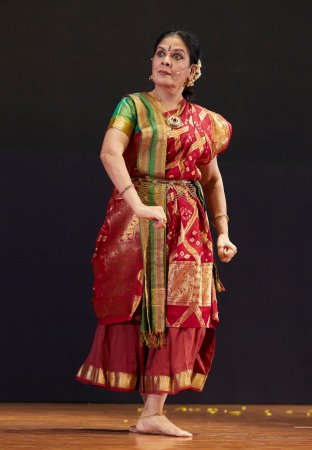 Ramaa Bharadvaj (Photo: Jayant Mehta) Ramaa opens her presentation by promising her audience to help them learn 'who, what, when, where, and why' of India's culture ancestry. To do so, in what can be approximated as a Walt Disney style of teleportation, she boards us onto a magic carpet and drives it across space and time, to Sage Bharata's gurukula-āśrama in the Himalayas. The sage is visited by other curious visitors, who had come to learn, just like the audience of the Avataraṇa, the manner in which he was blessed with the knowledge of the fifth Veda. Ramaa now starts narrating the story, through the words of Sage Bharata. Long ago, when the Kṛta-yuga was about to end and the Tretā-yuga set in, the worlds were driven by vulgar emotions, such as jealousy, greed, animosity, and anger (Ramaa displays the nuanced differences in these flavours of emotions as effectively as she portrays the happier ones!). The teachings of the four Vedas were lost upon the common man. Thus, when the world was emotionally stressed, with no spiritual anchor, the need for the audio-visual means of entertainment was felt. For the creation of something new, the devas, led by Mahendra go to the Creator, who brews up a brand-new Veda by deriving inspiration from the existing Vedas - like the old wine in the new bottle, but in a more palatable fashion - tasty and healthy. While the request was for a means of entertainment - krīḍanīyakam, the four-faced Brahmā ensured that it had an underlying current of education as well. This fifth Veda, the Nāṭya-veda, enraptures the heart, educates the intellect, and elevates the soul. While the devas and the other beings looked for an immediate remedy, the visionary Creator, ensured that the solution he now creates is universal and timeless - it can be accessed by people of all backgrounds and ages, at all times. Brahmā offers the art of nāṭya to the devas and Indra, who realises that his people do not have the capability to learn, practise or teach the art, and hesitates to take the responsibility. The story suggests that people who cannot come out of their comfort zones and those who have not experienced all shades of emotions cannot be artistes. Brahmā then offers it to Bharata, a muni. Ramaa succinctly quotes who a muni is - manana-śīlaḥ muniḥ; a contemplative person is a muni. This also aligns with the words of Bhagavān Śrī-Kṛṣṇa, who says in the Bhagavad gītā, vīta-rāga-bhaya-krodhaḥ sthitadhīrmunirucyate - a muni is a person who has overcome desires, fears, and anger, is steadfast and possesses a tranquil mind. It is amply clear that the composite art of nāṭya can be carried forward in the best possible manner, only by a teacher with the qualifications of a muni; every artiste should try their best to reach the ideal. Ramaa has ensured that she picks and highlights these important nuances from the story of nāṭyotpatti. In accordance with the well-known dictum, prayoga-pradhānaṃ hi nāṭyaśāstram-that the true significance of the Nāṭyaśāstra lies in its practical application-Bharata Muni resolves to stage a performance with the assistance of his hundred sons. In doing so, he brings together the three vṛttis-ārabhaṭī, bhāratī, and sāttvatī-which constitute the foundational modes of dramatic expression. Ramaa brings these concepts vividly to life through dramatic enactment, infusing the presentation with humour and accessibility. At the same time, she highlights the enduring relevance of these classical principles by illustrating how the vṛttis continue to manifest in contemporary cinema and modern performance traditions. Within the narrative framework of nāṭyotpatti, Ramaa has creatively interwoven two additional episodes drawn from the Nāṭyaśāstra: the allegorical account of the origin of the vṛttis and the story describing the creation of musical instruments. These episodes reflect the depth and rigour with which she has engaged with the treatise in conceiving and shaping the production. The twentieth chapter of the Nāṭyaśāstra narrates that the vṛttis emerged from the cosmic combat between Bhagavān Viṣṇu and the demons Madhu and Kaiṭabha. Ramaa presents this episode through a succinct yet evocative enactment of the battle, culminating in the emergence of the four vṛttis. Similarly, the Nāṭyaśāstra describes the origin of percussion instruments as being inspired by the sound of water droplets striking lotus leaves spread across the surface of the water. This episode is rendered with remarkable sensitivity in the background score and is brought to life in an inimitable manner through the artiste's expressive interpretation. While Bharata thinks that he will be successful in his production with just his male students, Brahmā tells him that it is impossible without the help of women, who are adept at kaiśikī-vṛtti. He thus creates apsarās out of his mind, and Ramaa enacts the birth of these damsels who represent the water element, in an absolutely alluring fashion. She mesmerises the audience with her āṅgikābhinaya, representing the various apsarās. This inner grace and the aspect of rasa - water, which was missing in Bharata's concept, is now filled by the presence of the apsarās. Ramaa's extension of the principle of water and rasa to Āyurveda and the Svādhiṣṭhāna-cakra is a great value add to the śāstra. She observes that svādhiṣṭhāna-cakra is where creativity lies, is connected with the element of water and a sense of taste. Similarly, in Āyurveda, it is said that disorders in taste perception is linked to imbalance in the water element. 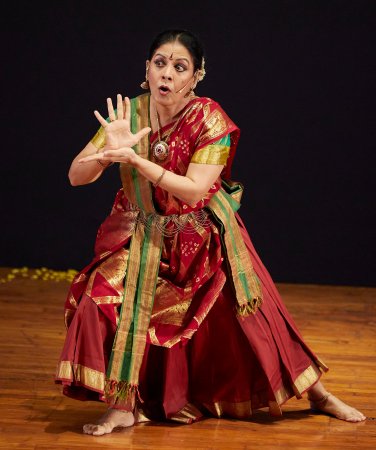 Ramaa Bharadvaj (Photo: Jayant Mehta) Ramaa then moves on to the very first presentation. She explains the allegory of the Samudra-mathana and then brings on stage the devas and rākṣasas - and in the background of music, which must be relished by watching the performance in person! The current review shouldn't be a killjoy, revealing too many creative elements of the production! The production is enacted by the artistes trained by Bharata, and all the devas come forward to offer gifts. And from this, Ramaa derives a practical and important piece of advice to artistes - never think of freebies! The audience and the organisers need to ensure that artistes are remunerated, and this is suggested in the very first chapter of the Nāṭyaśāstra! When the real rākṣasas in the audience create a ruckus, Indra subdues them with his flag staff, which is gifted to the artistes as jarjara - the rākṣasas who cannot think beyond the obvious, fail to recognise the difference between reality and art. To ensure that there is no further trouble, Brahmā instructs his son, the divine architect Viśvakarmā, to construct a theatre, and requires the various devas to occupy positions to guard the structure. Ramaa makes an interesting observation - the door of the theatre was guarded by Yama-dharma - a caution to both artistes and connoisseurs - they will have to adhere to dharma, or face deadly consequences! Ramaa also foregrounds Brahmā's profound teaching that the art of nāṭya is not intended to discriminate among people or to unduly glorify any individual or group. Rather, its purpose is integrative and universal-to reflect the activities of the three worlds while serving as an aesthetic confluence of all art forms and branches of knowledge. She concludes the presentation by emphasising the principle of aucitya-appropriateness and propriety in artistic expression. Art, when exercised without discernment or responsibility, can lead to undesirable consequences. Thus, she underscores that artistic practice is inseparable from ethical awareness and carries with it a profound sense of responsibility. Throughout the presentation, Ramaa's skill in switching between her role as a narrator and as various characters is exemplary; in the Indian aesthetic tradition, this can be stated as an optimal blend of kavi-prauḍhokti and kavi-nibaddha-prauḍhokti. Another interesting feature is the presence of the Doppelganger, who, almost like a devil's advocate, raises the kind of questions the Nāṭyaśāstra may face. Ramaa, as the main narrator, answers them by drawing principles from the śāstra and the paramparā - it is akin to pūrva-pakṣa and siddhānta in the Indian scholarly tradition; while the Doppelganger poses the pūrva-pakṣa, the artiste presents the siddhānta. The presentation was met with resounding applause and a standing ovation from the audience. Several connoisseurs seated nearby even expressed the wish that Ramaa develop the work further into an animated film or an engaging illustrated booklet. The production clearly resonated with audiences across generations and levels of familiarity, winning the admiration of both the layperson and the scholar alike. Through her remarkable command as a solo performer, Ramaa creates the compelling illusion of an ensemble presence on stage, embodying multiple characters, moods, and narrative dimensions with extraordinary finesse. I would strongly recommend that every Indian and all connoisseurs across the globe witness this presentation. 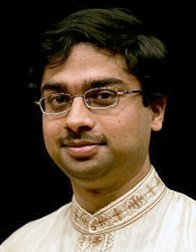 Arjun Bharadwaj is a Sanskrit scholar with deep interest in literature, philosophy, and aesthetics. As a poet, he has penned numerous compositions for dance and theatre productions. Well-versed in Sanskrit, Kannada, English, Greek, and German languages, he has authored and translated over fifteen works, which have gained renown around the world. |
