
|     |
|
| |

REVIEW / REPORTAnatomy of devotion- Anurag Chauhane-mail: anuragchauhanoffice@gmail.com Photos: Innee Singh May 10, 2026 By the time the lights settled over the Stein Auditorium, the room had already grown unusually attentive. Conversations had thinned to murmurs, latecomers moved with caution, and the charged expectancy particular to classical audiences had begun to gather. What followed over the next two hours was not a conventional recital arranged as sequence, but a carefully composed interior journey in which memory, theology, longing and lineage were given choreographic form. A Divine Space, conceived and choreographed by Madhur Gupta, asked a demanding question of its audience: can devotion be made visible without reducing it to ornament. By the close of the evening, the answer seemed unmistakably yes. 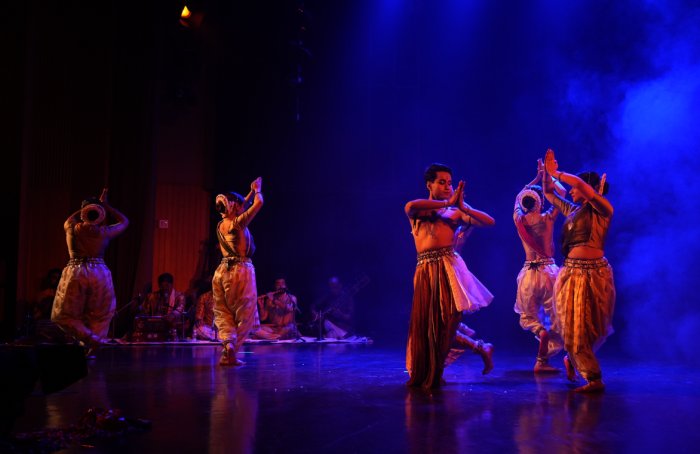 What distinguished the production was its refusal to separate biography from classical grammar. The personal was not narrated through anecdote, but through raga, tala, stance, breath and abhinaya. Gupta used the body not as an instrument of display, but as a site of inheritance. The opening work, Usha Suktam, drew from the Rig Veda and was set in raag Vibhas, a melodic choice associated with the threshold between darkness and dawn. Dedicated to the memory of the artiste's late mother, the piece was marked by restraint. In Odissi, stillness can be as demanding as speed, and Gupta understood this well. His chauka retained structural clarity without hardening into rigidity, while tribhangi lines unfolded with softened transitions that gave the movement an interior pulse. Torso articulations were measured and breath-led, never decorative. The abhinaya resisted overt grief; instead, remembrance appeared through pauses, lowered drishti, and the careful suspension of gesture before completion. Lighting design by Gyan Dev Singh was especially perceptive here. Rather than illuminating the dancer as object, it created zones of emotional weather. Amber tones and half-shadow suggested ritual intimacy, allowing the stage to feel less like a proscenium and more like a sanctum. 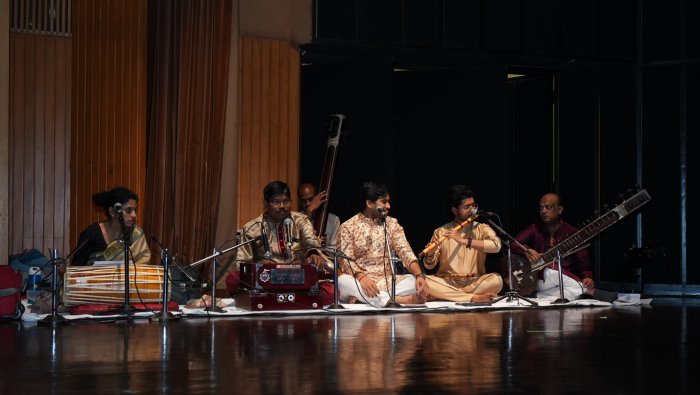 If the first piece invoked memory, Akar Sakar moved into metaphysics. Built on Ragamalika and Talamalika, it explored the philosophical movement from the formless into form. This was among the most formally interesting sections of the evening. As melodic frameworks shifted and rhythmic cycles changed, Gupta responded with evolving movement architecture. Chauka positions dissolved into curvilinear passages; sculptural freezes gave way to fluid diagonals. The choreography demonstrated an understanding that in Odissi, geometry and sensuality are not opposites but companions. The ensemble work here was disciplined, with dancers maintaining clean spatial alignments and responsive timing through changing rhythmic accents. Particularly effective was the dialogue between mardala phrasing and foot articulation, where percussion did not merely accompany movement but provoked it. The music, under Gupta's direction, drew strength from an original score shaped by Nikhil Kumar on flute and composition, with Namrata Dave's mardala and rehearsal intelligence giving the section rhythmic authority. Vocals by Sukant Nayak and Ashish Nayak added gravitas, while Janab Anees Rehman's sitar brought lyrical texture, supported by Amit Kumar on tanpura and Suraj Jha on manjira. The evening's most layered proposition arrived with Mori gagariya kahe ko phodi re Shyam, a thumri from the Lucknow tradition of Kathak inherited through the luminous pedagogy of Pt. Birju Maharaj. Gupta, who began his training in Kathak before committing himself to Odissi, returned to that inheritance without nostalgia. What emerged was not fusion, a term too casually used and often aesthetically imprecise, but palimpsest: one discipline visible through another. Kathak's nazakat and conversational wristwork surfaced through the arms and glance, while the torso retained Odissi's tensile curvature. Tatkar was understated, favouring lyrical cadence over exhibitionist speed. Chakkars were implied rather than pursued as spectacle. In the thumri mode, where emotional nuance matters more than athletic punctuation, this restraint served the work well. The complaint of the broken water pot ceased to be merely playful shringara and became an allegory of ego ruptured by encounter with the divine. 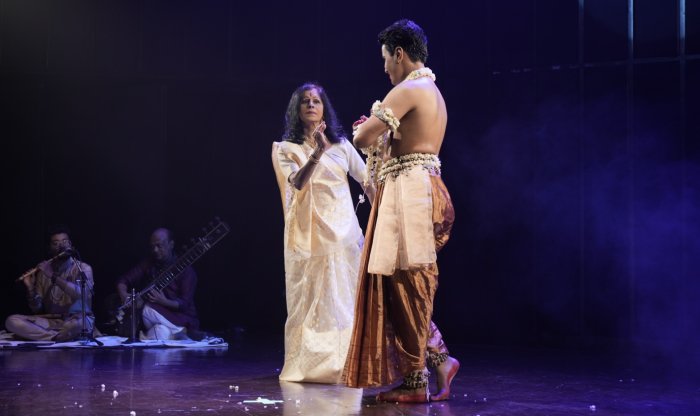 It was in this section that Guru Dr. Shovana Narayan joined Gupta on stage, and the atmosphere of the evening altered perceptibly. One hesitates to call it a duet, for it functioned less as paired choreography than as philosophical exchange. In her presence was the authority of distilled time, the body that has spent decades converting grammar into instinct. In his, the urgency of a younger artiste negotiating inheritance without becoming trapped by it. She offered a phrase in Kathak, marked by calibrated tatkar, contained energy and eloquent economy of glance. He answered through Odissi line, asymmetry and sculptural pause. Neither idiom surrendered itself to the other. What transpired was rarer than stylistic blending: mutual recognition between systems of knowledge. It reminded the viewer that classical forms need not compete for relevance; they can illuminate one another simply by standing in truth. The concluding Kumarsambhavam, with Sanskrit translation guided by Guru Kumkum Lal, drew from Kalidasa's epic and traced the arc of desire, penance, testing and union. Gupta wisely resisted literal narrative excess. Instead, he distilled emotional states. Parvati's tapasya was rendered through repetition, lengthened lines and an ascetic narrowing of gesture. Here the choreography trusted austerity. Shiva's presence, by contrast, was conveyed through composure rather than theatrics. The eventual union was staged not as romance but as ontological completion: stillness finding counterpart in movement. The Odissi spine of the evening also carried the unmistakable imprint of Guru Sharon Lowen's lineage, where sculptural discipline and emotional clarity coexist without compromise. One sensed that what arrived on stage had travelled through years of transmission before becoming performance. The evening also carried an institutional gesture, with endowed scholarships announced for young practitioners, reminding the audience that lineage is sustained as much by patronage as by performance. 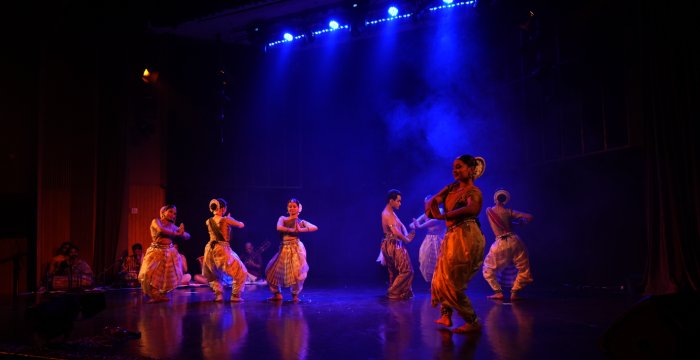 The ensemble dancers supported the final work with commendable cohesion, maintaining rhythmic precision and group geometry even in layered stage patterns. Their entrances and exits were handled cleanly, and their collective energy never distracted from the central arc. Costumes were thoughtfully judged, respecting classical silhouette while allowing kinetic readability under changing light. Fabrics responded particularly well during turns, bends and low stances. Throughout the evening, music functioned as dramaturgy rather than backdrop. Vocals carried emotional contour, flute opened meditative space, sitar added texture, and percussion anchored kinetic logic. One sensed rehearsal intelligence in the relationship between score and movement, especially in transitions where many productions lose tension. 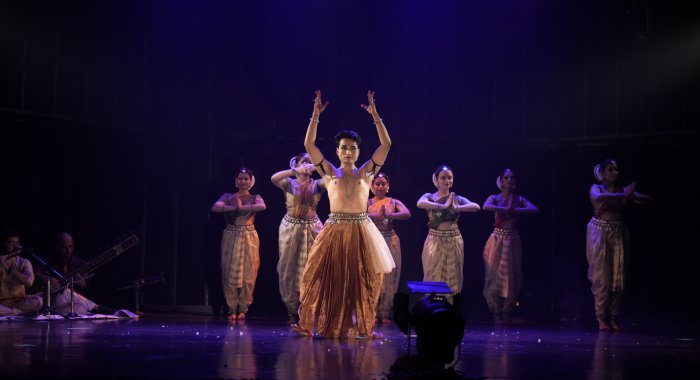 What A Divine Space finally argued was that lineage is not preservation in glass. It is transmission through risk. Gupta's most compelling achievement was not technical fluency, though that was evident, nor thematic ambition, though the production possessed it. It was his willingness to let vulnerability coexist with formality, softness with rigour, memory with forward motion. The audience responded with enthusiasm, but the more telling measure arrived a moment earlier, in that charged silence before applause when a hall collectively postpones reaction because something has reached it more deeply than language can manage. Devotion, on this evening, was never announced. It was visible in stance, in breath, in rhythmic exactitude, in the patience to inherit seriously, and in the courage to make inheritance one's own.  Anurag Chauhan, an award-winning social worker and arts impresario, combines literature and philanthropy to inspire positive change. His impactful storytelling and cultural events enrich lives and communities. |
