
|     |
|
| |

 History that moves: Navina Jafa's Sair-e-Motorcar and the performative archive- Shah Kulsum Shaikhe-mail: shahkulsumshaikh@gmail.com Photos: Team Jafa May 7, 2026 In the conventional gallery, heritage is frequently relegated to the static - reduced to the silent weight of a vintage chassis or the frozen, sterile gleam of a radiator grill. Encased behind glass, these artifacts often exist in a state of suspended animation, disconnected from the living pulse of the present. On April 10th, however, Dr. Navina Jafa's Sair-e-Motorcar staged a radical departure from this museological stillness. In an ambitious synthesis of form, the production wove together the rhythmic machinery of Kathak with the narrative architecture of Dastangoi, all anchored by the distinct melodic lineages of the Jaipur, Delhi, and Moradabad gharanas. The result was a kinetic workshop of memory that transformed the stage into a site of reclamation. Here, the golden age of Indian motoring was not merely remembered; it was engineered through movement, conjuring a vanished history without a single physical car in sight. 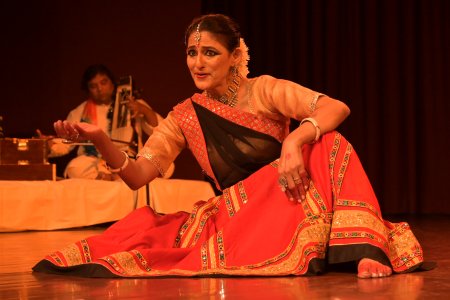 Dr Navina Jafa The Body as a vessel of industrial elegance Drawing from the intersections of art history and heritage conservation, the most compelling aspect of the production was the conceptualization of the Absent Object. Typically, our preservation efforts prioritize the tangible artifact - the metal, the chrome, the chassis. Yet, here, the artifact was reconstructed entirely through the epistemology of the performer's body. The dancers did not merely mimic a vehicle; they became the performative geometry of 1920s travel. 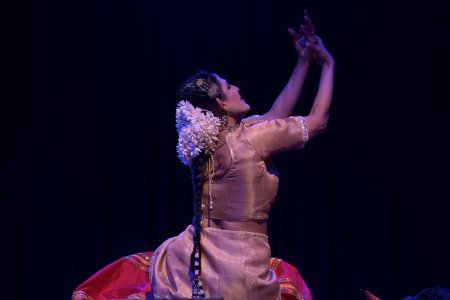 Dr Navina Jafa The performance commenced not with the mechanical roar of an engine, but with the evocative precision of the hands. In a striking display of gestural engineering, the dancer used her hands to simulate the tactile acceleration of a motor - a manual ignition that dictated the tempo for the tatkar (footwork) to follow. If the mudras provided the acceleration, the feet served as the internal combustion. The percussive pulse of the ghungroos became the steady, rhythmic thrum of a vintage motor, shifting seamlessly from a slow idle to a high-speed cruise as the bolts intensified. In this context, the chakkars (turns) transcended their role as aesthetic flourishes; they became the kinetic rotation of wheels navigating the unpaved roads of early 20th-century India. Through this rigorous alignment of hand and foot, the dancer's body functioned as a living vessel, proving that the mechanical elegance of our industrial past can be archived far more vividly through movement than through metal. 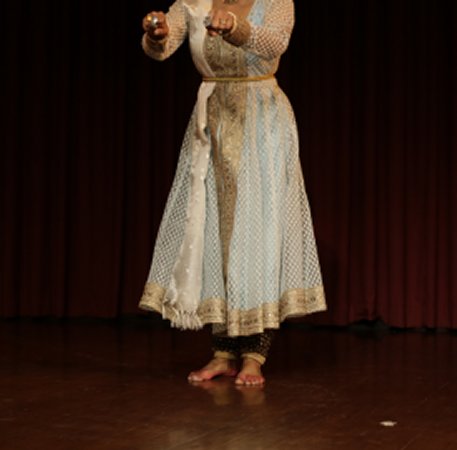 Navina Jafa using hand to simulate acceleration The activation of Rasa: The Alchemy of the witness Theoretically, the Rasa of this production existed only as a potentiality until the moment of the premiere. As an art historian, I observed this aesthetic flavor being activated not merely by the performers, but by the focused energy and drishti (gaze) of the spectator. In the absence of a material car, the audience was invited, perhaps even compelled to step into the role of the Sahrdaya, the sensitive witness whose own imagination completes the artistic circuit. 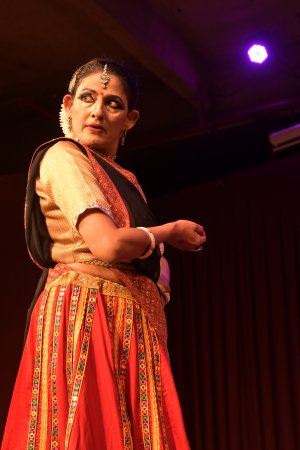 Navina Jafa (Drishti) This is the machinery of dance at its most profound: the stage functioned as a sacred canvas where the collective mind of the audience provided the final, essential brushstrokes. It was in the precise moment of intersection - when Dastango's narrative invoked the elegance of a bygone era and the dancer responded with a movement capturing the torque of a vintage motor - that the Rasa was fully realized. What unfolded was a three-way dialogue: a spiritual and intellectual conversation between the performer, the Absent Object, and the witness. It proved that heritage is not something we merely look at; it is a shared resonance that we bring to life together. 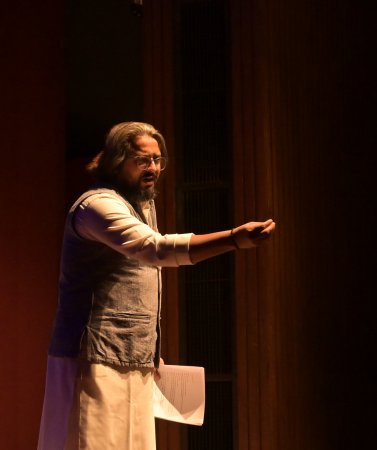 Sudheer Rikhari (Dastango) Innovative heritage: Beyond the metal Dr. Navina Jafa has long advocated for a shift in perspective - viewing heritage not as a dormant relic, but as a living, breathing entity. Sair-e-Motorcar stands as perhaps the most radical manifestation of this philosophy. Directed by Guru Maya Kulkarni and produced by Patron Diljeet Titus, the production consciously omits the physical vehicle, forcing a confrontation with our Intangible Heritage - the rhythms, the social hierarchies, and the human stories that the car once occupied. In the lexicon of art appreciation, we often speak of the aura of an original work - that unique presence in time and space. Here, the aura was liberated from metal and chrome and reassigned to the human form. This production posits a daring argument: that the most resilient archive for industrial history is not the temperature-controlled gallery, but the kinetic vessel of the artist. The dancer's body becomes a living repository of memory, translating the mechanical elegance of 1920s travel into a vocabulary that is simultaneously ancient and strikingly contemporary. By choosing the stage over the showroom, Dr. Jafa shatters the static glass of traditional museums. She proves that when we perform the past rather than simply displaying it, we reclaim a history that belongs to the people, not just the pedestals. In the rhythmic echoes of the Triveni Kala Sangam, the vintage car was never truly absent; it was being driven into the future by the enduring engine of the Indian spirit.  Shah Kulsum Shaikh is an Art Historian and Gold Medalist from Jamia Millia Islamia whose research focuses on the historiography of marginalized narratives and the mechanics of the performative archive. Her work investigates the colonial and institutional shifts that have shaped South Asian cultural production, specifically examining how material and intangible heritages are reclaimed through contemporary media and performance. Currently an independent curator and researcher based in Delhi, she contributes critical commentary on the socio-political evolution of style and the politics of cultural memory. |
