
|     |
|
| |

 Guru Smaranam 2026- Tapati Chowdhuriee-mail: tapatichow@yahoo.co.in May 5, 2026 Disciples of Guru Kelucharan Mohapatra celebrated his centenary year with great pomp. Guru Smaranam 2026 was held at Rabindra Sadan, Kolkata, on 7th April 2026 by Rajib Bhattacharya. Kolkata witnessed an evening of profound devotion, artistic excellence, and cultural grandeur. Organised by Srijan Chhanda, the event commemorated the 21st death anniversary and centenary birth year of Guru Kelucharan Mohapatra, one of the principal architects of modern Odissi dance. The evening of Guru Smaranam 2026 was gracefully and eloquently compered by Neeladyuti Chaudhury, senior disciple of Srijan Chhanda, whose poised presentation beautifully guided the audience through the programme. The evening began with a serene Pushpanjali, invoking divine blessings and setting a spiritual tone for the programme. The event was graced by an illustrious gathering of eminent personalities from the world of Indian classical dance. A major highlight of the evening was the book launch of "The Living Sculpture: Odissi Between Temple and Modernity" by Dr. Rajib Bhattacharya. The work offers a deep analytical study of the stylistic contributions of the three pioneering gurus - Pankaj Charan Das, Debaprasad Das, and Kelucharan Mohapatra - highlighting the evolution of Odissi from its traditional roots to a contemporary classical form. The performance segment featured mesmerizing presentations by stalwarts including Guru Ratikant Mohapatra, Priyadarsini Govind, Tanusree Shankar and her dance company, and Sharmila Biswas with OVM ensemble. Their performances, marked by depth, grace and mastery, created an atmosphere of artistic brilliance and spiritual elevation. Choreographies by Dr. Rajib Bhattacharya and his ensemble members Surajit Biswas, Soumen Kundu, Kamalika Bose, Shruti Dhar, Salini Sinha, Debasri Adhikari, Angana Bose and Ayantika Roy further reflected a fine blend of tradition and innovation, embodying the enduring legacy of Guru Kelucharan Mohapatra. The programme also acknowledged the dedicated efforts of technicians, photographers, and backstage members whose contributions ensured the seamless execution of the evening. The felicitation of students of Srijan Chhanda highlighted the institution's commitment to nurturing future generations of artistes. Guru Smaranam 2026 emerged not just as a commemorative event, but as a living tribute to a Guru whose vision continues to inspire the world of dance. The evening concluded on a note of reverence and gratitude, celebrating the timeless Guru-Shishya parampara that lies at the heart of Indian classical arts. 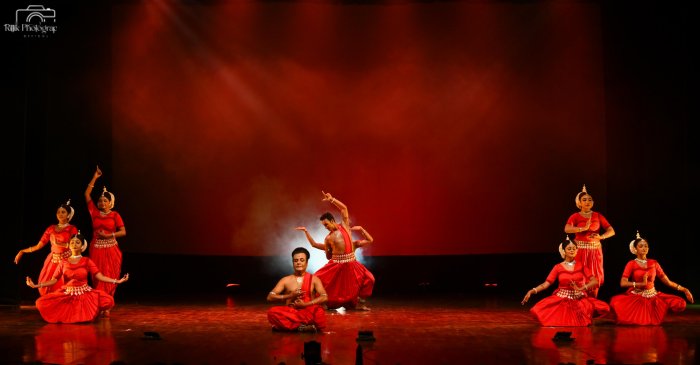 Rajib Bhattacharya & ensemble A quick runover of the evening's performance brings me to the pieces performed by Rajib Bhattacharya and his ensemble. They paid their obeisance to Lord Shiva, describing him with unhurried grace. The group practically enabled rasikas to visualize the Divine playing the role of taming the torrential river Ganga to stop the destruction of the earth - a symbol showing us that pure knowledge and divine grace must be balanced and disciplined. "Sthapthya Angabilash" represented the sculpture like body showing curvaceous beauty that is synonymous with the Odissi dance form, reconstructed, among other sources, from the sculptural poses that are to be found in the temples of Odisha. It showcased the beauty of nritta in various speeds finally to end on a crescendo amidst thunderous clapping. Srijan Chhanda repertory members and its artistic director presented their last piece "Bhawani Dayani" in praise of Devi Durga. This traditional piece praised the multi-faceted Durga who is the protector of mankind. The Durga theme is always a winner. 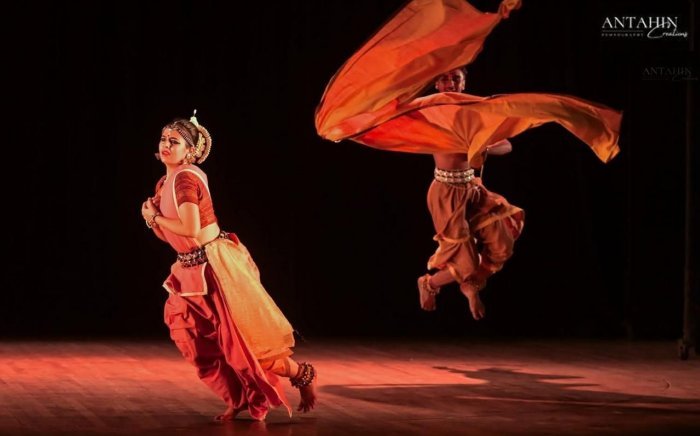 OVM ensemble OVM presented in duet, one of the most popular Bhakti bhava lyrics "Prana Sanginere" written by Banamali Das, where Radha tells her sakhi, how she was fooled by Krishna who came in the guise of a woman to decorate her feet with alta - red colour - and inscribe his name under her feet. Her intense bhakti for her lord left her embarrassed, because the lord had touched her feet. The presentation was rather sensual. Ratikant Mohapatra is not only a famed choreographer and composer, he is also a gifted performer who has quite a few solo pieces to his credit. 'Sabari' is one of them. The story of Sabari is brought alive with fresh nuances and additions with every performance, which makes it a contemporary piece. 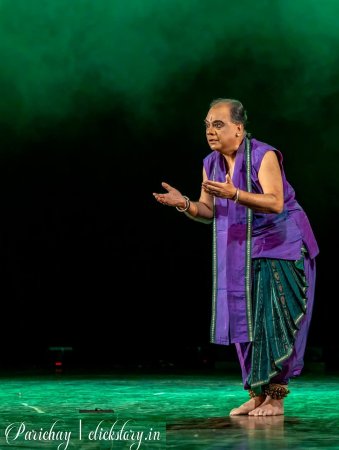 Ratikant Mohapatra 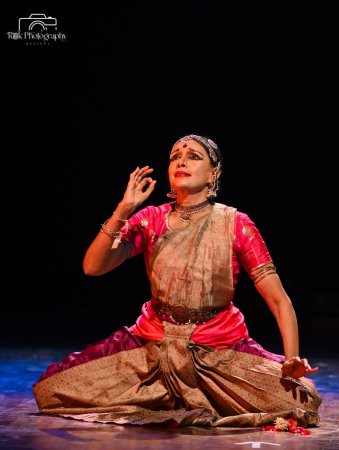 Priyadarsini Govind The ace dancer of the evening was Bharatanatyam exponent Priyadarsini Govind. It is sheer hard work coupled with talent and vision that transforms a dancer to evoke rasa. A virtuoso is skilled in the technicalities as well as in the subtle acting nuances and Priyadarsini is well equipped in both. She evoked in the audience rasa of untold beauty and was adept in all three categories of nritta, nritya and natya. Bhakti sringara was evoked in "Kuru Yadu Nandana" from Jayadeva's Gita Govinda. The abhang "Vrindabane Venu Baje" steeped aficionados with Bhakti bhava. 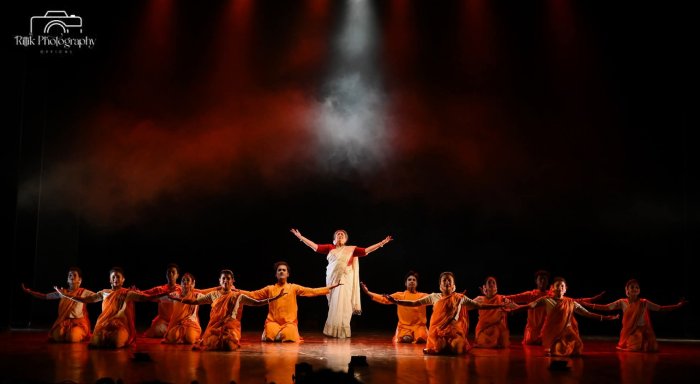 Tanushree Shankar & group Tanusree Shankar - the last performer - is well versed in Uday Shankar style of dance, a century old tradition which needs no introduction. It is Modern Dance blending traditional and Folk forms alongside ballet technique, free expression, thematic storytelling and innovative movements. The proud disciple of Amala Shankar presented two very innovative pieces to the compositions of Pt. Ananda Shankar. A set of well-trained dancers regaled the audience. Tanusree Shankar herself was in the second dance piece.  Tapati Chowdhurie trained under Guru Gopinath in Madras and was briefly with International Centre for Kathakali in New Delhi. Presently, she is a freelance writer on the performing arts. She is the author of 'Guru Gopinath: The Making of a Legend.' |
