
|     |
|
| |

REVIEW / REPORTA powerful Odissi interpretation- Mini Somakumare-mail: minikunnath@gmail.com Photos: Innee Singh May 4, 2026 On the evening of March 31, 2026, the Stein Auditorium at India Habitat Centre wore a quiet anticipation. Known for its intimate yet acoustically rich setting, the space has long been a meeting ground for serious art and thoughtful audiences. That evening, it brought together an attentive gathering of rasikas, young dancers, and several eminent gurus. What unfolded was Draupadi's Mahabharata... the epic that began with her, an Odissi dance production by the Bengaluru-based Odissi dancer Madhulita Mohapatra and her Nrityantar Dance Ensemble. The work does not attempt to retell the Mahabharata in its vastness; instead, it chooses a more compelling lens - Draupadi. Through her, the epic becomes personal, immediate, and deeply human. From the very beginning, the production establishes its tone with clarity. The narrative flows seamlessly, moving through familiar milestones - the swayamvara, the game of dice, the humiliation in the court, the war, and its aftermath - but never as disconnected episodes. Everything feels linked, almost inevitable, as if one moment quietly pushes the next into existence. This continuity is one of the work's strengths; it allows the audience to stay within Draupadi's inner journey rather than merely watching events unfold. 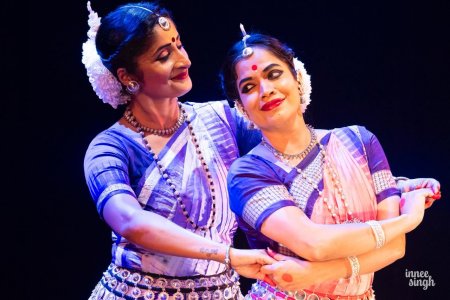 At the centre of it all is Madhulita Mohapatra as Draupadi. Her performance is marked by a rare intensity of abhinaya - controlled, deeply felt, and never overstated. There is dignity even in anguish, restraint even in anger. She does not rush to display emotion; instead, she allows it to emerge gradually, giving each moment time to breathe. Her Draupadi is not just a wronged queen demanding justice; she is also a witness - absorbing, questioning, and carrying the weight of what unfolds around her. Particularly striking is how the emotional graph is handled. The anger that rises during the court scene does not remain loud or external; it settles into something quieter, more internal as the narrative progresses. By the time the work reaches the aftermath of war, the energy has shifted completely. There is no triumph, no sense of victory - only reflection, fatigue, and a lingering question. This transition is handled with great sensitivity and leaves a strong impact. Rooted in the classical grammar of Odissi, the choreography blends sculptural precision with layered abhinaya and a strong theatrical flow. Drawing inspiration from Maharishi Vyasa's Mahabharata, the narrative is continually enriched with poetic inputs by Ashtavadhani Balachandra Bhat in Sanskrit and Kedar Mishra in Odia. Evocative music by Rupak Kumar Parida and rhythm composition by Guru Dhaneswar Swain shape the production's lyrical depth and dramatic intensity. The choreography reflects a clear and mature vision. It stays rooted in the grammar of Odissi, yet allows space for theatrical expression. Group movements are clean and well-structured, creating clear visual patterns without clutter. Each character is introduced and developed with enough distinction to remain identifiable, yet none distract from the central voice of Draupadi. The ensemble moves with discipline and cohesion, supporting the narrative without overwhelming it. At the centre stands Madhulita as Draupadi. Her abhinaya begins in controlled embers - wounded pride and iron will contained within a dignified bearing - and rises to a blaze in the curse, then settles again into reflective stillness as she walks the battlefield after war. Rage is shaded with grief, conviction with doubt; nothing is hammered, so that the final soliloquy does not prosecute a case but leaves a question. 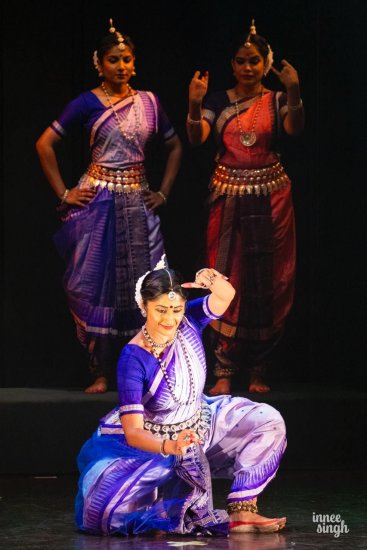 Around her, the Nrityantar Dance Ensemble brings the epic to life with distinct roles; each dancer has a clear movement motif that keeps the canvas from blurring. Sahana Raghavendra Maiya's Arjuna has clean lines and a hint of hesitation - pulled between duty and compassion. Reshmi Divakaran shifts convincingly between a calm, steady Krishna and an upright, inward Yudhishthira. Sumana Das's Bhima is grounded and sure-footed, with power rising through the body. Aditi Das's Karna is noble and quietly moving. Prasun Mondal shows unapologetic pride and arrogance as Duryodhana. Anupama Kumar's Shakuni is all sharp eyes and sly weight shifts. Srudhi Retheesh's Dushasana is ruthless and overbearing. Siri Reddy's Kunti conveys grief with quiet dignity. In a neat double, Nandhana S gives Bhishma calm authority and Subhadra gentle warmth. The ensemble, including Sreyashi Dey, maintains a cohesive presence throughout, ensuring the narrative remains clear and engaging without losing its emotional focus. Several passages drew warm applause. Five-year-old Mihika Mahnoor's brief turn as baby Abhimanyu was especially endearing - musical and on beat, light on her feet, with neat cartwheels that earned spontaneous applause. Abhimanyu's sacrifice was etched without excess. Angeleena Avnee offered a brave, contained portrait of the young warrior; when he finally fell and the music receded, the hall fell still - grief and melancholy settling over the audience, leaving them deeply moved. Later, Dushasana's death is staged not for gore but for moral closure: the vow made in the court is paid off, yet Madhulita chooses to keep Draupadi's response inward, not triumphant or celebratory - a choice that preserves the work's ethical gravity. Brief Odia and Sanskrit verses - on dharma under trial, the turns of fate, and the cost of revenge, mark key points without sermon. What makes this production especially meaningful is its resonance with the present. In a time marked by wars, conflict, unrest, and constant images of human suffering, the questions raised on stage feel uncomfortably familiar. The work does not offer easy answers. It does not take sides. Instead, it gently but firmly asks - what is the cost of anger, of pride, of silence? And when the war is over, what truly remains? The audience seemed to engage deeply with this inquiry. There were moments of stillness in the hall where one could sense a collective absorption. The response at the end was warm and sincere, culminating in a heartfelt and well-deserved standing ovation. Draupadi's Mahabharata is not just a dance production; it is a reflective experience. It draws the viewer in, not through spectacle, but through honesty and thought. In doing so, it reminds us that classical dance, when approached with clarity and conviction, continues to speak to the concerns of our times with relevance and depth.  Mini Somakumar is a Bengaluru-based Odissi dancer and an attentive observer of the performing arts. With a deep interest in the grammar, aesthetics, and experiential aspects of dance, she brings a reflective and discerning perspective to performance analysis. |
