
|     |
|
| |

 Upasana Centre for Dance presents Utsava- Tapati Chowdhuriee-mail: tapatichow@yahoo.co.in Photos: Arijit Roy April 26, 2026 Upasana Centre for Dance celebrated Utsava at Gyan Manch, Kolkata, on the 29th of March in loving memory of his mother to signify the role of a mother in the proper nurturing of a child. Odissi exponent Aruna Mohanty was the invited guest who offered two gems to the audience of Bengal: Aswathama and Sunyaswarupa. Aswathama, son of Dronacharya, was as well versed in the art of warfare as the Kauravas and Pandavas - cousins and rivals in the great Indian epic Mahabharata. Dronacharya, who was the teacher of them all, was a Brahmin. According to the rules of those times, only Kshatriyas had the privilege of fighting. Therefore, as the son of a Brahmin, Aswathama was a Brahmin, as ordained during later Vedic times, could not take part in the great battle of Kurukshetra. However, Duryodhana, the eldest of the Kauravas, broke the rules and at one point gave Aswathama the opportunity to lead the battle. 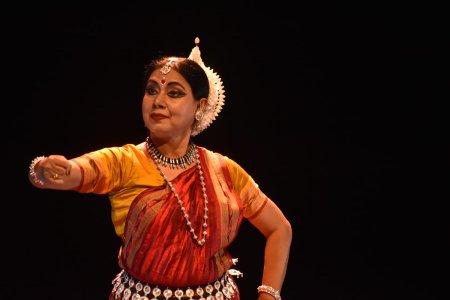 Aruna Mohanty Those were times when all was not fair in war. Ashwathama entered the Pandavas' camp in the middle of the night and mercilessly slaughtered their five warrior sons, mistaking them for the Pandavas. According to the rules of warfare, one did not have the right to take up arms against the unarmed. Krishna condemned Ashwathama for breaching wartime rules and morality. Ironically, Aswathama was cursed with immortality created by his misdoings - a powerful story told powerfully through the medium of dance. Well armed with her vocabulary of dance, assisted by an excellent script from scholar Kedar Mishra, and powerful lighting, this dramatic episode was savored by the audience. The dance choreography of the solo piece was choreographed by Aruna Mohanty, the performer herself, to the music composition and rhythm composition of Guru Ramhari Das and Guru Dhaneswar Swain. Based on text from the Shvetashvatara Upanishad, the next piece, Sunya Swarupa, depicted the mortals' search for the Universal Soul, whose presence is felt everywhere but cannot be seen. The devotee says, 'You have no hands or feet, but you are the one who gives and accepts all that is offered to you and are present everywhere. You have no eyes or ears but can see and hear the pleas of one and all. You exist in every individual. You express yourself in every creature; everything in the world is a projection of You.' This part is inspired by the legend of Dasia Bauri. Though denied entry into the temple, he remained unwavering in his devotion and offered a simple coconut from afar. The Lord, untouched by human boundaries of caste or distance, accepted his offering. For the divine moves without feet, receives without hands, and sees beyond what the eyes can perceive. The piece depicted the devotion of a devotee rendered with care by Aruna Mohanty. Dance choreography was by Aruna Mohanty, music composition by Bijaya Kumar Jena and Rupak Parida, rhythm composition by Bijaya Kumar Barik, script by Kedar Mishra. 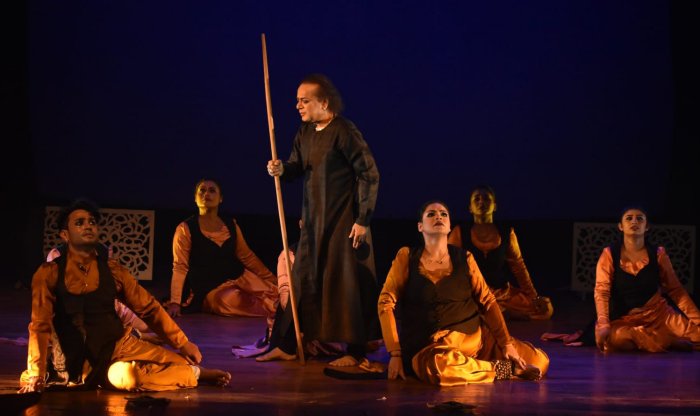 Ashimbandhu Bhattacharya and troupe Artistic Director Ashimbandhu Bhattacharya of Upasana Centre for Dance presented Andaz-e-Ghalib. Mirza Ghalib was an eminent 19th-century Indian poet of the Mughal Empire, known for his writings in both Persian and Urdu. In fact, he lived during the decline of the Mughals and the rise of British colonial rule. The depth and complexities of his poems were hardly understood by the people of his time. Known for his profound ghazals - dealing with themes of love, philosophical depth, and wit - he has stood the test of time. His understanding of religion and the Absolute did not confine him to popular beliefs and practices. Despite numerous adversities in his life, nothing stopped his creativity. His feelings of oneness with God, pangs of separation and loss glorified his verses, as he always found a "stream of life in death." 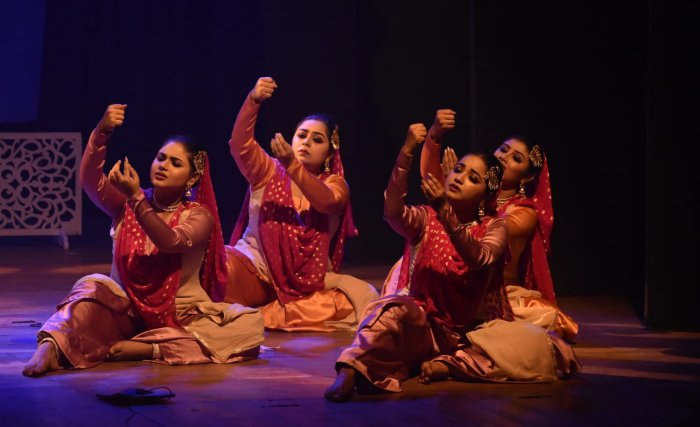 Upasana Centre ensemble Ashimbandhu Bhattacharya was mesmerized by Gulzar's TV serial Mirza Ghalib, and the ghazals of Ghalib sung by Begum Akhtar inspired his creative instincts. He had long nurtured a hidden desire to pay tribute to this great poet through his chosen medium of Kathak dance. While working on the project, he delved deeply into the philosophy behind Ghalib's creations. He took pains to learn Urdu, and while writing the script, he was guided by Janab Haider Ali Khan. According to Ashimbandhu, Ghalib can be placed on the same altar as Rabindranath Tagore and Shakespeare. Comparisons aside, he has tried to give his chosen theme a contemporary touch to make it accessible to people today. Andaz-e-Ghalib depicted the life and philosophies of Mirza Ghalib. The theme was abstract, dealing with feelings of love, joy, loss, tragedy, separation, union, and more. A Kathak artiste of repute, proficient in both the Jaipur and Lucknow gharanas, Ashimbandhu has put his heart and soul into the production, offering an aesthetic evening to rasikas. The piece - performed and conceptualized by him, as the writer has gathered - involved research and scriptwriting as a joint effort by Janab Haider Ali Khan and Ashimbandhu. A compelling production that will remain in the memory of aficionados.  Tapati Chowdhurie trained under Guru Gopinath in Madras and was briefly with International Centre for Kathakali in New Delhi. Presently, she is a freelance writer on the performing arts. She is the author of 'Guru Gopinath: The Making of a Legend.' |
