
|     |
|
| |

 Delhi Odissi Utsav: A growing collective of tradition and expression- Ratna Bharati Acharyae-mail: ratnabharati@gmail.com Photos: Ritesh Sharma April 22, 2026 The Delhi Odissi Utsav 2026, held on 12 April at Muktadhara Auditorium, New Delhi, marked another significant step in the festival's evolving journey as a platform for Odissi practitioners in the capital. Delhi Odissi Utsav is one of the eleven Odissi Utsavs being hosted across India by Odissi International Forum, Bhubaneswar, founded by journalist and arts writer Shyamhari Chakra. The festival, now in its sixth edition, continues to uphold its foundational vision--promoting Odissi, particularly solo dancers, by offering an inclusive stage irrespective of age or experience. Over the years, it has become a gathering of the Delhi Odissi community, fostering encouragement, and shared artistic growth. This year's convenor, Guru Subrata Tripathy, curated a diverse line-up featuring 19 soloists, 1 duet, 4 group presentations, and 4 invited artistes from across Delhi NCR. The festival unfolded across morning and evening sessions, separated by a brief interlude. Despite a delayed commencement, the programme regained momentum and concluded on schedule, reflecting efficient on-ground coordination. 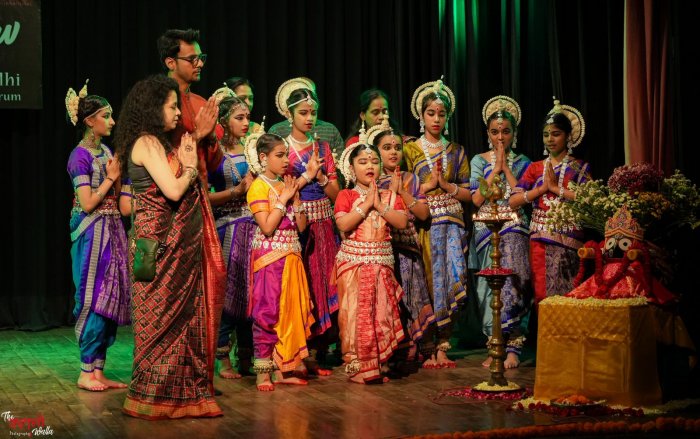 Participants with their gurus during the lamp lighting ceremony The morning session opened with the traditional lamp lighting ceremony, as young participants collectively invoked Lord Jagannath, setting a devotional tone. The inaugural performance, a Mangalacharan based on the shloka "Namami Vighna," was presented by a group of six children. The presence of a five-year-old performer lent a disarming innocence to the stage, underscoring the festival's inclusive spirit. All the young performers presented their pieces with sincerity and evident joy--at moments tentative yet earnestly striving to embody the training imparted by their guru. Among the early performances, Manvika Aggarwal, a disciple of Moumita Ghosh Vaats, presented a nuanced abhinaya in the Odia piece "To Lagi Gopa Danda," demonstrating commendable expressional clarity. A duet presentation of Saveri Pallavi by Ishita Kundu and Manpreet Kaur demonstrated commendable synchronisation, particularly given the compositional complexity of the pallavi format. However, Ishita Kundu's performance stood out for its refinement; her dancing displayed a notably polished quality. The session concluded with the distribution of certificates and trophies by Guru Dinabandhu Dalai, acknowledging the efforts of the participating artistes. 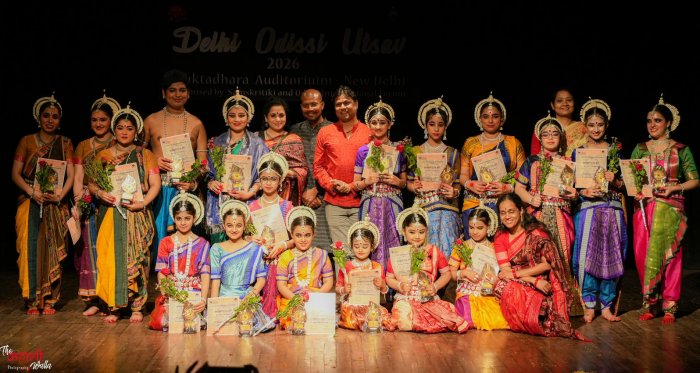 All participants of the morning slot after the felicitation The evening session commenced in the presence of chief guest Guru Kumkum Lal. A senior disciple of Guru Kelucharan Mohapatra, she has played a pivotal role in establishing and nurturing the practice of Odissi as far afield as Japan. Guru Kumkum Lal felicitated the winners of the Delhi Odissi Pratibha Utsav. Among the evening performers, Nerissa Rout, trained under Alpana Nayak and Santosh Kumar Swain, presented Rageshree Pallavi with technical assurance. Her footwork and bhramaris were executed with clarity and control; however, a more grounded and sustained chouka could have lent greater structural depth to the presentation. Raudri Singh, a disciple of Pratibha Jena Singh, presented "Konark Kanti" inspired by the Sun Temple at Konark. "Konark Kanti" is regarded as one of the earliest choreographic works of Guru Surendra Nath Jena. Raudri's sculptural poses were striking, evoking the temple's iconic imagery with clarity and control. In the compositions of Guru Surendra Nath Jena, the recitation of bols is rendered with a distinctive musicality--interwoven seamlessly with the rhythm, and shaped through subtle modulations of pitch that lend the style its unique character. Among the invited artistes, Guru Lipsa Satpathy's "Krishna Madhuri" stood out as a conceptually ambitious work, tracing the evolution of Odissi through Mahari, Gotipua, and Sakhinata traditions. The piece wove together episodes from Krishna Leela into a cohesive garland, drawing on Odia compositions such as "Dekhiba para aasare," Hindi compositions, and ashtapadis like "Chandana charchita" and "Dheera samire." A particularly evocative moment depicted Mother Yashoda adorning the young Krishna with anklets and urging him to dance; as Krishna begins to walk and dance to the gentle tinkling of the bells, Yashoda is overcome with joy--an episode rendered by Guru Lipsa Satpathy with remarkable tenderness and expressive finesse. The festival concluded with a felicitation ceremony led by Guru Pratibha Jena Singh, bringing all participants together on stage--a gesture that reaffirmed the collective ethos. 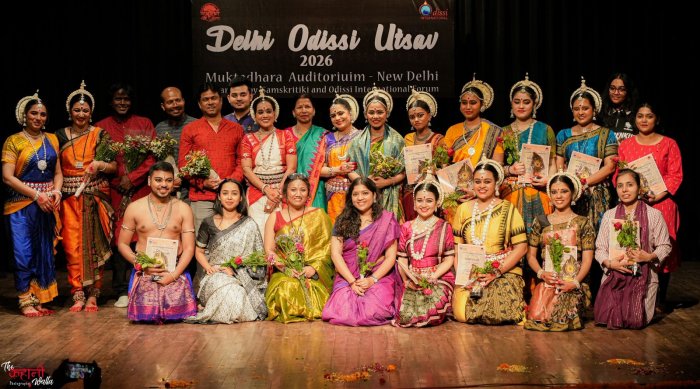 All participants of the evening slot after the felicitation with Chief Guest, Guru Pratibha Jena Singh (centre) From an organisational standpoint, a few refinements could further enhance the viewing experience. Greater attention to visual detailing--particularly in posters and stage backdrops--along with thorough pre-event sound checks, would help minimise minor disruptions. Additionally, ensuring audience decorum, especially among younger attendees, through dedicated volunteer support would allow performers to command the focused attention they merit. Given the presence of a distinguished guru like Guru Kumkum Lal, whose decades of experience enrich the field, it would have been valuable to invite her to share a few words. Hearing insights from such an eminent guru would have added a meaningful pedagogical dimension to the festival. 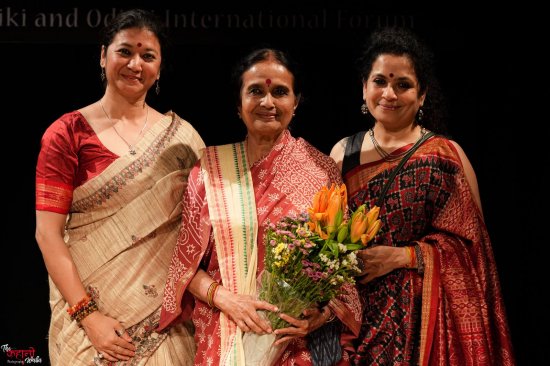 Lipsa Satpathy (left) and Subrata Tripathy (right) felicitating Guru Kumkum Lal (centre) The Delhi Odissi Utsav continues to occupy a meaningful space within the city's cultural landscape. It not only provides a stage for emerging voices but also enables audiences to engage with diverse interpretations rooted in the legacies of stalwarts such as Guru Pankaj Charan Das, Guru Deba Prasad Das, Guru Kelucharan Mohapatra, Guru Surendra Nath Jena, and Guru Mayadhar Raut. As it evolves, the festival stands poised between community participation and curatorial direction--an equilibrium that, if carefully nurtured, can further strengthen its artistic identity. 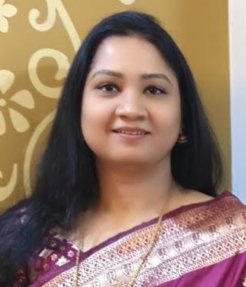 Ratna Bharati Acharya is an Odissi practitioner with a deep passion for the classical, folk, and traditional art forms of India, particularly those of Odisha. Her current focus involves an in-depth exploration of these artistic traditions, researching into their origins and subtle intricacies. Through her writing and storytelling, she strives to share these narratives with children as well as international audiences, especially dancers living beyond India's borders. |
