
|     |
|
| |

 'Iti Kalyani' - A raga-centric ode to love and melody by Sahitya Ramkumar- Satish Surie-mail: satishism@yahoo.co.in Photos: Prof K.S.Krishnamurthy April 22, 2026 Sahitya Ramkumar's 'Iti Kalyani' unfolded as a thoughtfully conceived and finely wrought Bharatanatyam solo that paid an evocative tribute to the "Queen of Ragas," Kalyani, and its luminous janya derivatives. Conceptualised, choreographed, and performed on the 7th of April at the Bangalore International Centre, by the Hyderabad-based artiste and founder of Sahityakalpa School of Arts, the production transformed the stage into a dreamlike aesthetic space where sringara, romantic love in its manifold shades, was explored through melodic nuance and rhythmic vitality. 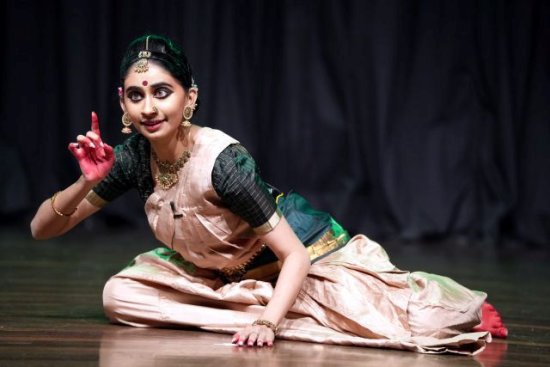 The title 'Iti Kalyani' suggested both a sense of conclusion and a summative vision, deftly invoking the Sanskrit "iti" while situating the recital within the expansive framework of the 65th melakarta raga Kalyani and its allied forms--Mohana Kalyani, Hamir Kalyani, and Yaman Kalyani. The conceptual impetus for the production drew from the exploration of a singular mother raga and its daughter ragas, resonating with the Nirupana tradition of Maharaja Sarfoji's court, where an entire repertoire of eighteen compositions would unfold within the ambit of a single raga. Sahitya structured the recital as a cohesive thematic margam. Within this framework, she examined love in its varied emotional registers, playful yearning, ritual devotion, and the transcendental ecstasy associated with Krishna bhakti. The recital opened with an inventive confluence of Jatiswaram and Alarippu in Mohana Kalyani set to mishra chapu tala. The buoyant geometry of the Jatiswaram segued seamlessly into a reimagined Alarippu, where the conventional linearity of the form gave way to the imagery of blossoming. This imaginative interpretation retained the structural integrity of the idiom while introducing a poetic visual metaphor, establishing the tonal and aesthetic direction of the evening. At the core of the performance stood the expansive Kalyani Varnam, "Sarasijakshudu Neevani," attributed to Sivananda of the Thanjavur Quartet (roopaka tala), with acknowledged inputs from Jeetendra Hirschfeld. Re-choreographed with intricate and dynamically structured jathi sequences, the Varnam emerged as the emotional and kinetic fulcrum of the recital. Sahitya's abhinaya was particularly compelling: her nuanced delineation of the nayika's longing for Lord Rajagopalaswamy of Mannargudi revealed a keen sensitivity to the inner landscape of devotion infused love. The portrayal was marked by expressive clarity, darting glances, tremulous anticipation, and moments of inward stillness that rendered the heroine's yearning palpable. Narrative interludes depicting temple processions and Krishna's playful episodes added dramaturgical richness. The charanam, "Gana vidya lola," incorporated a vintage style thani segment, allowing the recorded ensemble to momentarily foreground rhythmic virtuosity before returning to the central melodic thread. A striking highlight of the evening was the presentation of a relatively rare Hamir Kalyani Thillana by Muthiah Bhagavathar, composed in praise of Maharaja Nalwadi Krishnaraja Wadiyar. This segment revealed Sahitya's command over nritta, combining brisk footwork with sculptural karanas inspired by the Naṭya Shastra, traditions she had imbibed under her teacher Vithya Arasu. The choreography effectively exploited the raga's vakra movement and its interplay of prati and suddha madhyama, resulting in a piece that was both technically exacting and aesthetically fluid. 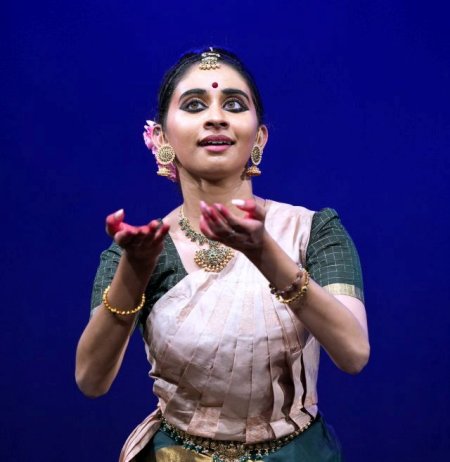 The recital concluded with a Swati Tirunal bhajan, "Aaj aaye Shyam Mohan", in Yaman Kalyani, evoking the timeless imagery of the Ras Leela along the banks of the Yamuna. Here, the boundaries between bhakti and sringara dissolved seamlessly. Sahitya's movement vocabulary softened into lyrical expansiveness, mirroring the undulating flow of the music. The suggestion of Krishna's unseen yet omnipresent flute-playing lent the piece a quiet transcendence, culminating in an atmosphere of devotional rapture. Sahitya's aharya was understated yet elegant. The visual impression was one of refined classicism, complementing the thematic gravitas of the production. Her brief mimed introduction at the outset functioned as a gentle aesthetic prologue, inviting the audience into the emotional landscape of the recital. Credit was also due to the vibrant young music ensemble, presented on a recorded track and carefully assembled and nurtured by Sahitya herself: Divyasri Pisupati (vocals), Sai Venkata Gangadhar (nattuvangam--a Kuchipudi dancer who brought a refreshing dynamism), Koundinya Pannala (violin), and Veeramraju Lakshmi Ajay (mridangam). Their collective energy and cohesion infused the recital with a palpable verve, demonstrating how a thoughtfully curated musical ensemble can significantly elevate the overall dance experience. In sum, 'Iti Kalyani' stood out as a compelling example of how the traditional margam can be re-envisioned without compromising its structural or aesthetic integrity. Sahitya Ramkumar demonstrated a mature choreographic voice, one that was rooted in classical grammar yet responsive to imaginative inquiry. By weaving together raga architecture, expressive depth, and kinetic precision, she created a work that was both intellectually engaging and emotionally immersive.  Bangalore based Satish Suri is an avid dance rasika besides being a life member of the Music and Arts Society. |
