|     |
|
| |

 'Jwala' (The Rising Flame)- Manjari Sinhae-mail: manjari@sinha.com Photo credit: Gajanand Shekhar April 17, 2026 Dancer and choreographer Mythili Prakash recently presented her extraordinary dance production 'Jwala' (The Rising Flame) under the aegis of District of Raga, at The Barn, an intimate auditorium at Wolf Trap in Washington, D.C. Known for curating programs that highlight South Asian musical and cultural traditions while embracing innovation, the District of Raga series offered a meaningful artistic experience through this presentation. Mythili Prakash has emerged as one of the most respected young Bharatanatyam dancers of her generation, celebrated for her innovative choreography and distinctive artistic voice. She possesses a rare ability to articulate contemporary social and philosophical ideas through the classical language of Bharatanatyam. The daughter and disciple of the eminent Bharatanatyam artiste Viji Prakash, Mythili has also trained under Malavika Sarukkai, further enriching her solid foundation. Though born and raised in the United States, she has remained deeply connected to her cultural roots, dedicating time each year to rigorous training and practice in India. Her artistic integrity has earned her the prestigious USA Fellowship, along with numerous accolades from leading institutions of dance and music in India and abroad. The technical perfection of Bharatanatyam - its precision, purity of form, and sculptural grace - is merely her medium. What truly distinguishes Mythili is the authenticity of her creative vision, rooted in personal experience and introspection. Over the years, she has performed extensively across the United States, Canada, Mexico, Europe, Singapore, and India. 'Jwala' stands as her latest and perhaps most evocative offering. 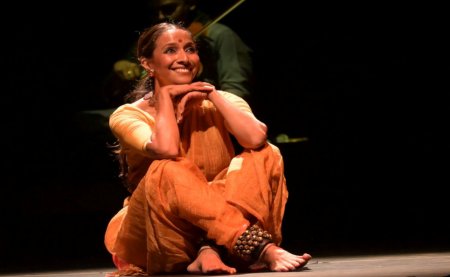 The concept of 'Jwala' signifies fire as life's eternal metaphor, symbolised by the flame, in which Mythili explores profound dualities such as life and death, joy and sorrow, presence and emptiness. The work also delves into themes of motherhood, tenderness, and the quiet voids born of solitude. Her literary curation is both thoughtful and expansive. The piece weaves together the Mahamrityunjaya Mantra, hymns to fire from the Rig Veda, and philosophical inquiries from the Katha Upanishad, reflecting humanity's enduring curiosity about life and mortality. Equally moving is the gentle portrayal of Vatsalya Rasa, maternal love, when a mother softly dims a lamp after singing her child to sleep, ensuring the light does not disturb the infant's rest. Here, the "flame" becomes a symbol not only of cosmic energy but also of intimate human emotion. The motif of fire extends further - appearing in the spiritual hues associated with the 'Rang' of Hazarat Ali and in the mystical teachings of Sufi philosophy, echoing the sentiment: "Burn within your own flame - become the moth that embraces the fire" (Apni aag mein khud jal jae, Tu aisa parwana ban ja). As the performance comes full circle, returning to the Mahamrityunjaya Mantra, the audience awakens from their spellbound state - deeply moved by both the gravitas of the philosophical theme and the ecstasy of its moving expression. 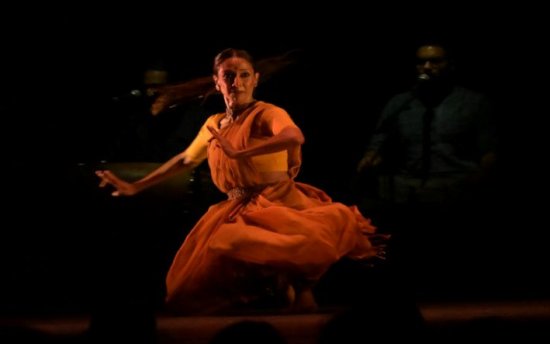 The performance opened with the auspicious swaras of raga Nattai, when Mythili, clad in a simple 'Laangdaar Dhoti' and minimalistic makeup (instead of the conventionally stitched Bharatanatyam costume and jewellery), takes to the rhythm of rupaka talam. As the curtain rises, darkness on stage is pierced by a focused beam of light, revealing a flame formed through the dancer's hand gestures. Gradually, the stage illuminates in tandem with the chanting of the Mahamrityunjaya Mantra. The imagery expands as the sun god, riding his chariot of seven horses, enters with the background score of the Vedic hymn "Om Agnimile Purohitam..." from the Agni Sukta of Rig Veda, which was thoughtfully accompanied by the melodic syllables of 'tanum'. Mythili's brilliance is matched throughout by her ensemble of exceptional collaborators. The production demonstrates meticulous attention to every artistic element - literature, music, sound, and lighting - all aligned with the thematic essence of Jwala. The philosophical exploration of life and death, echoing the Katha Upanishad is enriched through the tonal dialogues of raga Mohanam. A tender lullaby in raga Kapi (akin to Hindustani Pilu) evokes Vatsalya Rasa, the maternal affection, while a Sufi thought inspired Urdu verse in raga Yaman crescendos with rhythmic intensity in "Apni aag mein khud jal jae, Tu aisa parwava ban ja" ("Become the mad moth that burns in its own flame"). The climax resolves once again into the imagery of fire with the resonant chant of the Mahamrityunjaya Mantra, bringing the thematic journey full circle. 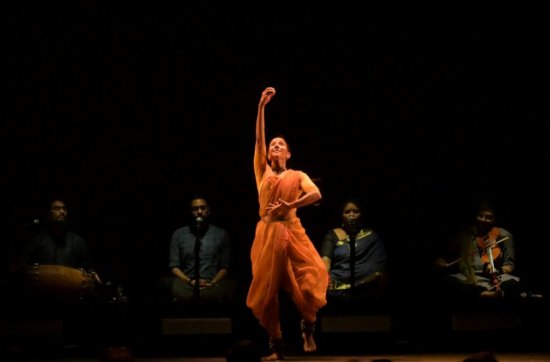 Mythili Prakash's 'Jwala' was indeed a flame that lingers on, with the lasting impact of its literature, music, movements and stagecraft in a seamless synthesis. The deeply evocative music, sensitive to the nuances of the text, seemed to arise organically from the poetry itself. The totally tuneful musical ensemble - remarkably comprising just four musicians - created a rich and immersive soundscape with Rohan Krishnamurthy on mridangam, Sai Rakshit on violin, and vocals by R. Rohit Jayakumar and Roopa Mahadevan. Their artistry, combined with nuanced sound design and lighting, elevated the performance to a deeply moving sensory experience. Mythili rightly reflects, "Every moment of life glows within us like an invisible flame, guiding our path." 'Jwala' is a powerful embodiment of this philosophy. It carries the audience along an unbroken stream of emotion and reflection, where the dancer's personal narrative transforms into a shared, collective memory. The impact is profound and enduring - leaving viewers with an experience that lingers long after the final note fades. 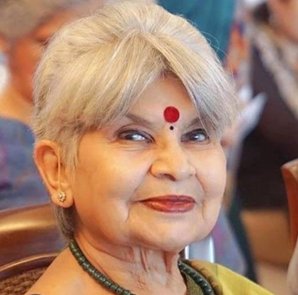 Manjari Sinha is a musicologist and an acclaimed classical music and dance critic. She has an MA in Sanskrit from Allahabad University, MA in Music from Vikram University, Ujjain; Sangeet Prabhakar in Hindustani Vocal, Tabla, Sitar and Kathak dance from Prayag Sangeet Samiti, Allahabad; and further training in Sitar under Guru Pt. Arvind Parikh in the lineage of Ustad Vilayat Khan. She has authored a book on Ustad Bade Ghulam Ali Khan, commissioned & published by Roli Books. She has contributed the chapter on Kathak for 'Indian Dance: the Ultimate Metaphor'. Her articles in English and Hindi on Music, Dance, Art & Culture are regularly showcased in a variety of leading journals and periodicals. |
