
|     |
|
| |

 Aviral Rang: Rhythm, Expression, and the Continuum of Tradition- Simer Preet Sokhie-mail: Simersokhi.ss@gmail.com April 16, 2026 On 8 April, at the Stein Auditorium of the India Habitat Centre, "Aviral Rang," presented by Kalaagat Niranjana Foundation, brought together the disciples of Malti Shyam in an evening that remained closely aligned with the ethos of the Lucknow gharana. Founded by Yamika Mahesh, one of her senior disciples, the organisation has consistently created spaces where training and performance come together with clarity and restraint. As a non-profit initiative, it is engaged in the preservation and promotion of Indian classical arts through performances, workshops, and cultural programmes, alongside its commitment to broader social outreach. The evening was thoughtfully managed, allowing the focus to remain on the work itself. 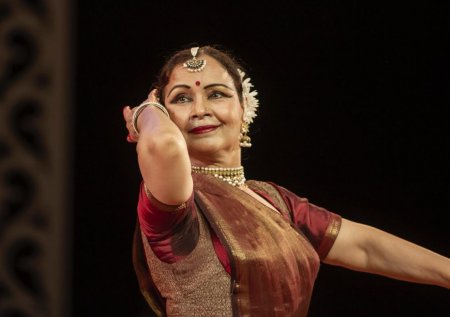 Malti Shyam What was striking, even before the performance began, was the presence of a wide spectrum of senior artistes in the audience: Manjushri Chatterjee, Madhavi Mudgal, Shovana Narayan, Geeta Chandran, Shashwati Sen, Deepak Maharaj, Abhimanyu Lal, Kavita Dwivedi, Santosh Nair, Chitra Sharma, Raju Das (Secretary, SNA), Vivek Virmani (Ministry of Defence) along with several others who have shaped Delhi's dance life over decades. Such a gathering is rare, and rarer still is their presence from beginning to end. That, in itself, spoke of the regard held for Malti Shyam and her work. Trained under the guidance of Guru Reba Vidyarthi and the doyen of the Lucknow gharana, Pt. Birju Maharaj, Malti Shyam carries a certain quietness in her presence. Her dance has long been associated with lyrical beauty and a refined attention to detail that does not draw attention to itself. This quality extended into the design of the evening, shaping its pace and mood with a sense of calm continuity. The evening opened with a solo presentation by Anchal Rawat with the Ganesh Vandana, "Jehi Sumirat Sidhi Hoye," set in raag Yaman and taal Dadra, a composition of Tulsidas drawn from the Ramcharitmanas. It set a composed and unhurried tone, allowing the recital to unfold without haste. This was followed by a segment of technical dance in Jhaptaal, maintaining the same steady pace. Anchal's solo then moved into the familiar structure of Kathak nritta. The thaat was composed and attentive, followed by a clear aamad, and paran-aamad that settled into the rhythm of Jhaptaal. The choice of taal marked a shift from the more frequently seen Teentaal, a feature that remained through the evening. The bandishes, drawn from the Lucknow repertoire, were rendered with precision, without exaggeration. Her footwork remained measured, and the transitions between compositions were handled with ease. She concluded with a Meera bhajan, "Sakhi ri mai Girdhar ke Rati," set in raag Yaman and Bhajani Theka, where the energy softened, and the abhinaya carried a sense of inwardness rather than display. 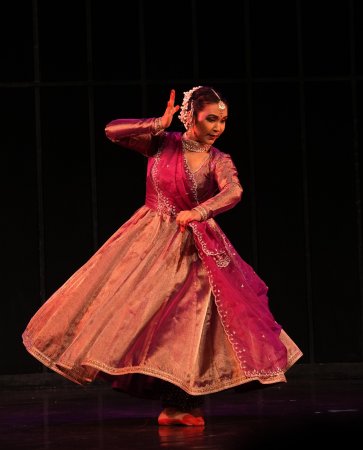 Anchal Rawat The trio opened with a composition based on Senapati's verse "Baran baran taru phule upvan ban," performed by Shary Gairola, Sanskriti Pathak, and Harshita Sharma. Based on the theme of Basant, it introduced a different rhythm to the stage. The choreography relied on coordination and balance, with all three dancers maintaining a steady synchronisation, something not always seen in traditional presentations. The use of taal Basant brought a welcome change in texture. They moved between group passages, duets, and brief individual segments, including padant, adding variation without breaking the flow. The dancers showed clear command over their material, and the pieces were presented with a certain deliberation and a sense of thehrav. It held together through its simplicity and clarity. 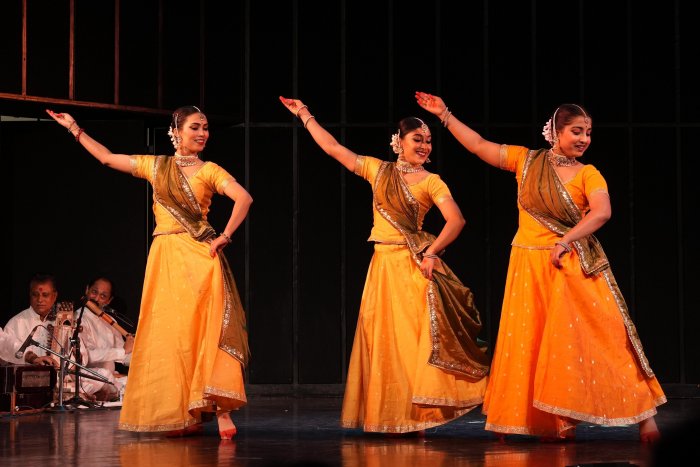 L-R: Shary Gairola, Sanskriti Pathak, and Harshita Sharma Ashwini Soni's solo took the evening into a more narrative space. Structured in the katha vachan format, it drew upon the episode of Daksha Yagya. The piece began with traditional elements, suggesting Shiva and Sati through bandishes and gat nikas, before gradually opening into a more descriptive mode. The inclusion of spoken text and voiceovers introduced a theatrical layer, while the presentation remained anchored in Kathak. The abhinaya was marked by control and an avoidance of overt display, carried through a measured use of ang, drishti, and mukhaj abhinaya, retaining the grace and nazakat associated with the Lucknow tradition. The exchange between Shiva and Sati, her insistence on attending the yajna, and the eventual humiliation were conveyed with care. The moment of Sati's self-immolation and Shiva's grief were handled without excess, allowing the emotional weight to emerge through pacing and gesture rather than overt dramatics. At a time when sustaining audience engagement often depends on speed and display, it is not easy to hold attention through a measured narrative; yet Ashwini's presentation remained engaging till the very end, sustained by the quiet intensity of its katha vachan. 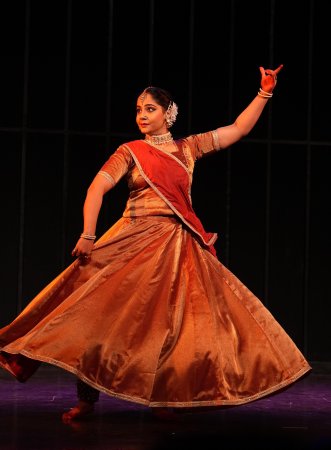 Ashwini Soni The concluding segments brought all the dancers together, beginning with the poetic piece "Mohini," written by Manu Vaishali and conceptualised in kavitta format by Malti Shyam, presented by Gauri, Charu Sharma, Dolma Gupta, and Abhilasha Azad. The composition explored the nuanced emotional states of a madhya nayika, where the abhinaya remained subtle and unhurried. The dancers approached the piece with restraint, allowing small shifts in drishti and expression to carry the emotional content, rather than overt gesture. A quiet attention to detail lent the presentation cohesion and depth. This was followed by the final group choreography on the traditional bandish "Chanchal Chapal Chatur Naar," set in raag Basant and Ektaal. With this, the energy of the evening opened out. The movement vocabulary became more expansive, and the stage was occupied with greater ease and confidence. The piece drew attention to the many facets of the nayika, her liveliness, intelligence, playfulness, and underlying strength, without losing the composure that had marked the earlier segments. The transition from the inward quality of "Mohini" to the more animated group work was gradual and well sustained. 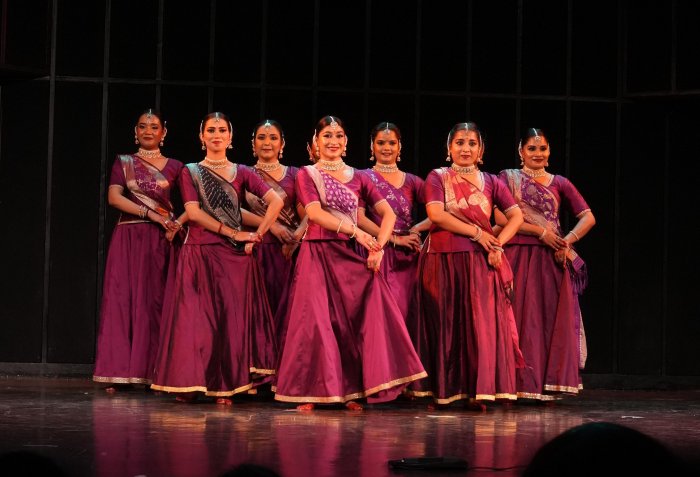 Chanchal Chapal Chatur Naar Taken together, these concluding presentations brought together rhythm, expression, and narrative in a manner that reflected the continuity of Kathak as a living practice, grounded in tradition yet responsive to the present moment. The live music remained a constant support throughout the evening. Yogesh Gangani on tabla maintained a steady dialogue with the dancers, attentive to their pace and emphasis. Jaywardhan Dadhich, a musician frequently seen working with a range of artistes across Delhi today, carried the melodic line with clarity, especially in the abhinaya segments. Ghanshyam Sisodiya, Ashish Gangani, and Dheeraj Kumar Pandey added depth to the sound, ensuring that the music stayed in close conversation with the dance. Ashish Gangani, in particular, offered steady support during the padhant segments, anchoring the recitation for the dancers with clarity and presence. Across the evening, what remained consistent was a sense of training, shaped by the guidance of Malti Shyam. The recital did not lean on spectacle. Instead, it stayed with the form, its structure, its pace, and its internal discipline. One could see not only individual effort, but the imprint of a shared pedagogy. Guru Malti Shyam's approach, marked by lyrical beauty and attention to detail, was visible in the way the dancers held their movement and presence. For those familiar with this lineage, this continuity is recognisable, not as repetition, but as a way of holding the form with care. "Aviral Rang" did not seek to impress through scale. It rested on something quieter, the steady passing on of a tradition, shaped by a guru whose influence is visible in the way her students inhabit and sustain the form. The Stein Auditorium remained filled to capacity, with a full and attentive audience present throughout the evening, reflecting the interest such a presentation continues to hold. The efforts of Kalaagat Niranjana Foundation in bringing together an evening of this nature deserve acknowledgement, and credit is due to Yamika Mahesh for organising a recital that remained attentive to both form and presentation.  Simer Preet Sokhi is an Assistant Professor and Head of Dance at the School of Performing Arts, World University of Design. A trained practitioner of Bharatanatyam, his research engages with Indian performing arts, iconography, and visual culture, with a focus on the relationship between movement, imagery, and aesthetic theory in South Asian traditions. He is currently pursuing his Ph.D. in Performing Arts. |
