
|     |
|
| |

 NatyaFest 2026: A spectacle of culture and creativity- Preeti Sreenivasane-mail: preetivasan24@gmail.com Photo credit: @prajeesh_lights_colors April 16, 2026 On the evening of 21 March 2026, the intimate performance space of Einstein Kultur transformed into a vibrant confluence of rhythm, storytelling, and classical Indian aesthetics as NatyaFest 2026 unfolded before an engaged Munich audience. Marking its fifth consecutive year, the festival has clearly grown into a dependable and much-awaited fixture in the city's cultural calendar. Conceived by the Nityaa Arts Centre, the festival has steadily cultivated a discerning audience for Indian classical dance in Munich, and this year's curation reflected both maturity and artistic confidence. What deserves special mention is the impeccable organisation of the evening. The program began on time and progressed seamlessly, free from the usual interruptions, delays, or logistical distractions that often challenge live events. This level of precision created an immersive viewing experience, allowing the audience to remain fully engaged with the performances. Behind this smooth execution lies the dedication of Shubhada Subramanyam, who, despite balancing a full-time professional career and responsibilities as a mother of two young children, continues to sustain this festival purely out of passion. Her commitment to not only performing but also creating a platform for fellow dancers is deeply commendable. As in the previous years, it was particularly heartening to note that nearly 80% of the audience comprised non-Indian viewers, reflecting the festival's success in reaching beyond the diaspora and cultivating genuine cross-cultural appreciation for Indian classical dance traditions. The evening unfolded in three distinct segments, each rooted in tradition yet shaped by the individuality of its performers. A poised opening: Bharatanatyam solo by Shubhada Subramanyam The festival commenced with a solo Bharatanatyam recital by Shubhada Subramanyam lasting a little over thirty minutes. She opened with Vatapi Ganapatim Bhaje set in the raga Hamsadhwani, an auspicious invocation that immediately established a devotional tone. The execution was marked by clarity of line and a composed stage presence, allowing the familiar composition to unfold with freshness. 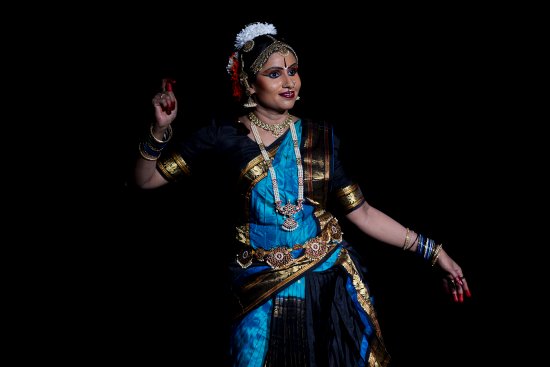 Shubhada Subramanyam This was followed by the swarajati Sambhashivayanave in raga Khamas. Here, the crispness of the nritta passages stood out - the footwork was precise, and the rhythmic patterns were rendered with a clean geometry that held the audience's attention. At the same time, she maintained a balance between technique and expression, ensuring that the piece did not become purely structural. She concluded with Kanjadalayatakshi in raga Kamala Manohari, a composition that offered ample scope for abhinaya. This final piece emerged as the high point of her recital. Her portrayal of the goddess was both graceful and evocative, marked by a gentle musicality that complemented the melodic richness of the composition. The transitions between devotion, admiration, and surrender were handled with sensitivity, leaving a lingering resonance. Rather than overwhelming the audience with complexity, she allowed each gesture to breathe, inviting viewers into the emotional core of the narrative. Overall, Shubhada's recital was marked by restraint and coherence. Rather than striving for spectacle, she focused on clarity and emotional accessibility, creating an opening that was both grounded and engaging. Sculptural lyricism: Odissi group presentation The transition to the Odissi ensemble introduced a contrasting visual and kinetic texture. Performed by a group of 3 dancers led by Naila Datsenko under the banner of Bhavani Odissi dance school, the choreography emphasized the form's signature tribhangi stance and fluid torso movements. 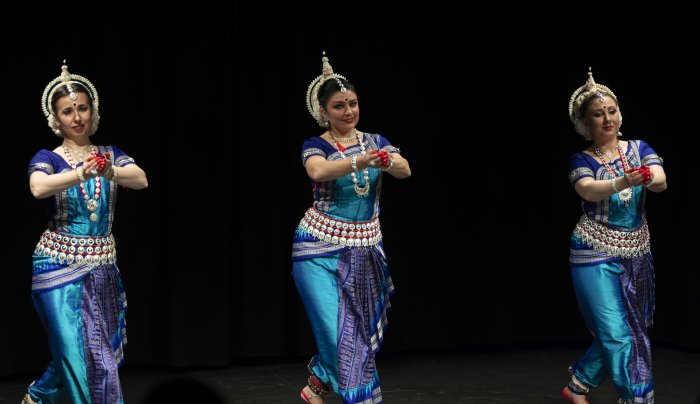 Bhavani Tanz Schule The opening was with Mangalacharan in raga Kedar and Megh choreographed by Guru Kelucharan Mohapatra. The next piece 'Hari Om' was a tribute to the 'Gurus' followed by the Megh Pallavi set to Jhampa tala. What stood out was the collective discipline of the dancers. Their synchronized transitions and spatial patterns created a sculptural quality on stage, reminiscent of temple friezes brought to life. They concluded their performance with a 'Moksha' in Ahir Bhairav raga. The ensemble managed to retain emotional coherence, particularly in passages that explored devotional themes. The choreography balanced symmetry with variation, ensuring that the stage never felt static. The interplay between stillness and movement - so integral to Odissi - was handled with sensitivity, offering the audience moments of visual repose amidst rhythmic complexity. Expansive energy: Bharatanatyam group by Narthanapriya The concluding segment by the Narthanapriya ensemble from Switzerland brought the evening to a dynamic close. Rooted in Bharatanatyam yet conceived for a group format, the presentation was a tribute to Gurus U.S. Krishna Rao and U.K. Chandrabhaga Devi. 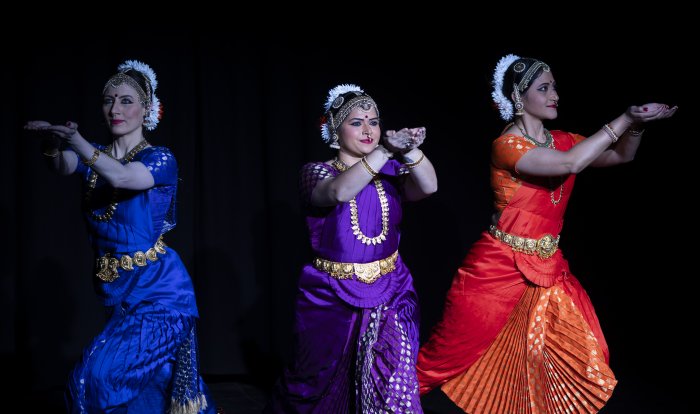 Narthanapriya ensemble Unlike the introspective solo that opened the festival, this work thrived on collective energy. The choreography explored layered formations, and rhythmic interplay between dancers, creating a sense of expansion across the stage. There was a palpable shift in tempo and intensity, drawing the audience into a more celebratory mood. A traditional Alarippu with a Ganesha shloka served as warmup for the second segment of the evening. The centre piece was the Varnam in raga Thodi composed by Narayana Iyer in praise of Lord Rama and Sita. The overall impact was compelling, particularly in sections where rhythmic precision and spatial design aligned seamlessly. The piece served as a fitting culmination - broad, vibrant, and outward looking. The presentation of Shringara Lahiri set to raga Neelambari stood out for its evocative portrayal of feminine energy. The essence of shringara was brought out - not merely as romantic sentiment, but as an all-encompassing grace. The feminine presence remained captivating across shifting roles, suggesting that beauty and strength coexist in every facet of womanhood. The rhythmic tillana in raga Poornachandrika with beautiful footwork and pure dance filled the room with energy. It was a clean and perfect synchronised presentation of the dancers Pranitha Kamat, Sriraksha Sholapurkar and Laetitia Sieffert. Narthanapriya is an annual festival conceived by Dr. Pranitha Kamat in Switzerland. Dr. Pranitha Kamat who moderated this segment of their performance mentioned it was also an inspiration from Shubhada and NatyaFest to start such a festival in Switzerland three years ago. She also thanked Guru Sujata Venkatesh for passing on these traditional choreographies to the dancers. Inderjeet Singh Kala from the Consulate General of India, Munich, addressed the gathering and highlighted how enriching it is to watch our art forms in a live concert against watching on television or other media. Shubha Tumala began the evening by invoking goddess Saraswati. The program was moderated by Vijaya Mahesh. NatyaFest 2026 succeeded not merely as a showcase of classical dance forms, but as a thoughtfully structured experience. The curatorial vision was evident in the progression of the evening: from inward reflection to collective expression. In doing so, it reaffirmed the festival's role as a cultural bridge - bringing nuanced, tradition-rooted performances to a diverse Munich audience while allowing each artiste's voice to resonate distinctly. In a city like Munich, which hosts a significant Indian diaspora and a large number of trained dancers, it is noteworthy that professionally curated, collaborative classical dance concerts remain rare. Most presentations tend to revolve around institutional anniversaries, showcasing teachers and their own students. NatyaFest stands apart in this context by consciously inviting and presenting diverse artistes, fostering a spirit of artistic exchange rather than insularity. It also reaffirmed the importance of independent, artist-driven initiatives in sustaining classical arts beyond their traditional geographies. In that sense, NatyaFest is a quiet statement of dedication - one that continues to enrich Munich's cultural landscape year after year. Preeti Sreenivasan is a student of dance pursuing Masters degree in Germany. |
