
|     |
|
| |

 Aham Pravahini- Miruthula Jegadesane-mail: miruthulaj000@gmail.com April 14, 2026 "And when the river reaches the shore of the sea, it does not know whether it will be lost in the vastness, or whether the vastness will be found within it." - inspired by Kahlil Gibran, On Fear There are productions that entertain, and then there are productions that disturb you into awakening. Aham Pravahini, the latest thematic Bharatanatyam offering by Shobana Bhalchandra, belongs unmistakably to the latter. Drawing its philosophical seed from Kahlil Gibran's meditation on fear - wherein a river, on the cusp of merging with the ocean, trembles at the loss of its identity - this production unfolds as a sweeping, emotionally layered allegory of the human journey from birth to dissolution, and ultimately, to rebirth. The title itself is a masterstroke. Aham Pravahini - I, the River - places identity at the very heart of the inquiry. It is not simply a dance about nature; it is a dance about the self, about the stories we tell ourselves as we move through time, and about what remains when the story ends. And crucially, the choreographic vision is anchored in a bold structural choice: the production begins not at the beginning, but at the end. We meet the river at her most vulnerable - aged, uncertain, standing at the threshold of the ocean. The entire performance then unfolds as a flashback, a river recounting her life to herself in the final moments before surrender. This narrative inversion is not merely a dramatic device; it is a deeply philosophical one, positioning the audience as witnesses to memory itself - and memory, as any student of the Puranas knows, is never simply the past. It is the past seen through the eyes of the present. A JOURNEY THROUGH THE SCENES The production opens - in flashback - with the birth of the river from the mountain: a sequence of extraordinary kinetic energy in which the dancer's body becomes geology itself, conjuring the weight of rock, the first trickle, the gathering of waters. What follows is nothing short of a civilisational journey. It is a reminder of what Bharatanatyam uniquely possesses among classical forms - the capacity to be both cosmic and intimate within the same breath. The spring sequence is rendered through the Ashtapadis of Jayadeva's Gita Govinda - a choice both aesthetically luminous and conceptually precise. Youth, the text suggests, is the season when the river is most herself: free, playful, enchanted by the world's beauty. Jayadeva's language, already a river of images, marries seamlessly to the riverine metaphor. This section glows. 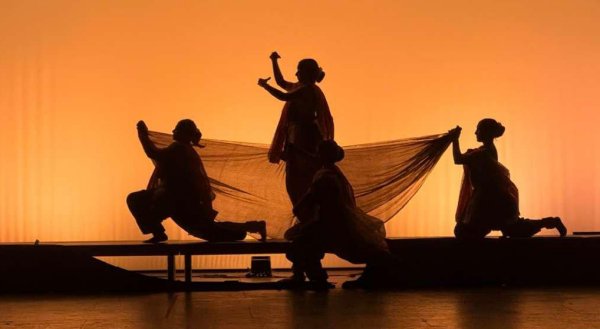 The Bengali folk sequence - rendered with vibrant folk beats and an earthy, celebratory energy - captures the river in her most communal dimension: she belongs to the people, to their festivals, their rhythms, their everyday joy. It is here that the visarjan finds its place - the immersion of the divine into the river - reminding us that in the Indian civilisational imagination, the river is not merely geographical but sacred, a vessel that receives what is most beloved and carries it forward. There is an infectious vitality to this sequence that contrasts beautifully with the more introspective passages that surround it, a reminder that the river's journey is not only spiritual but also deeply, gloriously human. The Nithya Anushtana Karma sequence moves in an altogether different register - quieter, more inward, suffused with the unbroken rhythm of daily sacred practice. The river here is not festive but reverential; she flows alongside the devout, witnessing the oblations of the faithful, the continuity of dharmic life across generations. This sequence reflects a depth of scholarship - an understanding that the river's significance in Indian life is not confined to grand occasions alone, but is woven into the very fabric of the everyday. The drought sequence is the emotional nadir, and it is handled with admirable restraint. A dancer lesser in her maturity might have descended into pathos; here, the suffering is internalised, expressed through a body that contracts, a face that searches, and a silence that aches. The river believes she will die. The audience is inclined to believe her. And then - the rain. If the drought is the production's valley, the return of the rains is its mountain peak. There is a visceral release in this section that is difficult to describe in words - which is, of course, precisely why it is best expressed in dance. The river is revived; the world is revived. The harvest scene introduces a dimension of altruism that elevates the entire narrative. The river does not merely flow - she contributes. She leaves a part of herself in the soil, in the grain, in the lives of those who depend on her. This is the production's most humanistic moment: the suggestion that meaning is found not in self-preservation, but in what we offer to the world as we pass through it. The river's joy here is unmistakable - and infectious. The final scene brings us back to where we began: the old river at the ocean's edge. But she is transformed. She has lived, and in living, she has understood. The return to this opening image is not repetition - it is resolution. When she finally merges into the ocean, it is not defeat. It is, as the production's closing note proclaims with rare tenderness, rebirth. Her journey continues yet again. 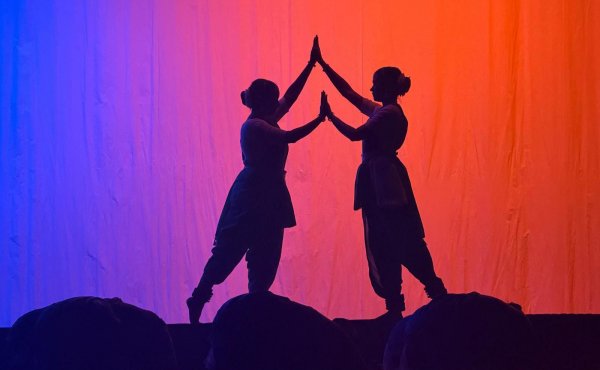 ON THE CRAFT Shobana Bhalchandra demonstrates in Aham Pravahini that she is a choreographer of genuine philosophical seriousness. The decision to weave together Jayadeva's Ashtapadis, Bengali devotional verse, and the Nithya Anushtana Karma tradition within a single production reflects not only breadth of literary knowledge but also a clarity of curatorial vision - each is chosen not for its individual brilliance but for what it contributes to the whole. This is mature choreographic thinking. It is also worth acknowledging that the script binding this journey together was crafted by Sruthi Swaminathan, Shobana Bhalchandra's daughter-in-law - a contribution that lent the production its literary cohesion and narrative spine. The abhinaya throughout is sophisticated and nuanced, particularly in the quieter passages. The moments of transition - mountain to spring, drought to rain, harvest to ocean - are handled with the understanding that in dance, as in life, it is the threshold, not the destination, that reveals character. The production also succeeds in the rare feat of making a philosophical abstraction - the fear of dissolution of identity - emotionally immediate. This is no small achievement. Gibran's poem is beautiful but cerebral. Dance must make it felt. Aham Pravahini does. THE ENSEMBLE A production of this thematic ambition can only succeed when every performer on stage has internalised not just the choreography but the idea behind it. In Aham Pravahini, Shobana Bhalchandra was joined by an ensemble of accomplished dancers -Preeti Anand, who also contributed her own choreographic sensibility to select portions of the production, Natasha Ganesh, Diya Johari, Poornima Murali, Charithra Sankar, Sukanya Chand, and Thina Subramaniam. The group performed with a remarkable cohesiveness, their collective energy giving the river its fullness - for a river, after all, is never a single strand but a confluence of many. 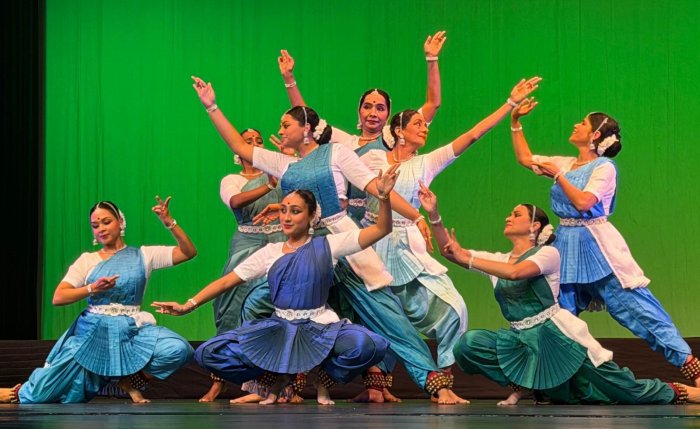 Preeti Anand's choreographic contributions deserve particular acknowledgment. The creative compatibility between two choreographic voices, rather than producing dissonance, deepened the production's emotional range, bringing varied textures to different phases of the river's journey. This is a mark of a production where artistic trust runs deep. Watching this ensemble perform on their US tour, with Arizona as the stage for this reviewer's encounter, one was struck by how effortlessly they carried the weight of the narrative across the arc of the production. There was no moment where the philosophical intent felt abandoned for mere spectacle, no moment where the spectacle did not serve the philosophy. That balance is among the rarest achievements in thematic Bharatanatyam. THE MUSIC: A RIVER IN SOUND If the dancers embodied the river, it was the music that gave it its voice. The score for Aham Pravahini was composed by Embar Kannan. His music does not merely accompany the dance; it is a parallel river, flowing alongside, sometimes merging with, sometimes rushing ahead of the visual narrative, drawing the audience deeper into the current. Embar Kannan's compositional choices across the production reveal an intimate understanding of the dramatic arc he was serving. The mountain birth sequences carry a weightiness of scale; the spring passages dance with the lightness of the Ashtapadis they support; the Bengali section moves with a devotional gravity that underscores the river's role as sacred intermediary. In the drought sequences, the music contracts and stills - and in the return of the rains, it opens with a generosity that feels like breath returning to a body. This is music that knows what story it is telling. The production was recorded by Sai Shravanam, whose rendering brought clarity and warmth to Embar Kannan's compositions, ensuring that every nuance reached the audience with presence and fidelity. The music and dance did not merely complement each other - they completed each other, as the river completes the ocean. A REFLECTION Kahlil Gibran wrote of the river: 'How shall I enter the sea without losing myself?' Aham Pravahini offers a Bharatanatyam answer to that question - one rooted not in the Western existentialist tradition from which Gibran wrote, but in the Indic understanding of identity as riverine by nature: always flowing, always becoming, never static, and never, ultimately, lost. In the traditions that inform this art form, the river is Ganga, the descent of the divine into the human realm. She loses nothing by flowing into the ocean; she completes her purpose. Shobana Bhalchandra, in choosing this metaphor, aligns herself with a vision of the self that is fundamentally hopeful - not despite its acceptance of impermanence, but because of it. Aham Pravahini is a production of genuine ambition and considerable achievement. It deserves wide viewership, and Shobana Bhalchandra deserves our gratitude for reminding us, in the language of nritta and abhinaya, that the river does not end at the sea. It begins again.  Miruthula Jegadesan is a Bharatanatyam practitioner and teacher based in Arizona. She is the Artistic Director of Shree Natya Kalalaya. |
