
|     |
|
| |

 Mischief Dance- Tapati Chowdhuriee-mail: tapatichow@yahoo.co.in Photos: Antahin April 14, 2026 As part of their ongoing Storytellers series, Sparsh presented 'Mischief Dance' by Odissi exponent Sharmila Biswas and ensemble at G.D. Birla Sabhaghar, Kolkata, on 27 March 2026. Sharmila Biswas, trained under Guru Kelucharan Mohapatra, has always trodden her own path, infusing her learnt form by holding a mirror to vibrant life and drama that is a part of life. Even a simple piece of dance - where Radha confides in her sakhi, her "prana sangini," about her wily divine lover, who discreetly visits her in the guise of a female to manicure and groom her, leaving her uncomfortable until she finally discovers her Krishna - has been creatively constructed to arouse a plethora of emotions, laughter among them. About 'Mischief Dance' in her note, Sharmila says: "In Indian storytelling and traditional performing arts, humour plays an important role. Hasya Rasa often makes the audience burst out laughing, while the other rasas do not." "Creating humour on stage is a tough job," she confessed, "Mischief Dance was created as a challenge to see if my choreography could evoke spontaneous laughter." The first piece, performed by a group of her repertory members, was Avartan-Vivartan, which unleashed boundless energy. Rasikas were transported to their childhood games - more often than not, played in the streets - where Sharmila had interwoven complex rhythm patterns with fast-paced dances. As street games usually are, the proscenium stage turned into a playground, with high-energy battles fought to decide the winner. 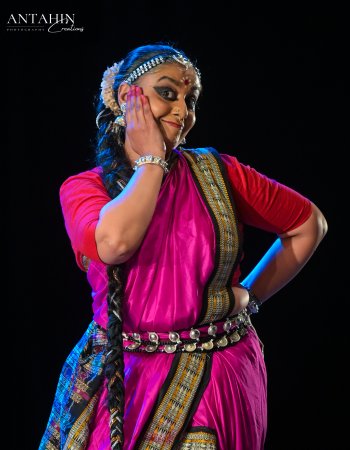 Ayona Bhaduri Satyabhama - one of the ashtabharyas of Krishna and the epitome of dignity, courage, and faith, besides being a warrior princess and an avatar of the Earth Goddess, Bhudevi - far from being a docile mythological queen, a person of grit and feminine pride, in short, a force to be reckoned with - learns that Patrani Rukmini has been given Parijata (Seuli or sefali) flowers by Krishna. Her jealousy brings out her true colours. Outraged, she confronts Krishna. Challenged as a soloist, Ayona Bhaduri in the role of Satyabhama met every demand with her commanding stage presence, engaging the audience throughout convincingly as she handled the challenges of the strong personality of the character she portrayed. Her long braid, resembling that of a Kuchipudi dancer, was captivating and powerful in her confrontation with the one she loves. Satyabhama's jealousy is a different mettle altogether. Beneath the shouting and the drama lies a profound truth about her character: her single minded devotion to Krishna. Leela-Kalaha displayed the rage of Satyabhama for whom Krishna was forced to battle with Indra and bring the Parijat tree from Swarga to Marta for her. 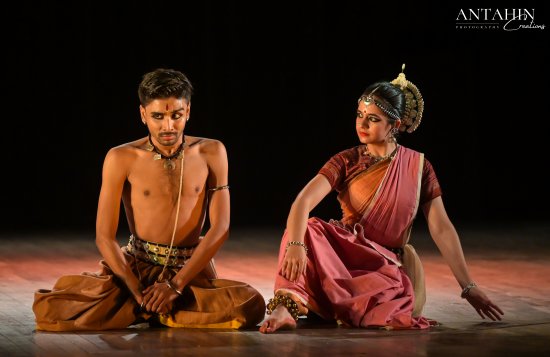 Krishna and Radha In the piece A Divine Deception, Radha pens a letter to her friend, confiding in her about the embarrassment she faced at the hands of her eternal lover, Krishna. She wrote, "Krishna arrived at my chambers in secret, disguised as a female beautician. I sat before 'her,' making no effort to cover myself as he went about his work. He performed every task. I was uncomfortable. He completed his task by stealthily tracing his own name upon the soles of my feet. Oh, my dear friend, what an utterly embarrassing situation!" This incredible story in words was translated into Odissi dance most tellingly. The dance showcased wily Krishna coming to mortal Radha to give her a beauty treatment in the guise of a woman. However, Radha was uncomfortable with the beautician, not knowing the real reason. But when she did come to know, there was a kind of cat-and-mouse game with a happy ending. The abhinaya produced rasa, enjoyed thoroughly by the rasikas. The short and sweet recital by the troupe ended with Murchhana Vadya. Mrudanga is everywhere in Odisha. It's this incredible clay drum that's basically the heartbeat of the countryside, heard in tiny village rituals as well as in massive, high-energy performances. The sheer variety and richness of what one can do with the mrudanga had totally mesmerized the choreographer. Sharmila's heart's desire was to use its raw energy and complex rhythms, basking in its beauty and the culmination of rhythm into dance. 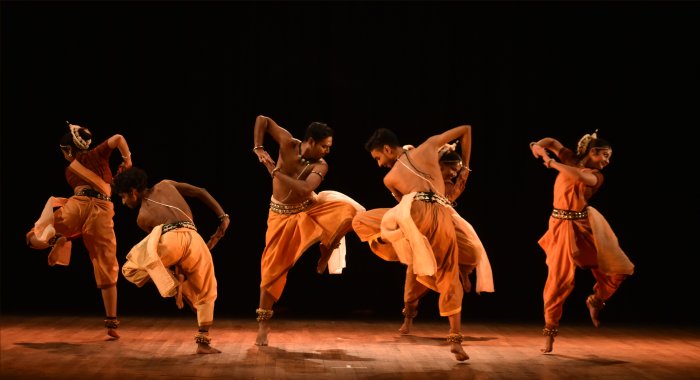 Murchhana Vadya Murchhana Vadya negotiated structured modulation, where the starting point is changed, effectively creating new musical designs and displaying the pure joy of rhythm experienced by the whole village community - or the audience in a hall. The stress of the day is washed away with the play of rhythms. The performance of the piece was truly relaxing. The dancers - Koushik Das, Biswajit Mondal, Raaginni Hindocha, Dipjoy Sarkar, Priya Manna, and Sayantani Roy - danced with such energy and vigour that they made the evening for the onlookers. There was much perfection in their rendition. Speedy and slow movements were dealt with powerfully. There were moments of pause that were most coherent. The lights by Saheb Sanyal were very creative in highlighting and subduing where needed. Costumes were not the typical stitched ones usually worn by Odissi dancers. In fact, mellow coloured long lengths of cloth served as the costumes. In the grand finale of the last piece, the dancers brought plates of gulal and created an aesthetic ambience by scattering them, causing a cloud of colours on the stage and ending the evening on a joyous note.  Tapati Chowdhurie trained under Guru Gopinath in Madras and was briefly with International Centre for Kathakali in New Delhi. Presently, she is a freelance writer on the performing arts. She is the author of 'Guru Gopinath: The Making of a Legend.' |
