|     |
|
| |

 'Dance-theatre by Thanjavur Maratha Rajas' by Indumati Raman - A book launch- Chandra Anande-mail: chandra6267@yahoo.co.in April 9, 2026 Books are tools that are store houses of information. They document the pulse and thoughts of a specific era and reveal lifestyles of people of its times, inclusive of their passion, culture and rich traditions they followed. 'Dance theatre by Thanjavur Maratha Rajas: Design and Rhetoric of Marathi Yakshaganams' by Indumati Raman, throws light on the golden period of the Thanjavur Maratha Rajas bringing together their overall contribution to history, literature, dance, theatre, music and traditional art forms; along with two Yakshaganams - dance drama pieces 'Mrtyunjaya Chiranjivi' written by Shahaji II and 'Sakuntalnatak' by Bavasaheb Ekoji II, with emphasis on their literary design and rhetoric. The launching ceremony of the book was held on 27th January 2026, at the P. L. Deshpande Mini Auditorium, Mumbai, in the august presence of Shanta Gokhale, Pt. Vidyadhar Vyas and Vittal C. Nadkarni and many other dignitaries. 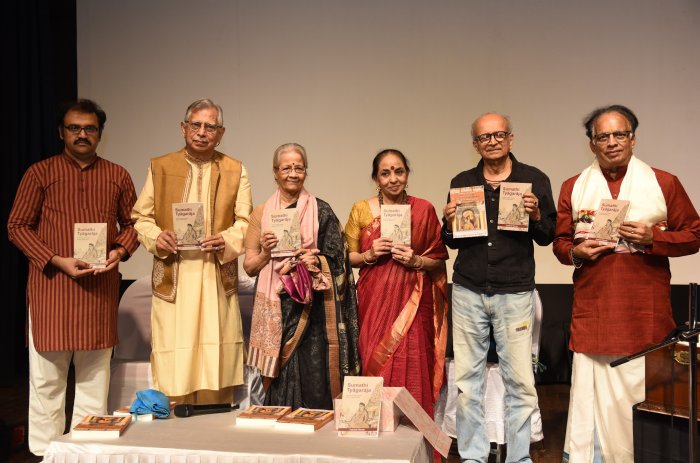 L to R: Subramanian Chidambaran, Pandit Vidyadhar Vyas, Shanta Gokhale, Indumati Raman, Vittal Nadkarni, Bombay P.S. Krishnamurthy Photo: Sunil Nandgaonkar Thanjavur Marathas came from Thanjavur, and their mother-tongue was Marathi. Their education was in Tamil, Telugu, Sanskrit and Hindi. They were musicians, poets, scholars well read in Natya Sastra, Mantra Sastra and Alankara Sastra. They renovated temples, built temples and celebrated religious festivals. They honoured saints and scholars. In fact, their contribution to dance, music, theater, literature, poetry and fine arts for two centuries long can be considered as the golden era of fine artistic knowledge. Such a wonderful lineage has been brought to light by author in her book. Marathi Yakshaganam is the classical art, which from being street drama (veethi natakam), peaked during the Nayak reign and got shifted to the court halls, and made its way to the temple. Marathi Yakshaganams are designed to be performed as worship inside a temple. It was performed to function as an instrument to create bhakti in devotees at temple festive gatherings, by telling the stories from Ramayana, Mahabharata and Puranas. The stories also informed about the ways of right living and processes of praying to deities to achieve salvation. In this milieu, there was direct engagement between performers and the audience, resulting in the audience 'become' witnesses to the spiritual journey of epic heroes. Thus, Bhagavata Mela captured the epics which featured a revolution through every story and showcased the perennial values, social thoughts, beliefs and religious activities held and done through the protagonists, in the created world of Yakshaganam. Thus, Yakshaganams act as a mirror of the traditions that flowed down through ages, continuing to project its relevance to contemporary times. Yakshaganam tradition, in regional forms, is prevalent in South India, in languages Sanskrit, Marathi, Telugu, and Tamil. This traditional art is well described with its history and aesthetics in the book. While 'Yakshagana', without 'm', is the theatre tradition of Karnataka's exotic theater tradition, and in Andhra it is called Kuchipudi, Yakshaganams mentioned by Indumati Raman in this book is the name of a dance-drama format that originated in the 15th century during the Vijayanagar reign and later developed by the Thanjavur Maratha Rajas in 17th and 18th century. Their format is multilingual, musical and dance-theater oriented with classical Carnatic music. In the book, 'Dance theatre by Thanjavur Maratha Rajas: Design and Rhetoric of Marathi Yakshaganams', Indumati Raman focuses on the Marathi theatrical dance texts that emerged in the 17th and 18th century cultural milieu, and throws light on artistic harvest of the Maratha rulers of Thanjavur who wrote their dramas in Marathi language using Telugu script. The dramas chosen, shed light on two different styles of writing. They are also from two different periods, wherein the first one 'Mrtyunjaya Chiranjivi' is the initial Yakshaganam by Shahaji Raje Bhonsale I who is considered the father of Marathi Theatre and the second is 'Sakuntalnatak' by Bavasaheb Ekoji Bhonsale II. Indumati has translated the Yakshaganam originally written in Sanskrit or Marathi to English language as a global outreach. The two Marathi or Sanskrit Yakshaganams are translated into English, with transliteration, annotation, and Devanagari script. The reader is introduced to the history of Thanjavur Maratha Rajas, the development of Marathi language from its poetic nature to prosaic literature and how Marathi was the official language of Karnataka for some time. The book launch ceremony was preceded by presentation of a short film 'Kuchipudi' that documented a visit by the author to Kuchipudi village as part of the field work for the Tagore fellowship. The documentary on the Kuchipudi village featured the senior most Kuchipudi Guru Vedantam Radheshyam performing a padam and a tillana, and practice sessions of a Kuchipudi Yakshaganam. His younger brother Vedantam Dr. Ramalingam, then Principal of the University, spoke of humongus efforts put to popularize the tradition. Dr. Nagaraj Paturi, who has written the foreword for this book, shared interesting information about the non-existing fourth wall in Indian theatre. An interesting informative conversation on musical aspects of the Marathi Yakshaganams with music composers Krishna Subramanian and Subramanian Chidambaran followed, where both efficiently shared their experiences of how they created the music for the two Marathi Yakshaganams embodied in the book, 'Sakuntalnatak' by Krishna Subramaniam and 'Mrtyunjaya Chiranjivi' by S. Chidambaran. 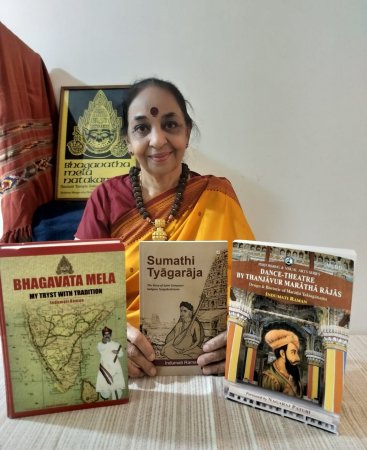 Indumati Raman - author of three books Photo: Bhuvnesh Shetty Another book written by Indumati Raman, 'Sumathi Tyagaraja', was launched at the same event. The subject of this book brings to life the inspiring journey of Saint Tyagaraja, one of India's greatest composers of Carnatic music and his philosophy. Set against the socio-political scenario of a village in Thanjavur, the story features historical figures who influenced his music and philosophy exemplified in the lyrics. The story begins before Tyagaraja's birth and traces his childhood. The stirrings of his first composition and many other emotional events that occurred in his life are narrated very expressively with descriptive nuanced body language. This book is a quick read in the form of historical fiction. Indumati Raman, an alumna of Rukmini Devi's Kalakshetra, Chennai, is a Bharatanatyam exponent, mentor, choreographer, and writer on classical arts. From 1992 to 2002, she was the Chairperson, sponsor and patron of Melattur Bhagavata Mela Natya Vidya Sangam. Most Bharatanatyam dancers and Carnatic musicians are aware of Marathi abhangs and bhajans made famous by Haridoss Giri Guruji, and Acharya Parvati Kumar - guru of Sandhya Purecha - who was the first to compose and choreograph compositions of Thanjavur Maratha Rajas like Serfoji Raje and Sahaji Raje. But the limelight had yet to shine on Marathi Yakshaganams. Indumati's tryst with Bhagavata Mela happened when she joined Kalakshetra as a student. Within six months of joining the college, Indumati was part of a Bhagavata Mela Natakam taught by Guru Balu Bhagavatar. Thus, this experience of being part of Bhagavata Mela Natakam helped her when she witnessed a natakam presentation at NCPA. As an arts writer, covering events for Times of India etc., she interviewed natakam's artistes backstage and understood their problems and frustrations. A few months later, she was invited by the Sangham for the 'Narasimha Swami Jayanti' festival celebration in Melattur. She witnessed an outstanding 'Prahlada Charitram' performance that filled the air with devotional fervor. In the formal function, she was asked by Guru Herambanathan to officiate as Chairperson of the Sangham and guide the group of twenty pandits and actors. Here began her ten year journey with the male Brahmin bastion of traditional temple dance-theatre. She felt that this shining diamond of a ritual tradition that had never gone out of this village, had to be brought out and exposed to the world. Thus, her vision for revival of the art form was to bring them forth on to the cultural scene, with performances outside the temple at various prosceniums in cities. And make extensive write-ups about this art's performance traditions, in order to secure this knowledge for future generations. In progression of the idea, the first three day Bhagavata Mela festival organized by her in Mumbai in January 1995 were houseful shows. The Mela artists were given a grand traditional welcome and reception by a few knowledgeable gurus of Mumbai, like Guru T.K. Mahalingam, then Principal of Sri Rajarajeswari Bharatanatya Kala Mandir and Guru Mani, artistic director of Kalasadan. Then followed performances at dance festivals, temples, lecture demonstrations at Natyakala Conference and finally it was time for the exposition of Marathi dance-drama 'Sakuntalnatak' in Mumbai. The experiment of collaboration of Bhagavatas and modern Marathi theater actors, to put up presentation of 'Sakuntalnatak Yakshaganam' and its performance was greatly acclaimed by the Marathi theater fraternity. In fact, the Maharashtra Rajya Sahitya Sanskriti Mandal honoured two Pandits, Bhimrao Goswami and N. Vishwanathan at a public function to express gratitude for their decades long hard work to resuscitate and continue the art of Yakshaganam. Vishwanathan mastered Marathi, learnt the Devanagari script and devoted a major part of his career to trans-create Telugu manuscripts in Devanagari, and conserved Thanjavur's rich linguistic heritage. This helped make these fine works of literature accessible to Marathi scholars. This book, 'Dance theatre by Thanjavur Maratha Rajas: Design and Rhetoric of Marathi Yakshaganams' by Indumati Raman is dedicated to Pandit N. Viswanathan's memory. Subsequently, the author, for write-ups on the tradition, brought out in her first book 'Bhagavata Mela: my tryst with tradition,' the history of Thanjavur and the Telugu natakams of Melattur Venkatarama Sastri, classical features of the Bhagavata Mela tradition and did documentation of the first ever collaborative production between Bhagavatas and Marathi actors of the Marathi Yakshaganam 'Sakuntalnatak' by Bavasaheb Ekoji II. 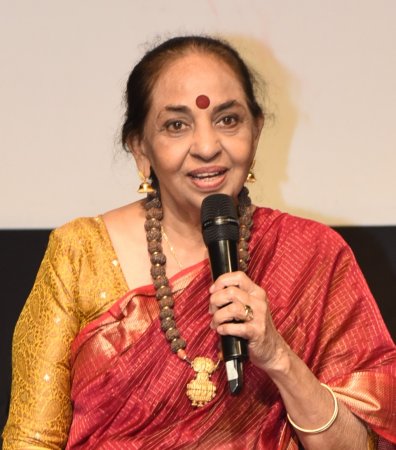 Indumati Raman wearing the 300-year-old Rudraksha mala Photo: Sunil Nandgaonkar Maybe time waited, as Indumati Raman was ordained to throw light on the Thanjavur Maharajas, for she, though born and brought up in Mumbai, Maharashtra, has her ancestral roots in Thanjavur. Her roots in Thanjavur goes back to her ancestral lineage of Appaya Dikshitar, a revered saint. Her maternal grandfather F.G. Natesa Iyer was a well-known thespian and patron of musicians and actors in Trichirapalli. His grandfather was Tyagaraja Sastri who was a contemporary of Sadguru Tyagaraja. In fact, she had worn that day, a 300-year-old rudraksha mala, inherited as a family heirloom that belonged to him. Indumati used the National Tagore Fellowship awarded to her in 2018-19 to work on the subject of 'Dance theater of Thanjavur Maratha Rajas'. This book is the first ever comprehensive analysis on Marathi Yakshaganams. Her Guru Rukmini Devi had been fascinated by the Bhagavata Mela drama format and adapted it for the famous Kalakshetra dance dramas. Through this book, Indumati has taken forward successfully the baton handed over by her guru to support Bhagavata Mela tradition. 'Natya Sastra' prescribes that "Natya is made of three elements viz. Poetry, music and dance". Just like all elements in a dish come together to provide one delicious taste, classical art presentation is best appealing when there is judicious amalgamation of "geeta, vadya and nritta". Incidentally, Bhagavata Mela traditional performances very much sustain the above formula or prescription. Another important fact about this is that these dance traditions are classical versions of dance theatre traditions and designed to perform in the temples. Thus perhaps, when the country got its independence, the art of Bharatanatyam and other classical dances were given precedence for it had already been salvaged from the stigma and ban on devadasis dancing at the temples and found its way towards the proscenium arena or stage of national culture of secular nature. Although Yakshaganam's format and techniques were essentially what the great text on the science of dramaturgy, 'Natya Sastra' by Bharatha Muni prescribed, the Bhagavata Mela performed only by men, still in use as a temple ritual encompassing a religious outlook, was put behind in the back burner. Perhaps, now, dance festival curators would now give a look at this tradition and open up opportunities to bring this format to lead our cultural ethos. It is only in the proscenium arena that can help stabilize and support these artistes and safeguard this beautiful art form of the Thanjavur Marathas. It is time for the rich literature of Marathi Yakshaganam form hidden for centuries to be offered to global theater connoisseurs. 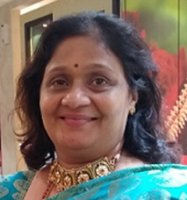 Chandra Anand is a Bharatanatyam artiste and teacher. She has an MA in Bharatanatyam from Tilak Maharashtra Vidyapeeth, and her series on 'Education in spiritual values through Bharatanatyam' is featured in narthaki.com. |
