
|     |
|
| |

 Sphurana cultural festival- Satish Surie-mail: satishism@yahoo.co.in Photos: Sudhi April 5, 2026 The Exposition - Arjun Bharadwaj on Classical Literature and Creative Freedom The Manyati Foundation launched its first cultural festival, 'Sphurana', at the Seva Sadan, Bengaluru, on the 8th of February 2026. Curated by Amrutha Naresh Rao, the inaugural edition opened with an illuminating scholarly exposition by Arjun Bharadwaj on classical literature as the living foundation of all artistic practice. 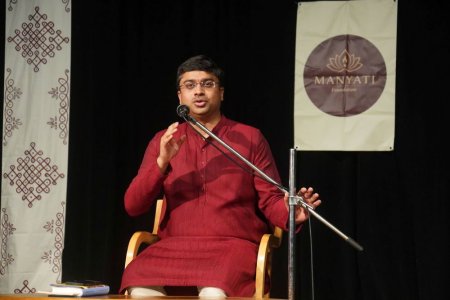 Arjun Bharadwaj Bharadwaj's central argument was unambiguous: every art form, dance, music, theatre, sculpture, draws its deepest nourishment from the classical texts. The Ramayana and the Mahabharata, he declared, are not merely great stories but staircases to spirituality, ascending structures that carry the reader toward a higher understanding of dharma, character, and the human condition. His practical counsel to artistes was direct: read these works from cover to cover, in a reliable translation in your own language, for there is no shortcut that can substitute for the full experience of these texts. He spoke of Valmiki as the Adi Kavi, the first to give literature its poetic heartbeat, and of Vyasa, whose very name means the diameter of a circle, as the great organiser who compiled the four Vedas and composed the Mahabharata, recontextualising ancient wisdom for the common person without diminishing its depth. Revered as the greatest Guru of the tradition, Vyasa is the axis through which the entirety of sacred knowledge becomes accessible. A thread that ran through the entire session was Bharadwaj's insistence on reading for the implied meaning rather than the literal surface. The legend of Valmiki emerging from an anthill, he explained, is a symbol not biography - an image of one so absorbed in inner stillness that the world formed around him. This interpretive principle, he urged, must be kept in mind when approaching the epics or any ancient purana. He brought this principle to life through vivid characterisation. He drew attention to Rama's extraordinary equanimity in the face of adversity, exile, loss, and betrayal, which do not break his composure; they reveal it, marking him as a truly sattvic character. He turned then to Ravana, a figure of formidable gifts whose downfall is all the more instructive for that, and to Poothana, the demoness who approached the infant Krishna in the guise of a nurturing mother, the demonic perfectly concealed within the beautiful. To give artistes a philosophical framework for understanding such characterisation, Bharadwaj recommended the 16th chapter of the Bhagavad Gita, which systematically maps the qualities of the sattvic and the demonic, and which he described as an indispensable guide for any serious performer. Sharanya B. Ravi: The story of Poothana If Bharadwaj's talk planted the seeds, it was left to the stage to bring them into bloom. Sharanya B. Ravi, disciple of Divya Nayar, presented a solo Bharatanatyam performance built around the story of Poothana, the very figure the scholar had used to illuminate the nature of the demonic just moments before. The choice could not have been more perfectly aligned. 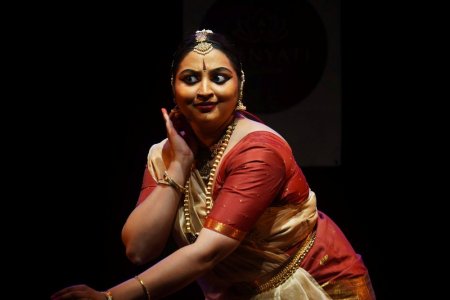 Sharanya B Ravi The performance opened not at the beginning of the story but at its end: Pootana in the final moments of her life. By presenting the conclusion first, Sharanya ensured that everything which followed - the disguise, the entry into Nanda's home, the fatal nursing - carried the full weight of inevitability. The audience watched the flashback knowing where it would lead, and that knowledge transformed every gesture into something charged with dramatic irony. Sent by the demon king Kamsa to seek out and destroy newborns, Poothana was a figure well-practised in destruction. Learning from a child in Nanda's household, she transformed herself into a woman of radiant beauty and entered the home with the appearance of maternal tenderness. Yet Krishna, the supreme Lord, was not deceived. Playing along with full knowledge of her intent, he suckled at her breast and drew out not only the poison but her very life force. Poothana fell lifeless, the body that had carried so much destruction coming to rest in the home of Nanda. What elevated the performance was the richness of Sharanya's abhinaya. Her expressions moved fluidly between registers, the cold calculation of the demoness, the studied warmth of the disguise, and the dawning realisation as the infant's grip tightened beyond what any child should be capable of. To hold both the beautiful and the monstrous within a single form, and to let each illuminate the other, is the mark of a performer who has understood her text deeply. In this, Sharanya demonstrated precisely what Bharadwaj had described: the classical literature, fully absorbed, frees the artiste rather than constrains her. Sakshi Mohan: A complete Bharatanatyam recital The evening reached its fullest expression with a complete Bharatanatyam recital by Sakshi Mohan, a graduate of the celebrated Kalakshetra Foundation, now under the guidance of Bragha Bessel and Vidya Girish. Where Sharanya had offered a tightly focused thematic narrative, Sakshi presented the full architecture of a classical recital, moving from the invocatory to the devotional, from philosophy to romantic wit, and finally to the pure joy of rhythmic dance. 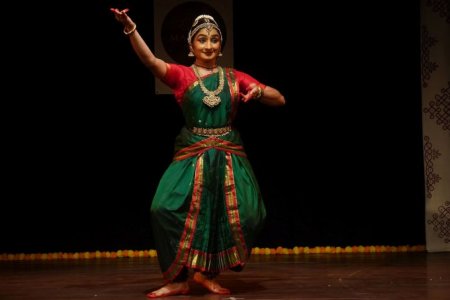 Sakshi Mohan She opened with a Mallari, the traditional instrumental invocation with which a Bharatanatyam recital begins, preparing the space and the audience for what is to follow. This gave way to a Thevaram in praise of Lord Shiva, rendered in raga Gambhiranattai - the deep, resonant quality of the raga perfectly suited to an offering of devotion. The philosophical heart of the recital was the Ardhanarishvara Stotram, the celebrated composition of Adi Shankaracharya, set to music by Madhusudhan in Ragamalika. The Ardhanarishvara, the form of Shiva that is half woman and half man, is the supreme symbol of the eternal union of Purusha and Prakriti, consciousness and nature, the still and the dynamic, the masculine and the feminine principles of existence. In movement, this manifested as the interplay of tandava and lasya, the vigorous and the lyrical finding their perfect balance within a single body on stage. Shankaracharya's verses, dense with philosophical significance, provided Sakshi the opportunity to demonstrate both the intellectual depth of her training and the suppleness of her expressive range. The mood shifted completely with the javali "Kopamelanu raka untunara", a composition of the celebrated Tanjore Quartet. Here, the Nayika holds the stage with righteous indignation: she has learned of her lord's flirtations with another woman, and she demands to know why she should not be angry. When she sends a message of reproach through her friend, his response, that her anger will upset the other woman, compounds the offence with breathtaking audacity. The javali is a masterpiece of dramatic wit, and Sakshi rendered the Nayika's wounded pride, dry fury, and sharp intelligence with evident relish, drawing the full comedy and pathos from every line. She brought the recital to a close with a Thillana in raga Behag, a composition of Ponniah Pillai of the Tanjore Quartet. The Thillana, with its cascading rhythmic patterns and exuberant footwork, is the dancer's celebration of pure movement, and it concluded here with an ode to Brihadamba, the presiding goddess of the Brihadeeshwara temple at Thanjavur. It was a fitting final gesture: the entire recital, from Mallari to Thillana, had drawn from the Thanjavur tradition, and to close with an invocation to the goddess of that great temple was to acknowledge the source from which the tradition flows. Sphurana, a word that suggests a sudden blossoming, a flash of illumination, chose its name well. In its inaugural edition, scholarship and performance worked in rare and seamless concert. Bharadwaj drew the philosophical map; Sharanya walked its darker terrain with precision and feeling; Sakshi traversed its full classical landscape with the confidence of a trained and thoughtful artiste. The Manyati Foundation, through Amrutha Naresh Rao's thoughtful curation, has announced itself as a space where art and thought are not separate pursuits but a single, indivisible act, and where the ancient and the living are shown, again and again, to be the same thing.  Bangalore based Satish Suri is an avid dance rasika besides being a life member of the Music and Arts Society. |
