|     |
|
| |

 Revisiting a forgotten temple dance tradition:Vichitra Chitra Nartana and the Saalagasuuda Prabhanda of Hoysala Karnataka- Dr. Veena Murthy Vijaye-mail: veenamurthyvijay@gmail.com March 19, 2026 Abstract This article reflects on the presentation "Vichitra Chitra Nartana - A Revisit into Saalagasuuda Prabhanda," a research-based reconstruction conceptualized by dance historian Dr. Karuna Vijayendra. The work draws upon inscriptional references from Belur, textual evidence from Śārṅgadeva's Sangeeta Ratnakara, temple sculptures of the Hoysala period, and interdisciplinary studies of music and dance traditions. Through these sources, the production attempts to re-envision a medieval temple dance practice of Karnataka. The choreography integrates Desi and Marga Karanas, Charis, and Angika Abhinaya, supported by a carefully researched musical framework. The presentation demonstrates how rigorous scholarship and artistic interpretation can revive historical performance traditions while engaging contemporary audiences. Vichitra Chitra Nartana - A revisit into Saalagasuuda Prabhanda I was most privileged last week to have the honor of serving as the Expert Chairperson for a remarkable presentation titled "Vichitra Chitra Nartana - A Revisit into Saalagasuuda Prabhanda," a research-driven reconstruction conceptualized by the distinguished dance historian Dr. Karuna Vijayendra. On that occasion, I reflected upon the profound origins of Indian classical dance traditions, which were conceived, nurtured, and elevated within the sacred precincts of Hindu temples. Indian dance, in its truest sense, is not merely an art form in isolation but represents a synthesis of multiple arts expressed through the human body. Within the language of dance, the painter perceives the harmony of line and colour, the sculptor recognizes the living grace of form, the actor encounters the dramatic expression of life, and the musician and poet alike experience the unfolding of poetry in motion. It was therefore particularly meaningful to witness a reconstruction that reconnects us with the temple traditions where Indian dance once flourished as a sacred offering. Against this broader cultural and aesthetic context, the presentation assumes considerable significance. The work represents a thoughtful and deeply researched attempt to revisit a lesser-known temple dance tradition that flourished in 12th-13th century Karnataka during the Hoysala period. Drawing upon inscriptional references, classical treatises, temple sculptures, literary sources, and musical traditions, Dr. Karuna Vijayendra has sought to reconstruct the contours of an ancient performance practice associated with Saalagasuuda Prabhanda, thereby illuminating an important yet largely forgotten chapter of Karnataka's dance heritage. The origins of this enquiry lie in a 12th-century inscription from Belur in Hassan district, which refers to Pattamahadevi Shantaladevi, the illustrious queen of the Hoysala dynasty and an accomplished dancer. The inscription describes her as a practitioner of "Vichitra Nartana," a distinctive and extraordinary dance form. This reference, first encountered by Dr. Karuna Vijayendra during her doctoral research in the late 1990s, remained an intriguing subject of enquiry for many years. A crucial breakthrough emerged during a national festival dedicated to Śārṅgadeva at Mahagami Gurukul in Aurangabad, curated by Guru Parwati Dutta. While preparing for a lecture demonstration on Gaundali Vidhi from the seminal treatise Sangeeta Ratnakara, Dr. Karuna Vijayendra encountered a revealing explanation describing the classification of Gaundali traditions into Shuddha (Marga) Gaundali and Vichitra (Desi) Gaundali. The text also refers to Chitra Nartana, in which the dancer performs while holding a small percussion instrument known as the Trivali. This discovery established a significant link between inscriptional evidence and textual references, opening a pathway for reconstructing the performance tradition referred to as Saalagasuuda Prabhanda Nartana. Subsequently, Dr. Karuna Vijayendra undertook an extensive interdisciplinary study examining sources ranging from dance history and musicological treatises to temple traditions, Hoysala sculptural representations, Haridasa Sahitya, classical dance practices, and living theatrical traditions. Through this layered investigation, the contours of a forgotten temple dance tradition gradually began to emerge. 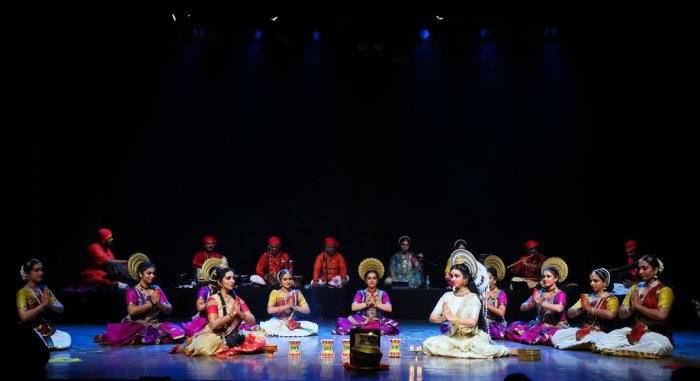 Geetalankara by Geeta Gaundali - Finale of Saalagasuuda Prabhanda The presentation Vichitra Chitra Nartana is therefore conceived as a conceptual reconstruction of this historic temple performance tradition from the Hoysala period. The structure of the presentation reflects the classical triadic framework of Indian performing arts: Geeta Prabhanda, the vocal composition; Vadya Prabhanda, the instrumental ensemble; and Nritya Prabhanda, the expressive dance component. Within this framework, the choreography incorporates Geeta Gaundali, Muka Gaundali, Vichitra Nartana, and Chitra Nartana, creating a layered and conceptually rich performance design. 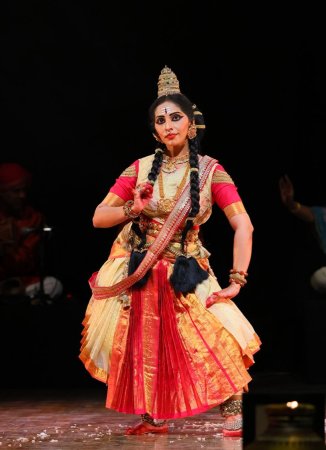 Kavitva by Muka Gaundali, evoking Gayatri and salutation to 3 different devis A particularly notable feature of the production was its careful adherence to textual technique and sculptural authenticity. The dancers' movements were further inspired by Marga Karanas researched by Dr. Padma Subrahmanyam and interpreted through the iconic dance sculptures of the Hoysala temples, allowing the stillness of stone to be translated into vibrant kinetic expression. The choreography revealed the extensive research undertaken by Dr. Karuna Vijayendra and her Guru Sundari Santanam (senior disciple of Dr. Padma Subrahmanyam), incorporating both Desi and Marga Karanas intricately embedded with Charis and other Angika Abhinaya elements. This integrated movement vocabulary reflects what appears to be a distinctive stylistic tradition associated with Karnataka, mentioned in Śārṅgadeva's celebrated treatise Sangeeta Ratnakara. 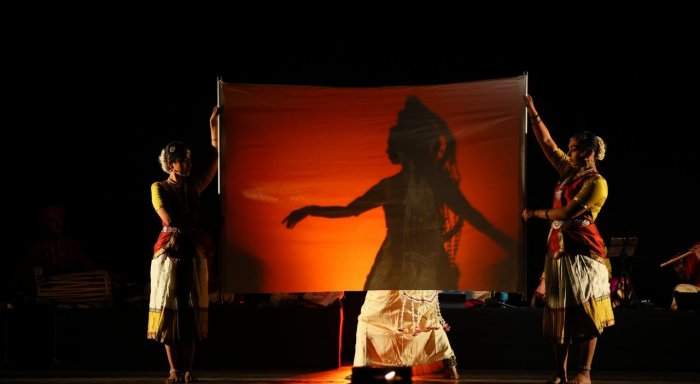 Vichitra Gaundali entry 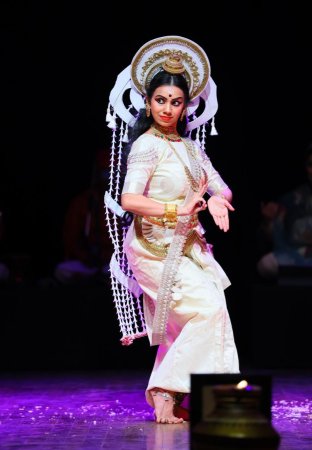 Roopakalapti by Vichitra Gaundali - Nritya Vidhi The scintillating performances of Samudhyatha Bhat and Samanvitha Bhat were particularly noteworthy. Their command over the demanding movement vocabulary, coupled with rhythmic clarity employing 35-40 sthanakas,60-70-Marga & Desi Charis, 30 Nritta Hastas and a remarkable range 216 Karanas with an expressive maturity, brought vitality to the presentations of Muka Gaundali and Vichitra Gaundali. This comprehensive integration of movement elements contributed to an authentic, richly textured kinetic language, reinforcing the credibility of the construction. 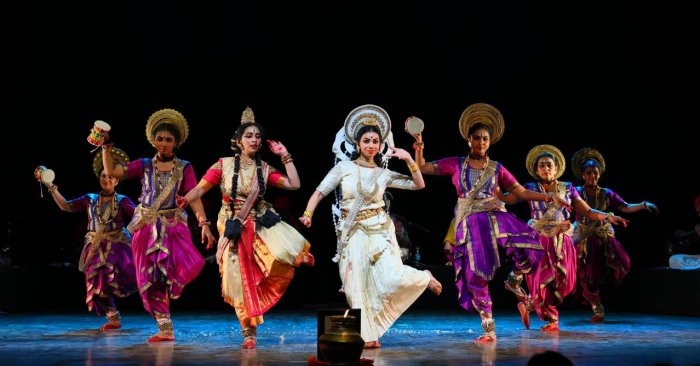 Kalasa by Muka Gaundali, Vadya & Nritya Prabhanda in Utthavana by Vichitra-Chitra Gaundali The ensemble choreography in Vichitra-Chitra Nartana explored the visual and rhythmic possibilities inherent in group movement, creating an engaging stage picture through well-designed spatial patterns, period designed (from Karnataka sculptures) special costumes with ornamentation and rhythmic intricacies. Equally significant was the musical architecture of the production. The ensemble was designed with five Avanaddha Vadyas (percussion instruments) along with string, wind, and metallic instruments, supported by vocalists. The music for Vichitra-Chitra Nartana was researched and composed by Dr. Ramya C. R., whose work brought both scholarly insight and aesthetic sensitivity to the production. She was supported by the music ensemble comprising vocalists Gargi Panchangam and other renowned musicians, whose accompaniment provided a vibrant sonic foundation for the dancers. 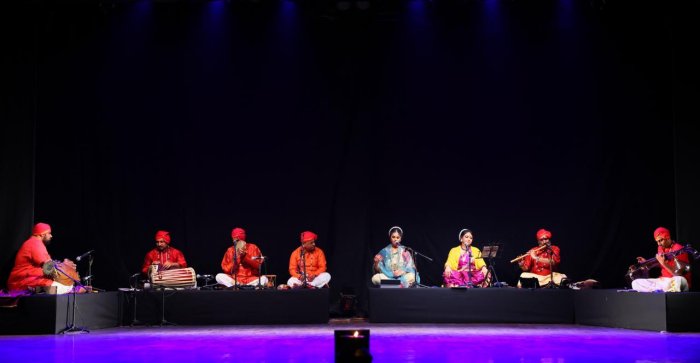 Melaapaka by the music ensemble The placement of the musicians was thoughtfully conceived and aligned with principles described in the Naṭyashastra and Sangeetha Ratnakara. Positioned at the rear of the stage, the musicians created a layered visual and acoustic space, allowing the dancers to perform in the foreground while maintaining a symbolic and structural connection to the music. The vocalists were placed on one side, while the string and percussion instrumentalists were arranged across the stage, reflecting traditional performance conventions. The visual presentation of the musicians further enhanced the theatrical experience. Their coordinated attire - featuring striking red turbans paired with dhoti-style costumes - contributed to the aesthetic coherence of the stage. This was complemented by well-designed lighting, which effectively highlighted the dramatic contours of the performance and evoked an ambience reminiscent of a sacred temple environment, thereby deepening the immersive quality of the production. The event on March 7, 2026 at ADA Ranga Mandira, Bengaluru, was well curated by the dancer Krishna Preetha Ravikumar on the auspicious occasion of Geetha Sundari Namana from her organization Guru Krupa Natyashala. Conclusion From an aesthetic as well as scholarly perspective, the presentation stands as a significant example of how rigorous research can meaningfully inform contemporary performance practice. By bringing together inscriptional evidence, textual references, sculptural study, musical research, and creative choreography, Dr. Karuna Vijayendra has opened an important window into a largely forgotten dimension of Karnataka's temple dance heritage. Such efforts remind us that the classical arts of India are not static traditions but living cultural streams that continue to evolve through scholarship, imagination, and artistic dedication. The presentation of "Vichitra Chitra Nartana - A Revisit into Saalagasuuda Prabhanda" therefore emerges not merely as a performance but as a valuable contribution to the ongoing dialogue between history, research, and artistic expression in Indian classical dance. The core team Dr. Karuna Vijayendra: Dance Historian, Original Research, Conceptual reconstruction, Musical Research, Costume and Hair style research and design Dr. Ramya C R: Musical Research and Composition Dr. Deeksha Shastry & Namitha B Rao: Dance choreography support Aswini Viswanath: Research assistance The performance was brought to life by a committed ensemble of dancers. Samudhyatha Bhat - Muka Gaundali, Samanvitha Bhat - Vichitra Gaundali Nartana Ensemble featured Ranjana Nagaraja, Bhuvana G. Prasad, Arabhi Ithumane, Chandana M.R, Rajalakshmi Kangod Purvaranga Vidhi featured Krishna Preetha Ravikumar, Padmashree Prasad, Prakruthi P.C. Co-dancers were Musunuru Vennela, Dhruti K. The music ensemble featured Dr. Ramya C R - Karnataka Sangita Shaili, Geeta Gaundali, Gargi Panchangam - Hindustani Shaili, Gurumurthy Vaidya - pakhawaj and maddale, Karthik Vydhatri - karata, hudukka and mridanga, D.V. Prasanna Kumar - morching, khanjira and hudukka, Mahesh Swamy - flute, Arjun Achari - veena, Krishnamurthy Thunga - chakra taala.  Dr. Veena Murthy Vijay is a Bharatanatyam and Kuchipudi exponent, dance mentor, choreographer and scholar, Arts Promoter, Director of Sri Raja Rajeshwari Kalaniketan, Samanavay Dance Company and AIM Bengaluru International Arts Festival, Bengaluru. |
