
|     |
|
| |

 When a Seed speaks: Celebrating Jyotisangh through the vision of Beeja: Earth Seed- Bijoy Shivrame-mail: bijoyshivram@gmail.com March 14, 2026 For more than nine decades, Jyotisangh has quietly nurtured dignity, resilience and possibility in the lives of women. Founded in 1934 under the visionary leadership of Mrudulaben Sarabhai, the institution emerged at a time when women were only beginning to find a public voice. Over the years, it gradually evolved into a platform that enabled women to build self-reliant and meaningful lives, responding sensitively to the changing needs of society. In its early years, Jyotisangh focused on literacy and vocational training, helping women earn with dignity from within their homes. Food production units supported women in financial distress, while crèche facilities enabled working mothers to pursue livelihoods with reassurance. One of its most enduring initiatives, Rahat Vidhan, continues to address domestic distress through counselling, dialogue and mediation - a compassionate intervention that has touched countless families. As society changed, Jyotisangh expanded its programmes to include professional training in nursing, computer education, English communication and fashion design, along with employment opportunities in sectors such as banking, retail and humanitarian services like the Red Cross. In the wake of the 2012 Nirbhaya gang rape case, the organization also introduced gender-sensitization programmes for those working in the social sector, reflecting its continued engagement with contemporary realities. Another significant initiative, the Sangini Project, supports adolescent girls by creating awareness about health, self-care and personal growth. Over the decades, the institution has brought together women from diverse social backgrounds, fostering a shared journey toward empowerment. Its growth has been shaped by the dedication of many remarkable women, including Vijaya Lakshmi Pandit, Sarladevi Sarabhai, Charumatiben Yodha, Ansuyaben Parikh, Urmilaben Girdharlal, Uday Prabhaben Mehta, Padmaben Jaykrishna, Hemlataben Hegishte, Sarojben Jhaveri, Nirmalaben Patel, Meherben Madora and many others. Today, the legacy continues under the stewardship of Jayshree Lalbhai. 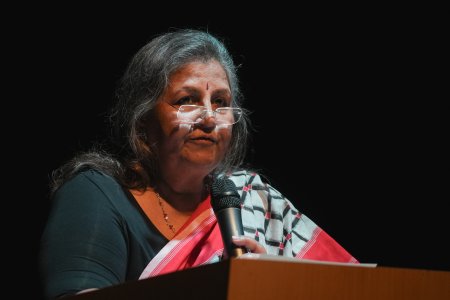 Jayshree Lalbhai (Photo courtesy: Jyotisangh) As Jyotisangh enters its ninety-first year, it remains a compassionate yet forward-looking institution, continuing to illuminate pathways of empowerment for generations of women. Beeja: A Seed, a Planet, a Warning Marking this significant moment in its journey, Jyotisangh, in collaboration with the Pannalalbhai Foundation, presented the deeply thought-provoking production Beeja: Earth Seed by the celebrated Bharatanatyam artiste Malavika Sarukkai. The work opened with the chanting of the Hiranyagarbha - the cosmic womb of creation described in the Rig Veda. Through a powerful surround-sound design, the stage seemed to expand into the vastness of the universe, where the Earth was imagined as a living seed within the cosmic order. Sweeping movements and extended arms evoking the four directions of space suggested the boundless potential contained within creation - fragile, yet immense. At the centre of this vast canvas stood Malavika Sarukkai commanding, luminous and deeply precise. Her anga shuddhi, the purity of classical movement, was striking. She traversed the stage with extraordinary energy, yet within that expansiveness lived moments of stillness and subtle abhinaya. Gradually, the stage settled into a contemplative stillness. The performance unfolded like a meditation suspended in darkness, inviting the audience to search for something almost invisible - a seed, small as a dot yet holding infinite possibility. This seed was revealed as Prithvi, the Earth itself, the home that sustains all life. 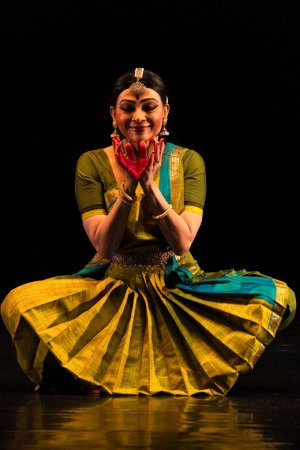 Malavika Sarukkai (Photo: Innee Singh) From this simple yet profound image, the performance gradually expanded into a philosophical reflection on the planet and the human condition. The changing seasons became metaphors for emotional cycles - the rains of Varsha suggesting longing, renewal and the impulse to nurture life. Through movement, sound and evocative narration, the work gently reminded the audience that nature and human experience are deeply intertwined. At the heart of the production was the voice of the seed - ancient, observant and enduring. It spoke of rivers carving their paths, mountains shifting across centuries and landscapes once abundant with life. Yet its tone soon deepened into concern. The seed had also witnessed the earth being plundered for its riches, smoke rising where animals once roamed freely, migrations disappearing and the air growing heavy and suffocating. "I am the seed that held its ground," the voice seemed to say - a witness to histories etched like rings in the bark of a tree, holding stories of kingdoms, ambition, conflict and humanity's struggle with nature. But the seed also sensed an unsettling change. The ground itself appeared to shift. Would its roots continue to find water? Would its branches still rise skyward in gratitude? Once, humans approached nature as companions. Now, the seed seemed to ask - why have we begun to walk away? One of the most moving sequences portrayed a young doe inhabiting a once pristine earth. Through delicate movement and nuanced expression, she brought to life a creature discovering the beauty of its world - innocent, curious, and joyful. But the serenity soon shattered. As the narrative turned toward humanity's intrusion into nature, the felling of trees became an unsettling motif. In a shocking moment, one of the falling trees crushed the young doe - a life that had only just begun. The abruptness of the scene startled the audience into silence, a stark reminder of the fragility of life in the face of human excess. Throughout the performance, the voice of the seed seemed to watch and remember - rivers carving paths, mountains shifting across centuries, lands once filled with migrating life. Yet it also witnessed the earth stripped of its riches, smoke rising where forests once stood, and the air growing heavy with human ambition. One of the most striking moments arrived when a form slowly emerged in the distance - something that could be an ancient banyan tree. The ambiguity lingered deliberately, placing the audience at the fragile crossroads at which humanity stands. Yet Beeja did not conclude in despair. It returned to the quiet promise of the seed, suggesting that the future still rests in human hands. If nurtured, life will continue to flourish; if ignored, that possibility may fade away. 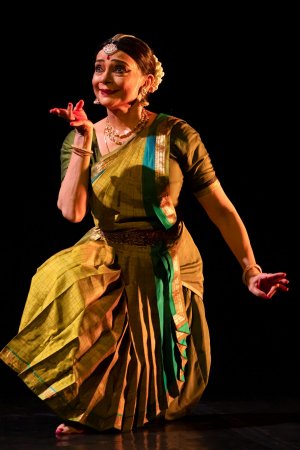 Malavika Sarukkai (Photo: Innee Singh) The soundscape of Beeja was particularly compelling in the way it wove together the immediacy of live music with the depth of recorded compositions. The live vocals of Kritika Arvind, rich with emotional nuance and the resonant presence of Nanda Balaji's mridangam brought an organic vitality to the performance. At several moments, their music seamlessly intertwined with the recorded tracks, creating a layered sonic experience that felt both intimate and expansive. This thoughtful interplay between live and recorded sound was a striking artistic choice, one that heightened the atmosphere of the work and deepened the emotional impact of the choreography, leaving the audience completely immersed in the world that Beeja unfolded. The performance was supported by a remarkable creative team: Sai Shravanam (music producer and sound designer), Niranjan Gokle (second director and lighting designer) and Sarvesh Shrestha (costume design), whose collaborative vision shaped the emotional landscape of the work. Reflecting on the journey that led to such a production, Malavika Sarukkai shared that decades of artistic and personal empowerment made it possible for her to create work that speaks directly to our times - about the earth, our lives and the direction humanity is taking. For her, dance is not merely expression; it is a way of speaking truths that words alone cannot hold. On an evening celebrating the enduring legacy of Jyotisangh, Beeja resonated deeply. Just as the organization has spent decades nurturing the potential of women, the performance reminded us of another seed entrusted to humanity - the fragile, living earth that sustains us all. 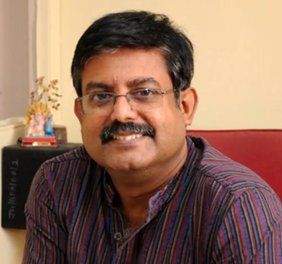 Son of journalists K Shivram and Amni Shivram, the first Malayali woman English journalist, Bijoy Shivram is an accomplished Indian classical dancer trained in Bharatanatyam and Kuchipudi. A passionate promoter of the arts and a skilled graphic designer, he currently serves as the Vice Principal of JG College of Performing Arts and the Assistant Director (Operations) overseeing 17 JG colleges. He is also the founder of Preksha, an organization dedicated to the promotion of art and culture in Ahmedabad. Since 2020, Bijoy has curated the YouTube series 'Gurudakshina - An Ode to our Gurus,' celebrating the legacy of mentorship and tradition. |
