
|     |
|
| |

 Margam in vivid hues- Satish Surie-mail: satishism@yahoo.co.in March 12, 2026 SUNIDHI HEGDE Disciple of Divya Ravi, Sunidhi Hegde's Bharatanatyam recital on January 30 at the Indian Institute of World Culture unfolded as a sensitively curated journey, progressing from ritual discipline through layered longing to the quiet fulfilment of bhakti. Attentive to structure, musicality, and emotional continuity, she opened with a Chatushra Alarippu followed by a Saraswati Shloka, functioning as an invocation and inner alignment. Free of narrative yet rich in intent, the sequence established clarity through well-held araimandi, clean lines, and calm rhythmic assurance, serving as a purificatory threshold for deeper expressional work. 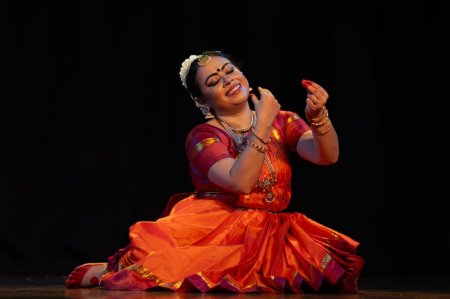 Sunidhi Hegde (Photo: Rajesh T.K) This foundation flowed into the varnam "Pantam elara na Sami" of Ponniah Pillai in raga Khamas and adi tala. Sunidhi negotiated its dual demands with poise: nritta passages remained measured and proportionate, privileging internalised rhythm over display, while abhinaya shaped the nayika's restrained plea, "Why this obstinacy, my Lord?", through subtle withdrawal, softened glances, and eloquent pauses. Introspective sancharis allowed silence to speak as eloquently as movement, resolving the emotional arc from questioning to acceptance. From this inward surrender, she transitioned seamlessly into Jayadeva's ashtapadi, "Sakhi he kesi madana udaram", from the Gita Govinda, where the voice of the nayikā softened into Radha confiding in her sakhi. Longing was deeply internalised, conveyed through lowered gaze, restrained gesture, and eloquent stillness, the vulnerability suspended in quiet anguish rather than dramatised. The live music ensemble enriched this landscape: Raguram Rajagopalan's sensitive vocals, Divya Ravi's assured nattuvangam, Srihari Rangaswamy's measured percussion, and Mahesha Swamy's lyrical flute collectively sustained the introspective tenor. The recital concluded with Kanakadasa's devaranama "Baro Krishnayya", shifting from yearning to invitation. Sunidhi's abhinaya opened outward with warmth and simplicity, evoking Krishna as a compassionate, accessible presence through unembellished movement and serene stillness. SARATH NAIK On February 2 at Seva Sadan, Sarath Naik, disciple of acharya Indira Kadambi, presented a Bharatanatyam margam of galvanic verve and virtuosity. His compact frame belied an explosive stage presence, aptly likened to a firecracker in motion. A Narasimha shloka by Adi Shankaracharya invoked divine grace before the Narasimha Kautvam in ragamalika (composed by Gurumurthy, music by Balasubrahmanya Sharma), depicted the avatar's annihilation of Hiranyakashipu with predatory dynamics, roaring expressions, clawing gestures, and incisive footwork, establishing a commanding tone. 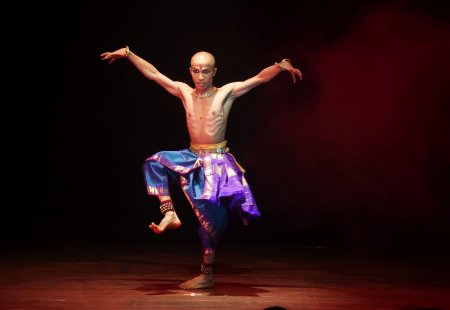 Sarath Naik (Photo: R.N.Sudhi) The centrepiece, the pada varnam, "Mohalagiri meerudhe", in raga Kapi by Kunnakudi Venkatarama Iyer, portrayed a virahotkhandita nayika yearning for Lord Muruga. Sarath navigated escalating emotions through rich sancharis, while swift, intricate jathis demanded, and received, razor-sharp laya control. His body kinetics were striking: utplavana leaps, and airborne turns embodied restless passion, contrasted by tender, introspective bhava supported by the orchestra's emotive lines. Kshetrayya's padam "Ososi" in Mukhari introduced introspective melancholy, depicting a nayaka renouncing worldly ties after betrayal. Preserving Kalanidhi Narayanan's choreography through Indira Kadambi's lineage, Sarath rendered the turmoil with restraint, quiet resignation unfolding into pained recollection and bittersweet resolve, his stillness conveying emotional depth. A playful contrast followed with Purandara Dasa's "Gokula dalli naa iralare", where he embodied the mischievous Balakrishna with endearing charm and narrative agility. Dr M. Balamuralikrishna's thillana in Kadana Kuthuhalam provided an exhilarating nritta climax, executed with speed, clarity, and buoyant joy, before a concluding bhajan of Vittala Dasa returned the mood to serene devotion. The ensemble - Rohit Bhat Uppoor (vocals), Vidyashankar (mridangam), Nitish Ammannaya (flute), Prashant Rudrapatnam (veena), and Indira Kadambi on nattuvangam - ensured cohesive musical architecture. The recital emerged as a promising milestone, balancing athletic dynamism with soul-stirring expression. SHASHWATI GARAI GHOSH 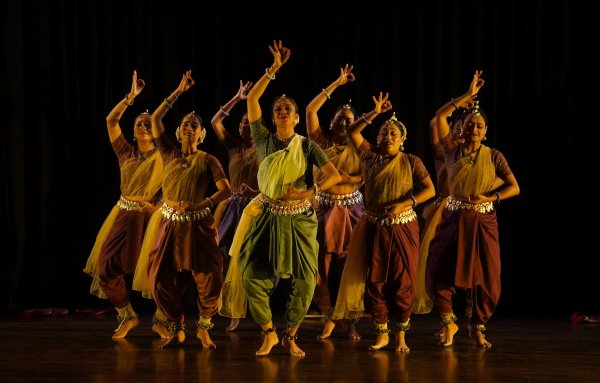 Angashuddhi Ensemble (Photo: Prof K.S.Krishnamurthy) On February 3 at the Bangalore International Centre, Shashwati Garai Ghosh's "Yati - Moving Towards Light" performed with the Angashuddhi Ensemble, offered a quietly luminous reimagining of the Odissi margam. Conceptualised and choreographed by Ghosh, the production traced a five-stage journey from rigorous discipline to transcendent dissolution, positioning technique as a vehicle for inner discovery and spiritual refinement. Rather than presenting the margam as a fixed sequence, the work unfolded as a meditative continuum in which each segment seemed to grow organically from the previous one, suggesting the gradual shedding of external form in pursuit of inner illumination. The production opened with crisp foundational precision. The invocation and early items showcased the Angashuddhi ensemble's clean lines, synchronised tribhangis, and deeply anchored chowkas that immediately established the dancers' command over Odissi's sculptural grammar. The geometry of the form was rendered with clarity and restraint, allowing the audience to savour the architectural beauty inherent in the style. Ghosh, as the central soloist, commanded attention not through theatrical display but through an inwardly focused intensity. Every abhinaya phrase bore the quiet authority of a practitioner who had internalised the idiom over decades of training under Guru Sharmila Biswas, transforming technique into lived experience. 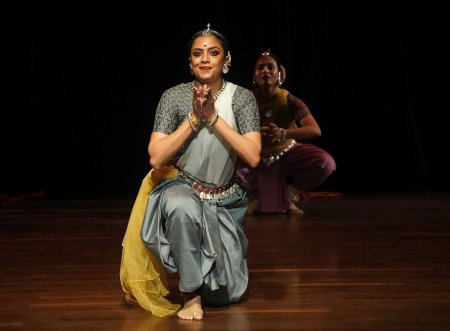 Shashwati Garai Ghosh (Photo: Prof K.S.Krishnamurthy) As the margam progressed, the choreography began to loosen its structural moorings. What initially appeared as disciplined adherence gradually evolved into fluid explorations of space, time, and emotional resonance. Ensemble passages introduced layered spatial designs, with dancers weaving across the stage in intersecting pathways that suggested currents of energy converging toward a luminous centre. These formations created a sense of collective momentum, reinforcing the thematic idea of many individual journeys moving toward a shared light. Ghosh's solo transitions became increasingly introspective, her torso isolations softening, her glances lengthening into moments of suspended awareness. By the time the performance approached its moksha like culmination, the boundaries between codified form and inner feeling had dissolved. Tribhangis melted into organic curves, the eyes no longer narrated stories but radiated contemplative stillness, and the hastas functioned less as narrative signifiers and more as emanations of inner radiance. The arc from discipline to luminous freedom was palpable yet never overstated, allowing the audience to experience the transformation intuitively rather than through explicit symbolism. Amlan Chaudhuri's lighting design played a crucial role in shaping this experiential journey. Soft amber washes and gradual intensifications mirrored the choreography's progression from grounded physicality to ethereal expansiveness. Early segments remained rooted in cooler tonalities that emphasised structure and clarity, while later sections unfolded in warm, glowing hues that enveloped the dancers in an almost otherworldly aura. The costumes caught and reflected this light, creating the impression of bodies suffused with living energy. The visual atmosphere thus became an extension of the thematic movement toward illumination. The musical score, grounded in traditional Odissi orchestration, provided a stable yet responsive sonic framework. Mardala rhythms articulated the kinetic precision of the early sections, while melodic passages on flute and violin expanded into more contemplative textures as the performance deepened emotionally. The music supported the dance without seeking prominence, its subtle modulations echoing the inward turn of the choreography and enhancing the sense of spiritual unfolding. Ghosh's artistic strength lay in her ability to honour the classical integrity of the margam while infusing it with a deeply personal voice. The supporting dancers, including Joyita Pal, Agnisha Basak, Parama Samanta, Priyanka Roy, Minakshi Kundu, Paromita Samanta and Audrija Roy, matched her rigour and commitment. Their unified presence created a textured ensemble field that amplified the impression of a shared pilgrimage rather than a hierarchical display centred solely on the soloist. If there was a minor reservation, it lay in the extreme subtlety of the transitions between the five stages. The seamless flow occasionally blurred the structural markers that might have clarified the progression for viewers seeking stronger dramatic punctuation. Yet this very restraint ultimately defined the production's aesthetic. In an era often drawn to emphatic innovation and visual spectacle, "Yati - Moving Towards Light" invited quiet contemplation. The performance concluded with a lingering sense of stillness, as though the journey toward light continued beyond the visible stage. What remained was not the memory of virtuosic display but a quiet afterglow, a recognition that transcendence in classical dance often arises not from breaking tradition but from illuminating its deepest essence. Shashwati Garai Ghosh and the Angashuddhi Ensemble crafted an Odissi experience that felt at once timeless and vitally present, reaffirming the capacity of the margam to function as both artistic structure and spiritual path. VANDANA SUBASH Vandana Subash, a disciple of Divya Ravi, presented a well-structured Bharatanatyam recital at the Indian Institute of World Culture on the 6th of February. The young dancer displayed a poised stage presence and quiet assurance, reflecting the disciplined training of her guru. 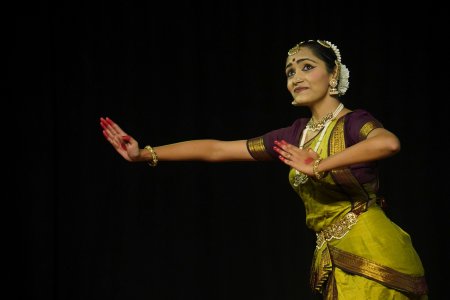 Vandana Subash (Photo: R.N.Sudhi) The evening commenced with a brisk Jatiswaram in Rasikapriya raga, a composition of Lalgudi Jayaraman choreographed by Kiran Subrahmanyam. It made for an assured and invigorating opening. Rasikapriya's distinctive melodic colour lent warmth to the piece, and Vandana negotiated its contours with sensitivity. Her footwork was crisp, the araimandi steady, and the rhythmic patterns were articulated with clarity. The Jatiswaram effectively foregrounded the geometric precision of Bharatanatyam and established an energetic tone for the recital. The central offering was the varnam "Vanajaksha ninne nammithini," a composition of T. R. Subrahmanian set to adi tala and choreographed by Divya Ravi. Here, Vandana came into her own. The varnam, the litmus test of a dancer's stamina and artistic integration, demands a sustained equilibrium of nritta, nritya, and abhinaya, and she met these demands with commendable poise. Her abhinaya bore an unaffected sincerity, allowing the bhava to emerge organically. The devotee's yearning for the lotus-eyed lord was conveyed with intimacy, drawing the audience into the emotional core of the piece. The choreography itself revealed thoughtful structuring and nuanced layering, indicative of the guru's meticulous investment. A reflective shift followed with the Meera bhajan "Tum bin mori kaun khabar re." Vandana's portrayal of the saint-poet's unconditional devotion to Krishna carried quiet emotional weight - the anguish of separation tempered by unwavering faith. She then transitioned into the Mahabharata episode of Draupadi's humiliation in the Kuru Sabha and the divine intervention that preserved her honour. The dramatic arc was rendered with conviction, balancing pathos with spiritual assurance and demonstrating a growing maturity in interpretative ability. Subramania Bharati's "Chinnanjiru kiliye" introduced a lyrical lightness to the programme. The familiar imagery of the little parrot - a tender metaphor for the yearning soul - was depicted with charm and warmth. Vandana's expressiveness here was relaxed and unforced, offering a welcome contrast to the preceding intensity. The recital concluded with a vibrant Thillana in Brindavani, composed by Dr M. Balamuralikrishna, followed by verses from the Bala Mukunda Ashtakam. The Thillana showcased her technical sharpness, clean lines, and sustained energy, while Brindavani's pastoral associations with Krishnalila provided an apt celebratory conclusion. The live orchestra provided a finely balanced aural architecture for the recital. Harshita Vidya's evocative vocals anchored the emotive content of the compositions, while Divya Ravi's nattuvangam offered precise rhythmic scaffolding and sensitive guidance throughout. Mahesha Swamy's flute lent melodic grace, enhancing the lyrical passages, and Vinay Nagarajan's mridangam playing supplied both vitality and nuanced support, sustaining the momentum of the performance with measured control. AISHWARYA LAKSHMI Aishwarya Lakshmi's Bharatanatyam presentation, guided by Acharya Indira Kadambi, on the 16th of February at the Seva Sadan, unfolded as an evening of consummate artistry and thoughtful curation. The recital opened with a Pushpanjali set in Ragamalika, a composition by Dr M. Balamuralikrishna, which established an atmosphere of devotional grace. Aishwarya entered the sacred space with quiet authority, her invocatory offering setting an assured and refined tone for the evening. The accompanying ensemble lent a rich aural texture throughout. Rohit Bhat's vocals brought warmth and clarity, anchoring each composition with sensitivity and musicianship. Indira Kadambi presided over the nattuvangam with characteristic precision, her rhythmic command providing an unwavering pulse. Nitish Ammannaya's flute added lyrical colour, Harsha Samaga's mridangam infused propulsive energy and rhythmic dialogue, and Prashanth Rudrapatna's veena contributed a stately resonance that deepened the sonic fabric. 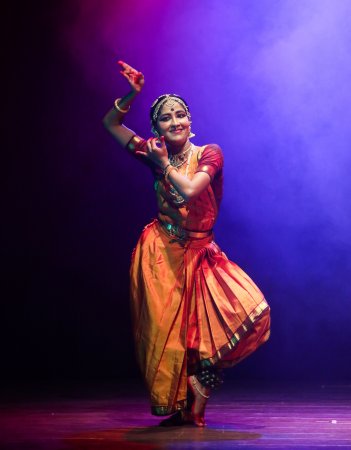 Aishwarya Lakshmi (Photo: V.B.Suresh) The centrepiece was the varnam "Samiyai azhaithodi va," composed by Dhandayuthapani Pillai, an ambitious work set in Navaragamalika, traversing nine ragas. As the lovelorn nayika, Aishwarya brought aching tenderness to her portrayal, her abhinaya vivid and sincere as she implored her sakhi to unite her with the beloved lord. The emotional architecture of the varnam was handled with maturity; the shifting raga landscape demanded musical intelligence and dramatic flexibility, both of which she navigated with assurance. Her nritta passages were crisp and energetically sustained. A Kshetrayya padam, "Intiki raninchana," introduced an intimate stillness, the shringara rasa rendered with nuance and depth. The recital then gathered joyous momentum with a Thillana in Misra Sivaranjani, a composition of Maharajapuram Santhanam, in which she offered a spirited prayer to Lord Muruga, invoking the deity astride his celestial peacock. The rhythmic vitality of her footwork and the buoyancy of her movement made this segment particularly exhilarating, culminating in a gratifying percussion dialogue with the mridangam. The evening took an unexpected and moving turn in its finale. Aishwarya presented a Bengali Shyama Sangeet, a "Krishnokali" bhajan sung by her father-in-law, Saumitra Paladhi, accompanied live on the tabla by her husband, Shouvik Paladhi. The composition explored the mystical union of Krishna and Kali, an unusual and philosophically rich theme. Through her interpretation, the imagery of a peacock feather placed in Kali's yoni, giving birth to Krishna, who then entered the world through Devaki, bound the two cosmic forces in a cycle of creation. Her portrayal of Kali was remarkable in range, moving seamlessly between the fearsome and the compassionate, the terrifying and the tender, her eyes alive with the goddess's many facets. The intimacy of the familial collaboration lent the piece palpable emotional resonance. Over the course of the evening, Aishwarya Lakshmi demonstrated not only technical accomplishment but the rare capacity to inhabit each composition fully, sustained by the collective artistry of a superb ensemble and guided by the steady, discerning hand of Acharya Indira Kadambi. It was a presentation that honoured tradition while daring, beautifully, to transcend it.  Bangalore based Satish Suri is an avid dance rasika besides being a life member of the Music and Arts Society. |
