
|     |
|
| |

 An evening of Memory and Movement: The Roots to Routes tribute- Bijoy Shivrame-mail: bijoyshivram@gmail.com Photos: Abhishek Kerketta and Jomoso Photography March 3, 2026 At the contemplative expanse of the CEE Auditorium, the evening in the Roots to Routes series unfolded with a quiet intensity - the kind that gathers slowly and deepens with each passing moment. What emerged was not merely a curated performance but a heartfelt Shradhanjali, a remembrance shaped through music, poetry and dance, dedicated to Pt. Atul Desai and Sandhya Desai. Organized by the Pandit Atul Desai and Sandhya Desai Foundation and presented by Vaishali Trivedi with her institution, Sangati Centre of Performing Arts, the evening found a sensitive rhythmic anchor in renowned tabla exponent Ramesh Bapodara. At the emotional core of the tribute lay the profound association that both Atulbhai and Sandhyaben shared with Kumudini Lakhia, whose artistic vision shaped the evolution of Kathak in Ahmedabad. Sandhya Desai belonged to the earliest generation of her students - a lineage that carried within it the formative years of a movement that would later redefine Kathak's contemporary presence. Over decades, she devoted herself not only to performance but to teaching at Kadamb, nurturing dancers with patience, discipline and an artistic openness that mirrored the spirit of her guru. Her work quietly extended the reach of the institution across audiences and students worldwide, ensuring that Kathak remained both rooted and alive. Alongside her, Atul Desai contributed to this artistic ecosystem with a rare musical and intellectual depth. A composer whose sensibility was shaped as much by literature as by rhythm and melody, he cultivated a remarkable engagement with poetry. His personal collection of works by poets and writers reflected an inner dialogue between word and sound - a dialogue that often found expression in his compositions. These works, intricate and nuanced, demand from performers not only technical skill but emotional maturity. They reveal a musical imagination that remained firmly anchored in tradition while constantly exploring new pathways of expression. Together, Atulbhai and Sandhyaben lived within the artistic environment that grew around Kumudini Lakhia's vision - contributing quietly, steadily and profoundly to a world where music, dance and thought could evolve organically. The Roots to Routes series itself echoes an idea closely associated with Sandhyaben: that artistes must remain anchored in their mool while discovering new routes within the continuum of tradition. Today, this philosophy continues to be carried forward by their children, Srinand and Vaidehi, who remain deeply connected to their parents' legacy. 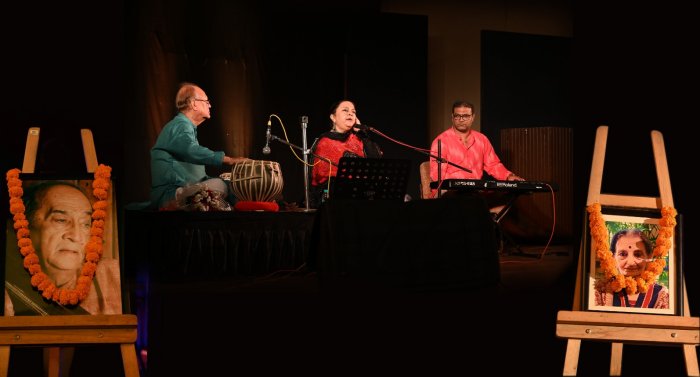 Vocal rendition by Vaishali Trivedi The evening opened with vocals, revealing an unexpected yet compelling dimension of Vaishali Trivedi's artistry. Known primarily as a Kathak dancer, she stepped onto the stage as a vocalist, presenting a series of compositions by Pt. Atul Desai that are seldom heard today due to their structural complexity and interpretive demands. Her singing possessed a quiet sincerity - unhurried, introspective - allowing the compositions to unfold with dignity and depth. She began with the evocative poetry of Chinu Modi, "Sapna ughadi aankhna..." set in the haunting contours of raag Shivaranjini, instantly establishing a reflective mood. This was followed by a Meera bhajan, "Tum bin meri kaun khabar le," rendered in raag Puriya Dhanashree with devotional warmth. The repertoire then moved into the lyrical world of Ravji Patel, with "Aavkaro aa jharan pami gaya," before unfolding into a deeply introspective ghazal in raag Jog Kauns - "Dard ki had se guzarna to abhi baaki hai." The sequence continued with "Shyam salona door na hona" by Roopanand Swamy, rendered in raag Gurjari Todi, and concluded with a bhajan in raag Gorakh Kalyan. Each piece reflected Atul Desai's distinctive musical imagination, where ghazal, geet, bhajan and the rhythmic sensibilities of Kathak seemed to converse seamlessly. Supporting this musical segment were Bhupendra Barot on keyboard and Ramesh Bapodara on tabla. Bapodara's accompaniment, in particular, stood out for its restraint and attentiveness. His playing never intruded upon the compositions but gently shaped their emotional and rhythmic architecture, allowing the music to breathe. 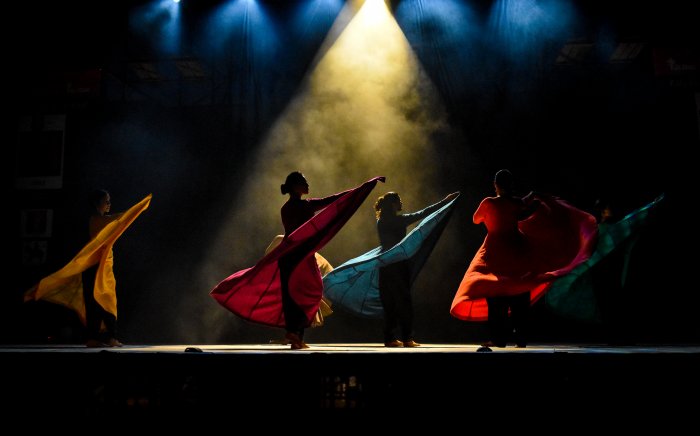 Sangati Center of Performing Arts From music, the thematic essence of the evening - the dialogue between roots and evolving routes - began to take visual form through dance. A group presentation titled ‘Anusangh', meaning connection or linkage, explored the delicate balance between parampara and contemporary expression. At its centre was a vibrant Tarana in raag Bageshri choreographed by Vaishali Trivedi. The dancers - Salomi Shah, Vaishali Shah, Anar Jaykrishna, Vama Shalinbhai Patel, Kirmi Mehta, Anushka Shah and Komal Bhagora - performed with clarity and rhythmic assurance. The choreography respected the grammar of Kathak while exploring spatial design and group dynamics that gave the work a fresh visual vocabulary. Patterns emerged and dissolved across the stage like shifting constellations, suggesting continuity within movement. The recorded music was composed by Sanjeev Vidhyarthi with tabla accompaniment by Ramesh Bapodara. Costumes designed by Shimul Jhaveri added cohesion and elegance to the presentation. 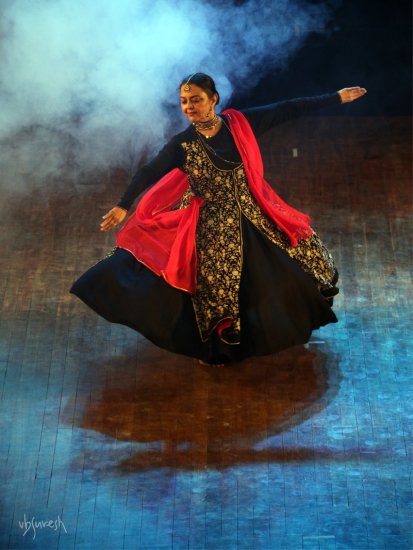 Vaishali Trivedi One of the most contemplative moments of the evening arrived with Vaishali Trivedi's solo in vilambit laya. Beginning with the serene Krishna Vandana "Kamal nayan varo" sung by Ashwini Bhide Deshpande, the performance moved into an original bandish set in raag Vachaspati. Gradually unfolding through amad, nritta and abhinaya, the piece reflected upon Krishna as Natvar - the divine beloved, the Poorna Purushottam who transforms existence into celebration and reveals the essence of love. What distinguished this presentation was its maturity of pace: gestures were measured, expressions subtle and rhythmic articulations clear without excess display. The result was a deeply inward performance, one that allowed the emotional core of the theme to resonate quietly. The concluding work, ‘Urban Sufi,' brought the evening into a contemporary frame. Drawing from a compilation created by Vaishali from the music of Dhafer Youssef, enriched with tabla and additional sonic textures, the piece explored the rhythms of modern urban existence - its urgency, fragmentation and inner restlessness. Within this landscape, the choreography traced a subtle sangharsh between the outer world and an inner spiritual longing. Movement shifted between grounded Kathak vocabulary and freer contemporary impulses, suggesting that even amid the speed of city life, the search for one's roots continues quietly within the self. Through Sangati Centre of Performing Arts, Vaishali Trivedi continues to play a significant role in Ahmedabad's evolving dance landscape - not only as a performer but also as a teacher shaping a new generation of artists. By the end of the performance, what lingered in the auditorium was a sense of continuity - a quiet understanding that the lives and work of Atulbhai and Sandhyaben continue to resonate through the artistes who carry their vision forward. 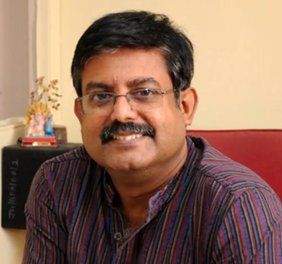 Son of journalists K Shivram and Amni Shivram, the first Malayali woman English journalist, Bijoy Shivram is an accomplished Indian classical dancer trained in Bharatanatyam and Kuchipudi. A passionate promoter of the arts and a skilled graphic designer, he currently serves as the Vice Principal of JG College of Performing Arts and the Assistant Director (Operations) overseeing 17 JG colleges. He is also the founder of Preksha, an organization dedicated to the promotion of art and culture in Ahmedabad. Since 2020, Bijoy has curated the YouTube series 'Gurudakshina - An Ode to our Gurus,' celebrating the legacy of mentorship and tradition. |
