
|     |
|
| |

 Mardala Manjeera- Tapati Chowdhuriee-mail: tapatichow@yahoo.co.in Photos: Arijit Roy February 26, 2026 In association with the Ministry of Culture, Government of India, Darpani presented Mardala Manjeera - The divine rhythm, on the completion of its 30th year. It was celebrated at Gyan Manch, Kolkata on the 17th and 18th of January 2026. It's a remarkable coincidence that the year also happens to be the centenary year of Guru Kelucharan Mohapatra, the doyen of Odissi dance. Not often does one get a double bill of this stature. Delhi based Odissi exponent Ranjana Gauhar was the guest artiste at the festival. Ranjana Gauhar's commitment to the Guru-Shishya Parampara has ensured the transmission of authentic knowledge and the continued evolution of Odissi. It was therefore a joyous occasion when Ranjana Gauhar opened the festival with the ashtapadi "Kuru yadu nandana" from Jaydeva's Gita Govinda, a signature piece performed by Guru Kelucharan Mohapatra. It exhibited the grip of a confident lover - Radha, in this case - over her ardent lover Krishna, as she asked him to adorn her disheveled dress, her hair, and the kohl in her eyes, restoring them to how they were before he made love to her. Based on raga Misra Kafi and taal Jati, the piece was identifiable to afficionados of dance. 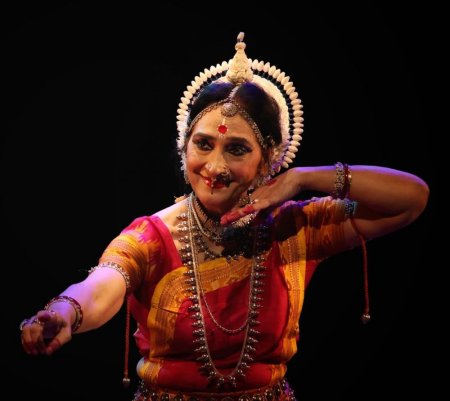 Ranjana Gauhar 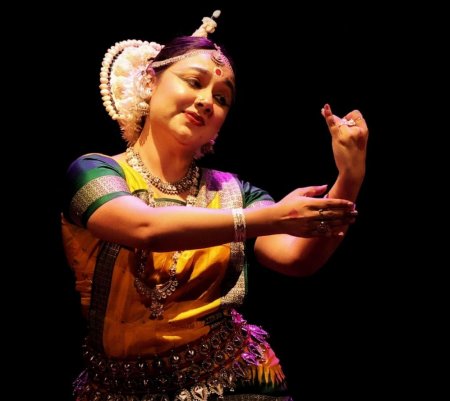 Vrinda Chaddha Ranjana Gauhar presented her disciple Vrinda Chaddha in a captivating piece she had choreographed, "Radha rani sange nache murali pani". It depicted Radha dancing with her eternal lover, the playful Krishna with his flute. Together they are an epitome of heavenly dancers. This beautiful vision has been cherished by poets since time immemorial. Holi, the festival of colour, infuses a vibrant mood as Radha and Krishna splash colours on each other oblivious to the world around. The song 'Radha Rani' brings out the flavour of the local ambience in a mood of passion and love during the Festival of Holi. Composed in raag Pilu and taal Ektali, it captured the passion of the festival of Holi. Music composition was by Ramachandra Sahu. 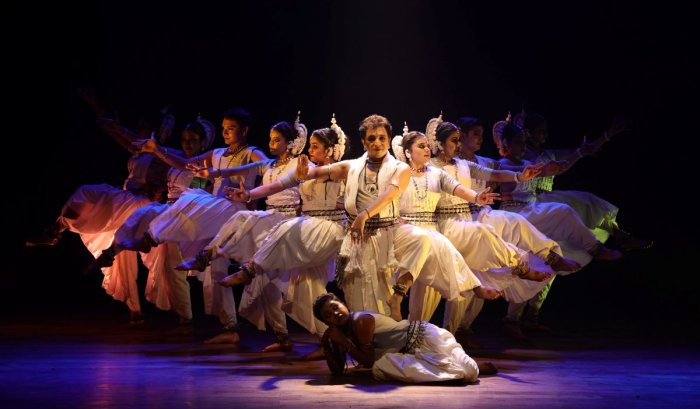 Arnab Bandopadhyay and Darpani troupe Under Guru Arnab Bandopadhyay's guidance, Darpani has grown into a thriving family of over 300 students, who shine on prestigious platforms. Shivaranjini Pallavi performed by his repertory members showcased the elaborate rhythm, music and graceful movements into a stunning tapestry. The dance composition was by Arnab Bandopadhyay, while the music was composed by Himangshu Sekhar Swain. Dancers Anusmita Bhattacharjee, Anaya Ghosh, Nikita Das, Soumily Sadhukhan, Brishti Roy, Sumouli Basu, Ishani Mukherjee, Shruti Mondal, Soham Dey, Abhijit Das and Kaahon Guha performed incredibly. Odissi exponent Madhavi Mudgal credited with bringing a refined sensibility to it, is a prime disciple of Guru Kelucharan Mohapatra. She and Arushi Mudgal, her very talented student, with an innovative approach to tradition regaled the audience with their performance. It was a treat to see the teacher and the taught perform together. The first piece performed was Kamalaa, an invocation to Lakshmi, the Goddess of wealth. The traditional prayer to Lakshmi was followed by a procession in which devotees participated with joy, asking for spiritual emancipation. The dance piece was choreographed by Arushi, while the music was composed and vocalized by Pandit Madhup Mudgal and Bhuvanesh Komkali with the first verse taken from Pandit Jasraj. 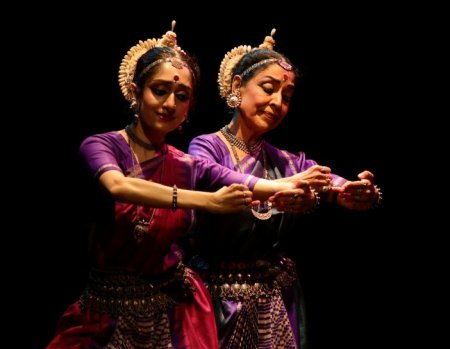 Arushi Mudgal and Madhavi Mudgal Choreographed by Madhavi Mudgal, Kshanamadhuna from Gita Govinda saw a persuasive Krishna implore his love for Radha and express his wish to allow him to press her tender and weary feet, emoted sensitively. In Pranasangini re choreographed by Guru Kelucharan Mohapatra, Arushi confides to her sakhi about Krishna, who came in the garb of a girl and decorated her feet inscribing his name under her feet and how it had embarrassed her. Acting out the details, Arushi left the audience awe-struck, a classic piece of work that one never tires of seeing. Dvidha is a Pallavi in raga Bhairavi in which Arushi Mudgal interwove rhythmical cycle with musical motifs into a unified whole. Arnab Bandopadhyay's artistry resonates with authentic Odissi idiom and spiritual depth. His artistic journey later found profound direction under Guru Kelucharan Mohapatra, followed by sustained and intensive guidance from Guru Ratikant Mohapatra, son and distinguished disciple of the maestro. Arnab nurtures emerging talent through his institution Darpani, guided by a deep commitment to preserve, propagate, and reimagine the timeless beauty of Odissi for generations to come. He performed Shiv Tandav solo. He established an instant rapport with his audience with Shiva's physical description; his tandava nritya and the sound of his damaru that emits the sound "Damat damat damat damat". With raag Bhatiyar and taal Khemta, he aspires for Shiva's blessing for all mankind. The composition of the dance and its music was by Guru Kelucharan Mohapatra and Pandit Bhubaneswar Mishra. Guru Ratikant Mohapatra, Director of Srjan, who has been immersed in the world of Odissi dance and music since 1975, was invited to dance along with some of his disciples. He along with Sujata Mohapatra blessed the proscenium stage with their flawless rendition of the great choreographic work of Jatayu Moksha. It was a neat performance of the two veterans of the Srjan family. Ratikant Mohapatra's enactment of Jatayu was emoted expressively. He helped the story to move on. 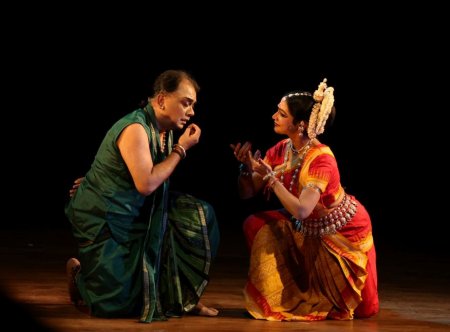 Ratikant Mohapatra & Sujata Mohapatra 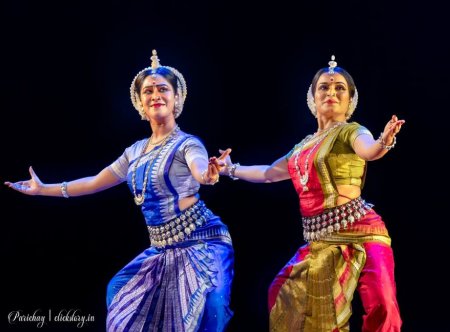 Preetisha Mohapatra & Rajashri Praharaj Rajashri Praharaj, an accomplished dancer and well versed in the Kelucharan Mohapatra genre of dance, went duet with the talented Preetisha Mohapatra in Tulsidas' bhajan, venerating Ram, an incarnation of Vishnu. Ram Vandana was very emotional. Their beautiful rendition spread bhakti rasa and mesmerized the audience. 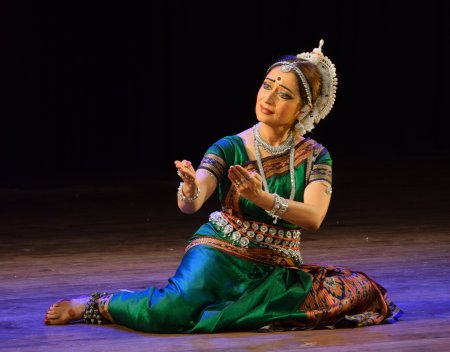 Nandini Ghoshal Guest artistes from Kolkata - Nandini Ghoshal, Rina Jana and Kakoli Bose - performed Singhendra madhyam Pallavi together. This Pallavi is one of the most vigorous and energetic Pallavis composed by Guru Kelucharan Mohapatra in taal Triputa and Ektaali, which was very well negotiated by the trio. Each of the three dancers commended marvellously in the abhinaya pieces, displaying the kind of rigour they went through under their guru. 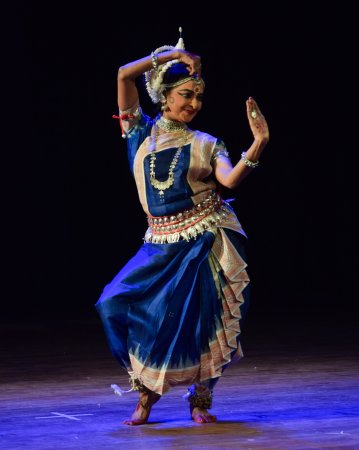 Rina Jana 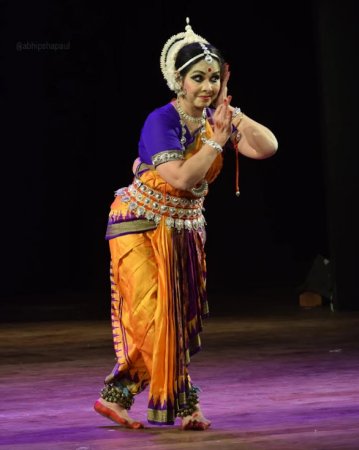 Kakoli Bose In the ashtapadi Sakhi hey from Jayadeva's Gita Govinda, Kakoli Bose as Radha remembered her first rendezvous with Krishna. She asks her sakhi to bring Krishna to their love nest. The message is duly conveyed to Krishna revealing to him Radha's pain of separation adding that he must see her at once. In the ashtapadi Sa birahe, Rina Jana displayed Radha's night long wait that has left her heartbroken at the appearance of Krishna coming at dawn with telltale signs of a night spent in passion. Furious Radha refuses to talk to him and asks him to go away. In Yahi Madhava, Nandini Ghosal carried forward the story of Radha's pain of waiting till dawn, only to be disappointed and like a Uttama Nayika, she asks him to leave. A part of the love story of Radha and Krishna was convincingly portrayed by the trio.  Tapati Chowdhurie trained under Guru Gopinath in Madras and was briefly with International Centre for Kathakali in New Delhi. Presently, she is a freelance writer on the performing arts. She is the author of 'Guru Gopinath: The Making of a Legend.' |
