
|     |
|
| |

 Elegance of agility and composure- V. Kaladharane-mail: vkdamaru.eda@gmail.com Photos: Rajesh Bhagavath February 25, 2026 Relentless tutelage under one Guru is no more a compulsion for the young generation dancers. Most of them do switch from one Guru to the other in pursuit of greener pastures. For them, bani is not a serious concern at all. Yet, there are a few dancers who are committed to becoming the flag-bearers of the bani established by their Gurus. Srividya Sailesh, the disciple of celebrated actor and dancer Shobana, is indubitably one among them. 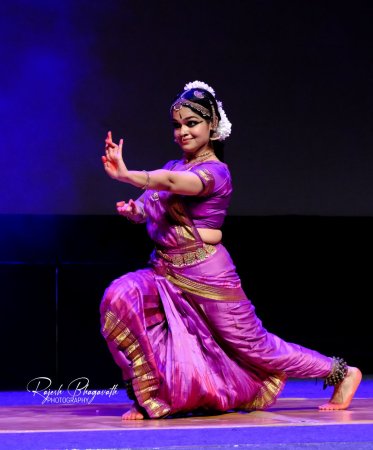 Srividya Sailesh Srividya gave a Bharatanatyam recital at the Nishagandhi Dance Festival hosted by Kerala Tourism, at the Kanakakkunnu Palace, Thiruvananthapuram, in the third week of February. She straightaway stepped into the splendid Padavarnam of Swathi Thirunal, Sarasa Shara Sundara, recomposed into Ragamalika and set to adi tala. Still, raga Neelambari dominated the composition for the most part. Her virtuosity was evident in the execution of a wide variety of adavus and postures. In the segment of textual dance, apart from evocatively explicating the multiple metaphors associated with the Nayika addressing Lord Sripadmanabha, Srividya incorporated two appropriate vinyasas. The first one was sage Bhrugu's arrival at the abode of Lord Vishnu who did not give him a warm welcome. An infuriated Bhrugu kicked the Lord on the chest with his foot. But the Lord didn't lose his temper. Instead, he apologized before the sage for failing to receive him properly. On the other hand, goddess Lakshmi became upset and she left Vaikunta. The second vinyasa closed in on to Lakshmi reborn on Earth as Padmavathi who comes across a hunter who was none other than Srinivasa. Entranced by his blue lotus like figure, Padmavathi longs for union with him. Srividya portrayed Padmavathi's pangs of separation and her eventual union with the Lord without being overly sentimental. Following the Varnam, the dancer moved on to the presentation of a Kshetrayya Padam, Kodi koose in raga Saurashtra set to tala adi. With Lord Krishna as the Nayaka, the interference of a rooster during the dalliance between the Nayika and the Nayaka provides a hilarious tone to the context. Turning this seemingly simple passage into aesthetically convincing visual phrases is easier said than done. Srividya concluded her recital with the alluring Lalgudi Thillana in raga, Pahadi, set to tala mishra chapu. 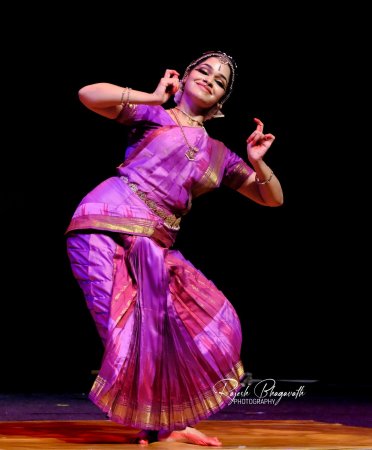 Srividya Sailesh The recital carried a distinctive texture thanks to the mesmerizing jathi rendition by Shobana. The sahitya and the charanaswaras were in perfect harmony with the ragabhavas as Krithika, the gifted vocalist, navigated the subtle terrains of the ragas imaginatively. Nellai Balaji, the seasoned mridangam player, enlivened the movements and expressions of the dancer with soft and sonorous fingerings. Karaikkal Venkatasubramanian accentuated the emotional contexts of the dance on the violin through and through. In short, the nattuvangam and the orchestra were an enduring inspiration for Srividya on stage. SHOBANA ON THE AESTHETICS OF NATTUVANGAM 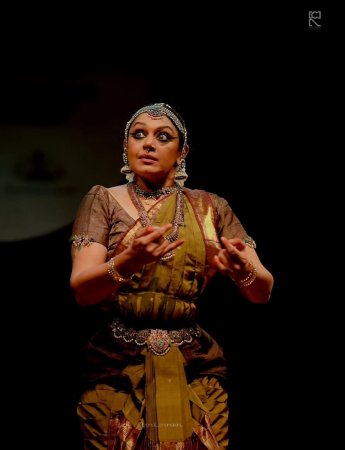 Shobana (Photo: Rahul Chandran) Did you take lessons in Nattuvangam? If not, how did you become conversant with it effortlessly? I didn't. The interest I had in Nattuvangam prompted me to learn it. I wanted to know all the fractions of Bharatanatyam. If one wanted to be a teacher, one had to practice it. My teacher was very good at it. I had listened to my teacher and her teacher rendering it. I developed a method of my own in putting the bols (mnemonic syllables) together to perform phrases. That could be the reason why it sounds different. I understand the entire vision of dance and how the bols should move with the percussion. What's your perception about the tempo of the Jathis? The normal concept was that the tempo of the Jathis shall be in the same tempo as that of the Padavarnam. Times have changed. By the time, charanams were brought in, tempo underwent transitions. The speed of the charanams was different even during the period of my learning. Not all dancers are performing the Padavarnam from the beginning till the very end in the same tempo. Jathis were not ever a part of the tradition. Everything is an addition. I raise the tempo of the jathis based on several aspects; my stamina, the way it sounds with the dance, prowess of the dancer concerned, so on and so forth. All said and done, there is no hard and fast rule regarding the rendition of the jathi. A very slow jathi can also be made to sound beautiful and effective. In your opinion, how much do Jathis contribute to the solidity and beauty of the non-textual dance? Jathis are, of course, a fabulous segment of the Bharatanatyam repertoire. In the yesteryears, we used to dance for forty-five minutes which demanded all kinds of variety, especially when the text and the music were not so detailed. It was just shabdartha. Afterwards came the sanchari. So many elaborations, alaap inside the Padavarnam itself. So, when you have all of these different colors, all of these solfa syllables add a variety to it. It kind of punctuates it beautifully. If one wants to keep on having the jathis throughout the performance, she/he can. It depends on how one conceives it. Sometimes, if you are doing something like a solid viraha sringara, it suddenly bursts into a jathi. It is thus a gorgeous fragment of the Varnam. 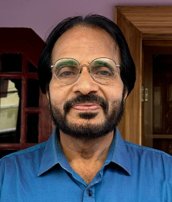 Former Deputy Registrar of Kerala Kalamandalam, V Kaladharan is also an art critic. He has published several articles at the academic level. 'From Meditative Learning to Impersonal Pedagogy' was published in an anthology 'Qui Parley' initiated and released by scholars and writers from the University of California, Berkeley. His articles on Indian performing arts and literature regularly appear in magazines and journals, and in the Friday Page of The Hindu. |
