|     |
|
| |

 Jailal Academy of Music celebrates Nrityakatha- Tapati Chowdhuriee-mail: tapatichow@yahoo.co.in Photos: Arijit Roy February 19, 2026 Jailal Academy of Music celebrated Nrityakatha, a two-day (Dec 18 & 19, 2025) Kathak dance festival dedicated to the revered memory of Pandit Jailal and Nrityacharya Pandit Ramgopal Misra at Gyan Manch, Kolkata. Nrityakatha was basically storytelling through rhythm, movement, and bols drawn from life, nature, and the universe. The festival endeavoured to present the many moods, colours, and philosophies that Kathak embodies. It brought together eminent Kathak exponents from the Jaipur, Lucknow, Benaras, and Raigarh traditions, while also providing a platform for young and emerging dancers to share the stage with legends. The festival attempted to preserve the purity, identity, and sanctity of Kathak. Jailal Academy was founded by Late Nrityacharya Pandit Ramgopal Misra in 1971 in the memory of his father belonging to Jaipur gharana. The tradition is kept alive by the Guru-sishya parampara. Some of the eminent disciples of Jailal Academy are Sumitra Mitra (Mukherjee), Kajal Misra Roy, Malabika Mitra, Madhumita Roy, Ashimbandhu Bhattacharya and others. 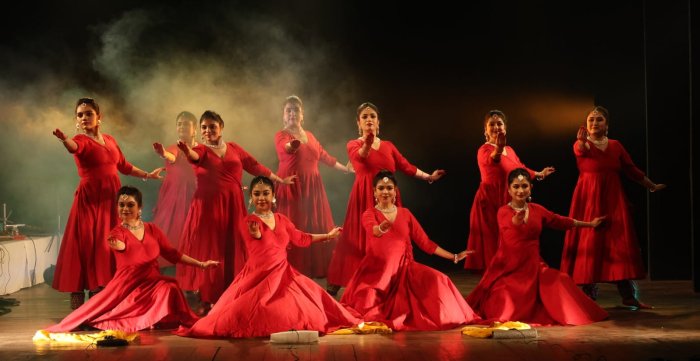 Students of Jailal Academy of Music The dance festival was inaugurated by Susmita Misra among others. The opening presentation by students of Jailal Academy was "Triveni" which is the confluence of three emotional streams. It began with Bhakti, where devotion flows with a quiet surrender and inner strength. From this stillness arises sringar rasa displaying tender expression of longing and awakening desire signifying the yearning of the heart before finally merging into the joyous rhythm of Spring breaking into a tarana, where movement becomes celebration and emotion finds release in happiness and bliss. The performers were accompanied by Sunando Mukherjee on the sarod. Sangita Chatterjee, a distinguished disciple of Guru Vaswati Misra, was a treat to watch. Having started with Ganesh Stuti, she amazed the audience with upaj, chalan, Sringar ki thaat, uthan, amad, paran in teental following it up with drut teental. "Choti ki gat" braid of a woman was interesting. Ably supported on the tabla by Biswajit Pal, she concluded with 32 chakkar ka tukda replete with chaumukhi chakkars. 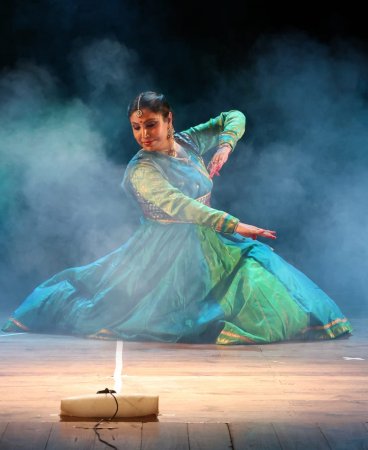 Sangita Chatterjee 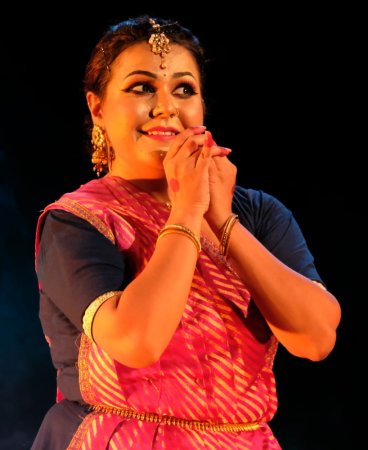 Trina Roy Following in her footsteps was Trina Roy, a direct descendant of Kathak maestro Pt. Jailal Maharaj. She is known for her graceful abhinaya, rhythmic clarity, and refined Jaipur aesthetics. Starting with Guru Bhajan, she explored the various possibilities of Teental, presenting a selection of authentic Jaipur gharana compositions by Pt. Jailal, Pt. Ramgopal Misra and Guru Susmita Misra. A significant highlight of the performance was a eleven-beat cycle drawing the attention of the audience. "Rangeela Shambho," a traditional composition introduced into Kathak by Pt. Kundanlal Gangani was her grand finale. 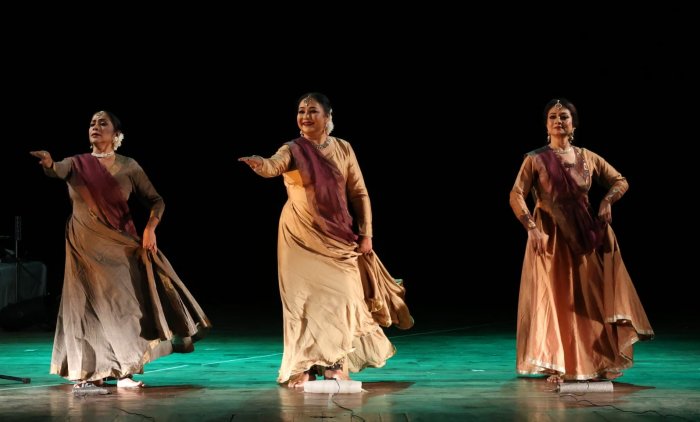 Luna Poddar, Paromita Maitra, Susmita Chatterjee Kathakas Luna Poddar, Paramita Maitra and Susmita Chatterjee who have trained under great names were ably supported by Biswajit Pal and Subir Thakur on the tabla, Chandrachur Bhattacharjee on the sitar, Umesh Misra on the sarangi and vocalist Arindam Bhattacharyya who mesmerized the audience with upaj in teentaal followed by explorations of various rhythmic intraforms, tukra, paran set to 16 beat time cycle showing their immense command over nritta. They danced their way into the hearts of the audience with the ghazal "Shahar dar shahar", which highlighted the trio’s exploration in the field of abhinaya. With the famous shayari written by Gulzar "Yeh kaisi umar mein aakar mili ho tum", they ended their recital. 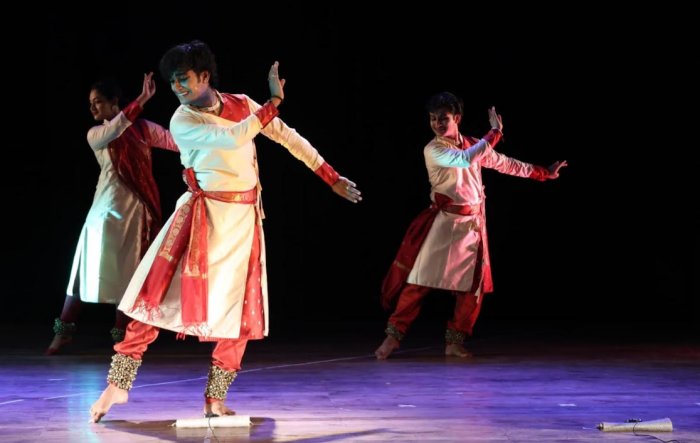 Rajib Ghosh and company The evening warmed up with the group presentation of Rajib Ghosh and company, Souvik Chakraborty and Pt Rajendra Gangani. Trayam presented the philosophy of three bodies and three souls coming together. It explored the idea that when three individuals move together in harmony, they become a single unified presence. The performance unfolded in three distinct yet interconnected sections. The opening segment, Shiva Stuti, depicted the sacred connection between Lord Shiva, the river Ganga, and the Earth, symbolising cosmic balance, energy, and harmony. This section established the spiritual foundation of the work. The second segment set to taal Dhamar exhibited the technical brilliance, rhythmic precision, and synchronicity of the three dancers, highlighting discipline, structure, and excellence. Tirvat presented a perfect blend of bol, sargam, and sahitya. This harmonious blend created bliss. In it, elements merged seamlessly into one expressive whole. This performance was possible because of the invaluable guidance of Guru Pt. Rajendra Gangani, who had choreographed the production. 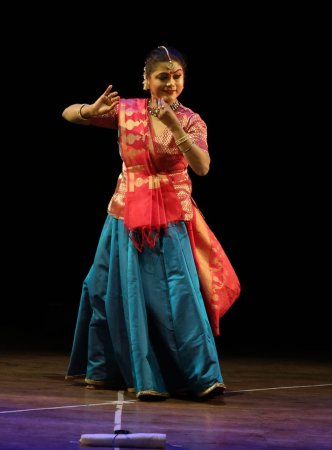 Pallabi De 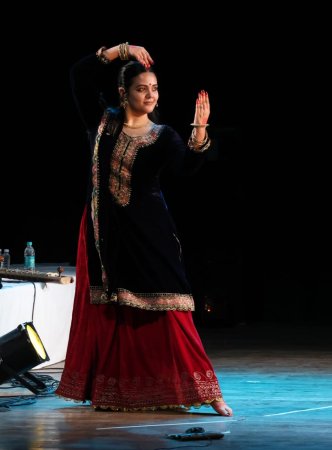 Saberi Misra Pallabi De trained meticulously under doyens of Lucknow gharana by Kanan Sen, Pt Birju Maharaj and Saswati Sen regaled the audience with her excellence. Saberi Misra, an Indian classical artiste based in London, belongs to the grand lineage of Jailal Maharaj and is the granddaughter of late Nrityacharya Pandit Gopal Misra and Guru Susmita Misra. Interestingly Saberi started her performance with an invocation through an alaap in raag Marwa - a beautiful evening raag - which she sang herself, along with improvised movements and expressions. She then began the technical part of her repertoire with upaj and thaat in vilambit teental, followed by Jaipur gharana’s compositions in both vilambit and madhya laya, all of which she recited herself while dancing. Saberi also improvised on stage by creating compositions and adding movements to them, emphasizing the tradition of ‘khula nach’. She then moved on to a 9 beat cycle which she performed without the help of accompanying artistes, but only with the aid of ‘taali’ and ‘khaali’ after which she swiftly moved to drut teental in which she once again performed some special Jaipur gharana compositions of her ancestors, gurus and herself and concluded her performance with ‘tatkaar’. She was accompanied on stage by her father and guru Pt Rajkumar Misra and on sarod by Sunando Mukherjee. 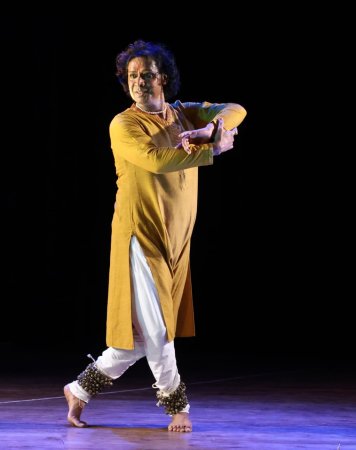 Abhay Shankar Mishra Abhay Shankar Mishra is a Kathak exponent, choreographer, researcher, and educator. He is the youngest son of tabla Shiromani Pt. Gama Maharaj, and is trained in each and every Kathak gharana, as well as tabla and pakhawaj, shaping him into a versatile artiste. He has received his advanced training from Pandit Birju Maharaj, Urmila Nagar of the Jaipur gharana, and Pandit Pandey Maharaj of the Benaras gharana. Abhay Shankar Misra began with a powerful Kaal Bhairav Ashtakam - a Sanskrit hymn of 8 verses dedicated to Kaal Bhairava - a fierce form of Shiva, composed by Adi Shankaracharya in praise of the chief of Kasi, the bestower of fearlessness, spiritual growth and salvation. He mesmerized the audience with his immense command over laya and rhythm while presenting traditional nritta repertoire of Kathak. He danced his way into the hearts of the rasikas dancing to the bhajan "Baal samay ravi bhaksh liyo" - Sankatmochan Hanumanashtak, a devotional hymn composed by Goswami Tulasidas dedicated to Lord Hanuman. The verse describes the mythological story of a young Hanuman mistaking the sun for a fruit and swallowing it, which caused a crisis in the universe. Abhay Shankar ended his solo recital with drut teental.  Tapati Chowdhurie trained under Guru Gopinath in Madras and was briefly with International Centre for Kathakali in New Delhi. Presently, she is a freelance writer on the performing arts. She is the author of 'Guru Gopinath: The Making of a Legend.' |
