
|     |
|
| |

 'Vivarta - Transformations' and 'Kalatra'- Chandra Anande-mail: chandra6267@yahoo.co.in February 11, 2026 Natya Veda was developed as the fifth Veda, as an easy way of disbursing precepts of the Vedas to the people. Methodology was to educate and enlighten the audience through entertainment. Natyashastra prescribes that "Natya is made of three elements viz. Poetry, music and dance". Just like all elements in a dish come together to provide one delicious taste, classical dance is best appealing when there is judicious amalgamation of "geeta, vadya and nritta". Members of the audience take away what appeals to them according to their knowhow of and experiences in the art form. Today, while the word Natya is synonymous with dramatic theatre, the word natyam is synonymous to dance. Consequently, the drama forms of theatre utilize dialogues and action with background music; the dance forms of classical dance employ nritya to express the narrative of thoughts in the poetry and nritta to behold joyous beauty of the art. The recent trend is to present productions in dance theatre format, where dialogues are part of dance presentations and even mix other dance forms for more easier connect. This, of course, seems to reach out well, also to those audience not having any orientation in classical dance. Two such productions were presented at the Cube auditorium of Nita Mukesh Ambani Cultural Center, Mumbai. VIVARTA- TRANSFORMATIONS Photo and Light credits: @The Cube, Nita Mukesh Ambani Cultural Centre, BKC, Mumbai. On 2nd January 2026, Shri Kalaa Mandir, Ohio, presented 'Vivarta - Transformations', a production in dance theatre format that expressed concern for environmental crisis and its rehabilitation. It was conceptualized by Guru Sujatha Srinivasan, artistic director of Shri Kalaa Mandir (SKM) and her daughter Shriya Srinivasan. "SKM's vision is to educate, enlighten and entertain through the art of Bharatanatyam, and thereby foster a cultural exchange". 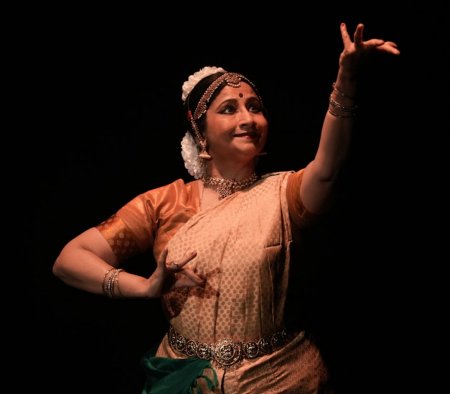 Sujatha Srinivasan In this presentation, Mother Earth (Sujatha Srinivasan) as the protagonist, expressed a totally contemporary problem of her environment being sullied beyond repair. She attempted to evoke the conscience of audience, towards repercussions of thoughtless attitude and disrespect towards the generous resources bestowed by nature on all living beings. She gave a wake-up call to human beings to stop the abuse of the natural phenomena's graces or be ready to face the wrath of Mother Earth. This original work on environmental conservation used Bharatanatyam idiom for gestures and included vachika abhinaya (dialogue) in English language. Clear confident dance movements and apt abhinaya was hallmark of this performance. The production at first showcased the creation of Earth. Artistes delineated through nritya and nritta the elements of matter that make up the universe, the creation of nature and its various environmental components like strong mountains and meandering rivers, sturdy trees and graceful creepers, the magnificent elephants and beautiful dancing peacocks, lively monkeys and spirited human beings. A jati was presented to show how humankind used resources of the earth to sustain themselves by farming. With eloquent actions that represented the processes done for the agricultural, the dancers regaled the audience. A verse from Atharvana Veda, "Yasyam samudra uta sindhur apo yasyam annam krrishtayah sambabhuvuh | yasyam idam jinvati pranad ejat sa no bhumih. purvapeye dadhatu ||", celebrated the immense power and evocative kindness that Mother Earth beholds. It conveyed that all living beings are born from her and also she is the power that mankind has to understand and seek out, so that they can be nourished by her. It is her blessings that brought prosperity and happiness to all. This was presentted by the dancers, in an enthusiastic combination of nritta and nritya. 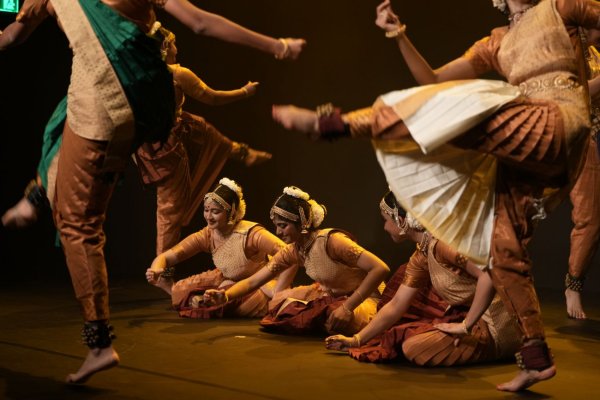 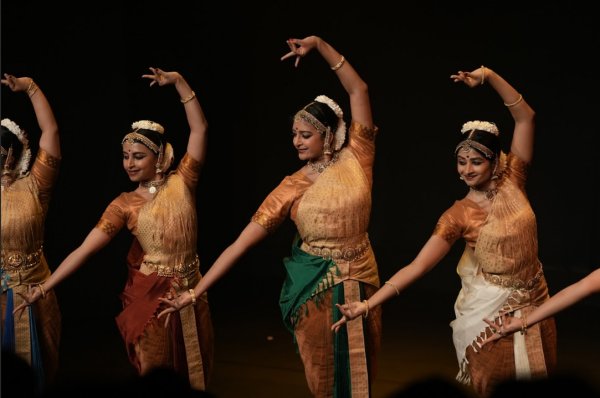 Vivarta The rising action brought the audience to the present times. Over time, the indulgence turns into negligence. Humankind's irresponsible use of natural resources is strained to a state of great vulnerability. The greed of mankind, moved man to erase forests, level down mountains, harness water for electricity and such many other deeds done, slowly wore down the environment. All this was shown with apt gestures and abhinaya, performed to effective music. The protagonist (Sujata) rises to lament her grief (tuyaram) riding on a vehicle of jati piece composed as "tuyaram ta di thom nam" and sequentially varied rhythmic phrases. Now the water stank and induced nausea, gases in air suffocated all and her soil got devoid of nourishment. Thus Mother Earth saw her body defiled and ruined. A heartfelt dialogue was used to give the wake-up call to humans to behave and restrain themselves. It's time to think of future generation and be sensitive to their contribution and effect on the natural landscape. At the climax, another electrifying jati was used to project Mother Earth's fury through floods, earthquake, volcanic eruptions. Realization dawns on the people, who beg her for forgiveness. Humans unite to restore and regenerate Mother Earth. A tillana was performed to celebrate that resolution. In conclusion, a homage was paid to Mother Earth, playing "Bhoomi Mangalam" composed by Pandit Ravi Shankar, from album 'Chants of India', with a dance of lamps. The presentation ended with hope and positive attitude. The dance was choreographed aesthetically and was well supported by a musical score that was totally complementary to the dance movements. The dance theatre production could gain with addition of poetry and inclusion of a Sutradhar instead of a voice over. The presentation was performed on recorded music. Lyrics and tunes were by Lalgudi G.J.R. Krishnan, Lalgudi Vijayalakshmi, M.S. Sukhi and Pandit Ravi Shankar. Dance choreography was by Sujatha Srinivasan and Shriya Srinivasan. The dancers were Sujatha Srinivasan and her students - Shriya Srinivasan, Nithya Kasibhatla, Sita Vakkalanka, Sweta Balaji, Samyutha Polaconda, Nandita Srikumar, and Sneha Upadhyayula. RASA TO ACTION 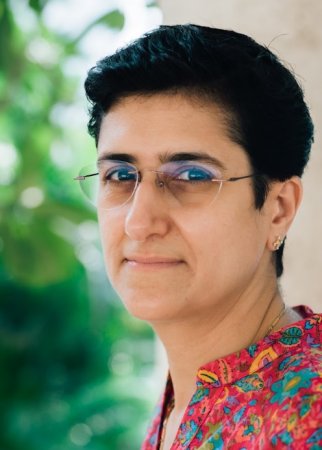
Dr.Rashneh N. Pardiwala This dance theatre presentation was followed by an enlightening talk by Dr.Rashneh N. Pardiwala that complimented the performance. Dr. Pardiwala is an ecologist (MSc & PhD, University of Edinburgh) and Founder & Director of the Centre for Environmental Research and Education (CERE) in Mumbai. She has led decades of impactful work in climate education, sustainability systems, afforestation, renewable energy, and environmental action across India. While the production 'Vivarta - Transformations' was a wake-up call towards plight of earth, Pardiwalla through her talk and exposition of slides expressed what we can do to reduce nuisance to earth. She explained with humans causing wreck to nature, air and water have been polluted. Destruction has taken place in all arenas of nature. Need of the hour is to "repair and heal" earth's resources. This will be possible with a change in the mindset of people and their consumerist lifestyle. The earth and its natural resources need to be cared for to sustain it for the future generations. Thus the requirement is to plant trees and bring back flora and fauna. The first step is to start conservation movements and plant trees in cities, particularly trees native to the area. Tree audit and digitization of the statistics need to be done to keep a record of work done and gauge the progress of rehabilitation. Solar electrified panels need to be set up and rain-harvesting trenches reaching the ground water need to be initiated where possible. Also carbon maps and caps have to be drawn out. The 4 R's were explained which are Reduce, Reuse, Recycle, and Recover/Refuse. Thus, move from "RASA to ACTION" was beckoned. KALATRA Light credits: @The Cube, Nita Mukesh Ambani Cultural Centre, BKC, Mumbai. On 16th January 2026, the Keelaka Dance Company, New Delhi, presented their production 'Kalatra' at the Cube auditorium of the Nita Mukesh Ambani Cultural Centre, Mumbai. Keelaka Dance Company (KDC) was founded by the Guru Shishya pair - Guru Jyotsna Shourie and her student Aneesha Grover. While Aneesha is Guru Jyotsna's student, Jyotsna is a very senior student of Guru Kalyanasundaram of Sri Rajarajeswari Bharatanatya Kala Mandir, Mumbai. The vision of KDC is to have a contemporary approach towards applying the art of Bharatanatyam, and to make available values inherent in the Indian traditional scriptures in a simplified manner, all the while sustaining India's cultural grandeur and eloquence. 'Kalatra' is a Sanskrit word primarily meaning wife or spouse. But, the word is referred in astrology to describe marital life issues (Kalatra Dosha) and relationships. So, this production brings to forefront conflicts the wives of Lord Murugan go through in their marital life due to him having two wives - one from the palace in the heavens and the other belonging to a tribe in the village on the earth. In fact, in the town named Kataragama in Sri Lanka, where Lord Murugan is worshipped by all religions (Hindu, Muslim and Buddhist) and indigenous tribes alike, the shrine of Deivanai is seen facing away from shrines of Murugan and Valli. Locals believe that this is because it pains Deivanai to watch her lord leave to meet Valli each night. On this premise of the Sri Lankan version, this work, where mythology meets fiction, was conceptualised and choreographed in a dance theatre format. The situation has the wives spar with words and compete to have the major time with their Lord, romantic situations with Murugan and their visits to marriage counsellor Kamadeva. Also the story where Murugan killed the demon Surapadman and got him turned as a peacock and blessed him to be his aide was enacted. Along with live dialogues spoken in English the presentation had a mix of Bharatanatyam and modern dance, and a mix of western and Carnatic music and beat boxing. The main highlight was the angika abhinaya and humour in this presentation. 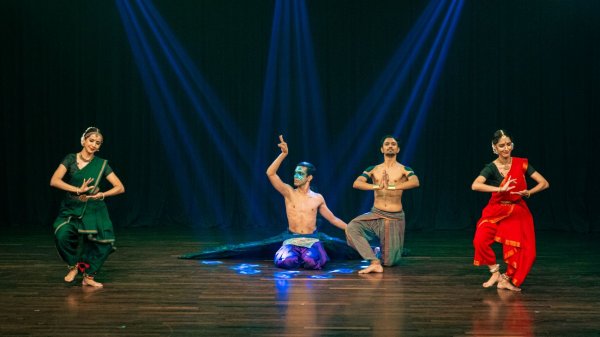
Aneesha Grover, Benjamin Jacob, Joe Mathew, Nandita Kalaan The presentation commenced with a short mallari performed by Valli (Nandita Kalaan) and Deivanai (Aneesha Grover). They appreciate each other and their fortitude, but smirk on the sides. Murugan (Benjamin Jacob) enters and all fall into a jati. Murugan dances contemporary dance while the girls dance Bharatanatyam. The two genres were well mixed and set to sollukattu of jati. The ladies start addressing Murugan to get his attention. One can see the formal language used by Deivanai and the informal one by Valli characterizing their different personas. Their perspectives of Lord Murugan differed, as Deivanai saw him as Lord of the world and Valli perceived him as her husband and lover. Then a romantic scene by Murugan and Deivanai is displayed and then another of Valli and Murugan. The romance choreographed was dignified, restrained and classy. The jatis, korvais and ardhis used to embellish the dance drama were interesting. In the dance choreography by Guru Jyotsna, all groups of adavus were given place in the nritta pieces. In fact one jati was in Kathak style, too. The hallmark of Guru Jyotsna's choreography is to seamlessly combine all styles of dance to reach out to a wider audience. The girls also danced holding their forms that was sanguine to their character. Deivanai carried a stately and graceful demeanor in performance and Valli danced the same adavus with light and lively movements. Thus the nritta was a joy to see which portrayed differences and similarities. 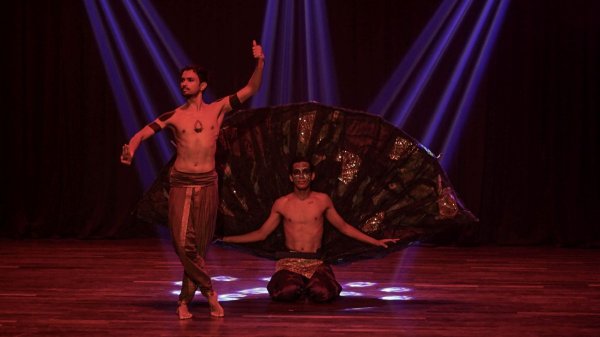
Benjamin Jacob, Joe Mathew Soon it's time for Murugan to go to the destined war with Surapadman (Joe Mathew). The fight ensues. Surapadman loses and he becomes the peacock, a vehicle and aide to Murugan. Surapadman is showed as having a strange, ugly form and his aggressive movements well expressed his demonic qualities and the amazing point noted was when Surapadman changed to peacock form, he becomes a handsome, elegant moving peacock. This whole piece was done using modern dance and composed on a jati sollukattu. Excellent choreography by Benjamin and Guru Jyotsna. The most hilarious scene was in the one where Deivanai waits for Murugan all night while he comes in the morning. She wonders where Murugan was all night, and angrily points out the telltale signs on his body of having been in dalliance with Valli. The scene had dialogues by Deivanai, nritya by Murugan. The humour in the scene was accentuated by beat boxing in the background by Joe Mathew and the references of one-liners from TV serials like 'phone a friend'. 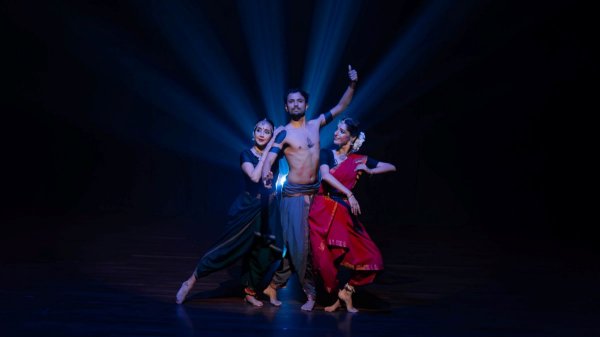
Aneesha Grover, Benjamin Jacob, Nandita Kalaan The surprise in the presentation was the contemporary take on the situation, where each of the Lord's consorts visit Kamadeva's clinic to solicit marital advice. An amused Kamadeva avers that in these times he not only has to have these couples married but also ensure that these marriages last. While Valli complains of Deivanai trying to covet more attention from Murugan, Deivanai in her visit says how could the Lord of Devas who is always busy looking after the universe fall for a tribal. She suspected a definite hand in the alliance, and lo as the match-making scene of Valli and Murugan was revealed, the culprit is made known. Here the character of Kamadeva too was projected denoting the affectionate play he has with bees which are part of his armor of arrows. Finally, all ends well, when both ladies decide to stay united and live like sisters. A tillana followed to celebrate the family of four (including peacock). The performance has been conceptualized by Jyotsna Shourie and Aneesha Grover. The script was written by Aneesha Grover. The awesome performers were Nandita Kalaan (Valli), Amrita Sivakumar (Kamadeva), Aneesha Grover (Deivanai/ Devasena/ Deivayanai) - all are students of Guru Jyotsna Shourie. Benjamin Jacob (Murugan) runs Modern Dance Company and Joe Mathew (Surapadmasuran / Tarakasuran and peacock). Music was by Daniel B. George, O.S. Arun and Madstarbase. The performance was danced to recorded music and beat boxing. 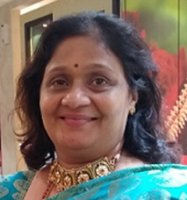 Chandra Anand is a Bharatanatyam artiste and teacher. She has an MA in Bharatanatyam from Tilak Maharashtra Vidyapeeth, and her series on 'Education in spiritual values through Bharatanatyam' is featured in narthaki.com. |
