
|     |
|
| |

 Mauli - A timeless tradition of devotion- Vijay Shankere-mail: vijaydance@gmail.com February 8, 2026 Bharatiya Vidya Bhavan presented ‘Mauli - A timeless tradition’ based on the philosophy and compositions of Marathi saints like Gyaneshwar, Namdev, Tukaram and Janabai, performed with "ekaharya abhinaya" by Bharatanatyam exponent Bala Devi Chandrashekar from Princeton, New Jersey, at their auditorium in Mylapore, Chennai on 9th January. Saint poets like Gyaneshwar, Namdev and Tukaram proved the point that devotion to the Almighty is not restricted to the supreme community of Brahmins, as they belonged to Bhakti movement that opened the doors of the temples to everyone, irrespective of any caste or creed. With utmost devotion everybody can reach out to the supreme level of consciousness, which was evident in the elevating performance by Bala Devi. Panduranga Vittala of Pandharpur, situated on the banks of the river Chandrabhaga explores the philosophy of Nama Sankirtanam, chanting of the Divine Name, as articulated in the Srimad Bhagavatam celebrated by Adi Shankaracharya and lived through the saints of Maharashtra Varkari tradition. 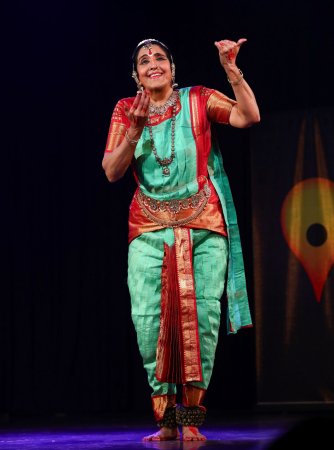 The solo dance drama exposition commenced with Act 1 with the congregation of pilgrims in Alandi and Dehu for the pilgrimage to Pandharpur exploring Adi Shankaracharya’s vision of Panduranga as "Parabrahman" with the rendition of Sant Tukaram’s "Jai Jai Rama Krishna Hari" (salutations to Rama and Krishna) and "Udand Pahile Udand Aikile" (I seek and hear the chants of the Lord), followed by “Namacha Bazar Patrika", "Chala Pandharis Jaun" and "Kare Prema Matlasi", as the pilgrims move forward chanting varied names of the Lord. Act 2 portrayed the arrival of the pilgrims at Pandharpur and they are excited to get the darshan of their Lord Panduranga, each devotee trying to reach out to the Lord. Bala Devi here picturised the devotion of the domestic maid Janabai who considers the Lord as her friend as the Lord undertakes all the domestic duties of the house like washing of clothes and cleaning the house and she sings songs in his praise with deep gratitude. While Namdev surrenders with childlike innocence, Gyaneshwar's radical vision of divinity in all beings are revealed in his renderings. Dhyaneshwar sings attributes of his physical form in "Roopa Pahata Lochani", while Namdev praises the Lord with varied offerings in "Teertha Vitthala, Kshetra Vitthala". Undoubtedly Bala Devi is a versatile performer, shifting to varied scenes with dexterity and effortless ease, combining the classical and folkish element, thereby divinity is accessible to the devout and the ordinary. Act 3 portrayed the legacy of Sant Tukaram with soul stirring scene when Tukaram was forced to get rid of the 'abhangs' written by him as they were rejected by the puritans and the scholars who felt that godliness can be achieved only by the upper class of the community. While Tukaram reluctantly submits his manuscripts to the Indrayani river, it was a miracle to see all the manuscripts coming back to the shores of the river after some days, intact, without any blemishes or writings being washed away. In gratitude to the divine intervention, Tukaram wholeheartedly sings "Bolava Vitthal, Pahava Vitthal" (I sing in your praise and I see you everywhere) and “Khel Mandeiyela Valavanti Ghai" which further follows the philosophy that devotion transcends division with the chanting of the divine name - Nama Sankirtanam. 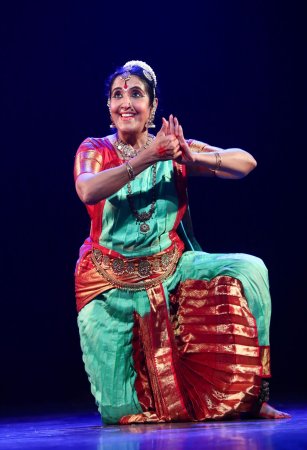 Mauli concluded with the divine awakening. Vishnu awakens on Kartik Ekadeshi, as the pilgrims feel rejuvenated and return home transformed and worship Tulasi - Damodara Kalyanam that symbolises the eternal union of devotion and divinity. Pandharpur is considered the Bhuloka Vaikuntha (heaven on earth) as every sound resonates with the name of Vitthala with renditions like “Sri Anantha Mudhsudana","Vitthala Kajari" and "Dhanya Dhanya He Nagari" (Blessed is Pandharpur). Mauli succeeds in spreading the message that divinity cannot be restricted to any particular language or community, it is for everyone. Mauli is conceived and choreographed by Bala Devi Chandrashekar with music by O.S. Arun. The script is crafted by Umapathy and Abhang Radhakrishnan with vocal renderings of O.S. Arun, Vinaya and Usha Raj with dynamic jathis composed and rendered by Sheejith Krishna, supported by a rich choral ensemble of Supriya, Preethi, Aarathi, Krishnan, Raghavendar, Sivamuth and Rithikeshvar. The music tapestry was further enhanced by Martin on tabla, Rakesh on mridangam, Kishore on sitar, Venkataraman on keyboard, Usija Nachiyar on veena, Sruthi Sagar on flute, Dr Usha Rajagopalan on violin, Mambalam Sivakumar on nadaswaram and shehnai.  Vijay Shankar is a Kuchipudi and Kathakali exponent, teacher, bilingual journalist, arts critic and actor. |
