
|     |
|
| |

 Glitch in the Matrix: Where Devotee meets Deity- Rajiv Rajamanie-mail: rajivrajamani@yahoo.com Photos: Rabin February 7, 2026 Maalyada: Andal's Sacred Garland Bharatanatyam by Rama Vaidyanathan HCL Concerts on Jan 16, 2026 at Narada Gana Sabha, Chennai The evening opened with a high-bar intellectual frame set by Jeysundhar D, whose book Maalyada served as the production's literary spine. His thesis was a challenge to the audience: to see Andal’s Thiruppavai not just as a collection of verses, but as a "levelling up" through the Nava Vidha Bhakti (the nine stages of devotion). From the first spark of listening (Shravanam) to the ultimate, ego-dissolving surrender (Atmanivedanam), the choreography used this evolution as its North Star. Eschewing tired contemporary deconstructions, Rama Vaidyanathan opted for a high-voltage, pure-Bhakti interpretation. Far from feeling dated, the dancers moved with a palpable, almost feral abandon, channelling ancient verses through a lens of total spiritual liberation. The journey began in the emerald heart of Srivilliputtur, Andal’s hometown. The choreography painted the anna vayal - those lush, vibrant fields where regal swans glide through the harvest. Here, Andal performed her most daring act of love: she draped the sacred Tulasi garland, meant only for the Divine, around her own neck. 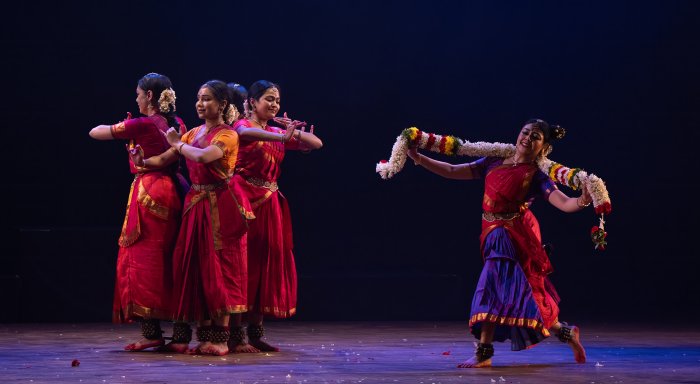 As she approached the mirror, the stage transformed into a liminal threshold. Using isomorphic partnering, Vaidyanathan blurred the line between the seeker and the sought. Two dancers moved in a hauntingly perfect, "empty frame" synchronicity - a glitch in the matrix of reality that deceived the eye into seeing a reflection. When Andal’s fingertips met the "glass," the flesh she touched was both her own and His. It was a choreographic sleight of hand that whispered a profound truth: the human soul is simply God looking at His own reflection through the eyes of the lover. The production thrived on this juxtaposition of mythology and metaphor. Krishna’s leelas became physical anchors for the soul’s abstract journey. Vaidyanathan’s genius lies in these cinematic morphs: a tree formed by swaying dancers, branches heavy with blossoms, dissolved seamlessly into a group of maidens harvesting the same flowers. The line between the seeker and the sought was perpetually blurred. We felt the light drizzle over the milking of the cows, which sharpened into the stinging arrows of desire. In one particularly electric sequence, Krishna’s form was both hidden and revealed by a writhing veil of cowgirls - a kinetic game of hide-and-seek with the Infinite. Moving away from the cliché of flapping arms, the image of Vishnu mounted on Garuda felt buoyantly alive, rising and falling with the atmospheric "lift" of massive wings. The "wanted list" of mythological villains - from the venomous Putana to the whirling Sakatasura - were rendered as a nightmare seen through the wide-eyed lens of a toddler, yet every "demon" eventually found peace at Krishna’s feet - a sublime execution of Padasevanam. Rama Vaidyanathan describes her approach as a move toward "emotional imagery," seeking to create "visions rather than visuals." By eschewing the “spectacle” of rigid angles and formations that often defines group work, she transformed the stage into an ecosystem. This was felt in the "curves in the paths" as Andal guided her companions toward Krishna’s door, moving in organic orbits rather than rigid lines. While the narratives are well-trodden, Vaidyanathan’s challenge was to tell the story through "abstraction and emotion." The result was a theatricality reminiscent of a refined Ragamalika; the performance wove signature and rare prayogas of movement, offering the audience a fleeting glimpse of each motif before exhaling into the next. 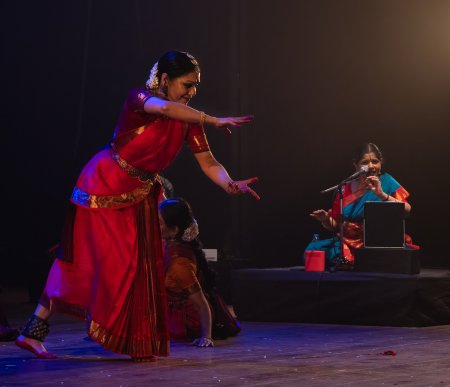 Like the shifting patterns of a murmuration, the ensemble of dancers moved in unison like a flock of starlings in the sky, constantly breaking apart only to coalesce into new organic visions. Their collective movement achieved that rare choreographic feat: a technical mastery so refined it felt entirely spontaneous. The narrative was a sophisticated dialogue between Vada Mozhi (Sanskrit) and Then Mozhi (Tamil), bridging the Upanishads and the Thiruppavai to show a spiritual language that is both ancient and immediate. There was a noticeable weight to the production, particularly during the Sanskrit interludes. When asked about the score’s solemnity, Rama Vaidyanathan explained that the "gravitas" was a choice of respect. She chose to honour the density of Maalyada, the source material, ensuring the dance remained a faithful reflection of the book’s intellectual heart while the jathi interludes provided a necessary kinetic release. These bursts of nritta acted as lighter, "rhythmic palate cleansers" amidst the heavy emotional weather of the poetry. The musical ensemble, led by the incomparable Sudha Raghuraman, didn't just play the score; they breathed it. Draped in a traditional madisar, her presence mirrored the Narada Gana Sabha’s historical soul as a venue for Namasankirtanam. Her sonorous voice moved with remarkable elasticity, pivoting from passages deeply laden with gamaka to moments of lighter, ethereal texture. In the exploration of the word “thozhudu” (to worship), in the line “Tuyomay vandhu naam, tumalar tuvi thozhudu”, her vocals in Brindavani Saranga seemed to physically lean into the syllables, "squeezing" every drop of rasa from the phrase until the entire hall felt drenched in adoration. The nattuvangam by Himanshu Srivastava and percussive support from Sumod Sreedharan and Sannidhi Vaidyanathan was soulful and precise, while Raghuraman Govindarajan’s flute provided the celestial breath of Venu Gana. Surya Rao on the lights completed the stage’s transformation. The production’s true triumph was the dissolution of the "fourth wall" between the dancers and the musicians. As Krishna’s cattle meandered through the pastures, the dancers literally wove through the orchestra, their bodies "enwrapping" the plaintive strains of raga Nilambari. The climax was a moment of communal rapture; the musicians were swept into the Namasankirtana, raising their arms like intoxicated Sufis. "The whole space had become Aayarpadi - Andal’s world," Vaidyanathan notes. 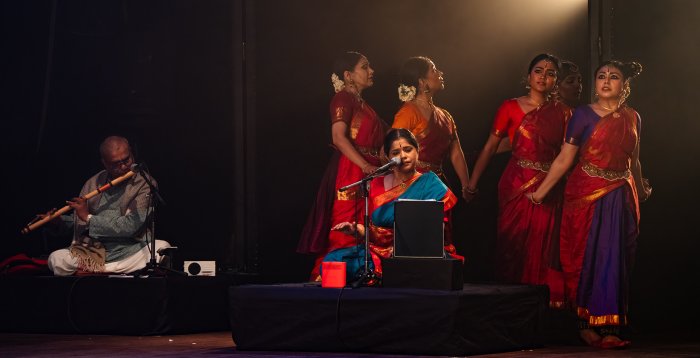 What lingered long after the lights dimmed wasn't just the technique, but the kinesthetics of emotion. Krishna’s kataaksha - that grace bestowing gaze - seemed to hang in the air; proof perhaps that this evening a little girl had somehow triggered a Matrix Glitch in the fabric of the material world.  Rajiv Rajamani is a film maker, author and connoisseur of classical music and dance based in Bombay, Auckland and Chennai (during the season). |
