|     |
|
| |

 A Growtowskian night in Irinjalakuda: Discussions on Western theatre and the Indian theatre tradition- Sona Mariae-mail: sona.maria.sj@gmail.com February 5, 2026 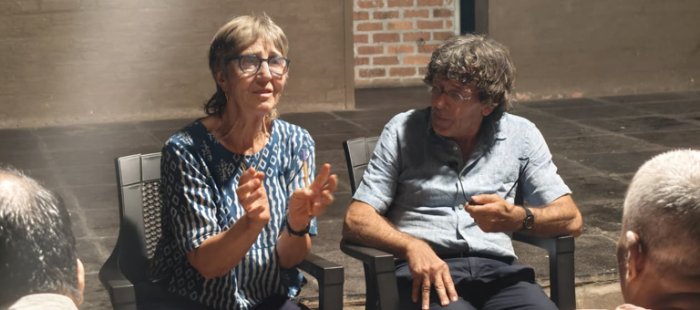 Francesca Catarci and Vito Di Bernardi at Natanakairali Navarasa Sadhana is a system of actor training developed by Guru G. Venu as a cornerstone for the daily practice and philosophies required of an actor. Now reaching its 130th workshop, it is renowned for its unique nature that draws from the studies and experiences of Guru G. Venu himself. From the Koodungallor Royal Family’s acting laboratories to Sage Bharata’s teachings in the Natya Shastra, to Leonardo Da Vinci’s use of the five senses in artistic practices and many more, Guru Venu’s extensive knowledge into traditional and worldly theatre, art and philosophies has shaped the unparalleled teaching system of Navarasa Sadhana. He always generously shares stories of mythology, history and theory with a warm smile daily in our classes as we practice the various exercises he has developed. The very important interplay between the Indian Theatre tradition and Western Theatre was poignantly discussed in our recent Navarasa Sadhana classes facilitated by Guruji with our guest speakers Francesca Catarci (director, author, and documentary filmmaker for Italian National Public Television) and Vito Di Bernardi (Professor of Performing Arts for the History of Dance and Dance Theatre in Asia at the University of Rome). It all starts with the distinguished Polish theatre and dramatist director and theorist, Jerzy Grotowski, who is one of the influences and a subject of intrigue for Guru Venu. Grotowski's experimental techniques centred around examining the limits of the physical and spiritual threshold of the actor. His theories were grounded in the physical experience of the actor as he pushed for the reliance of an actor’s body to tell a story. His pioneering methods were often labeled as paratheatre as he believed theatre was beyond the screen because it was a space where the spiritual and ritualistic could take place. His focus on the physical body as a source of energy combined with his intrigue of Indian spirituality brought him to Kerala in the early 1980s. Parallel to that, Francesca and Vito 40 years following Grotowski arrived in Irinjalakuda, Kerala, at the Natanakairali centre to learn about and document Guru Venu’s transformative Navarasa Sadhana workshop. Guru Venu had mentioned Grotowski’s influence on the world of theatre as we ventured deeper and deeper into exercises and theories of Navarasa. Here, by some mysterious serendipity, it was revealed that Francesca had directly been a student of Grotowski himself. On one of these evenings, with the cool breeze in the lush tropical trees surrounding the centre, Francesca kindly and openly shared with us her experiences of studying directly with Grotowski under his framework of theatrical practice. She told us that every day and night an array of exercises were led by guides selected by Grotowski from around the world, particularly from South America and India. Francesca strikingly said that he only appeared to the students at night and never spoke, which she describes as “a very powerful silent presence”. Francesca continued to delineate five of the exercises that she practiced under Grotowski’s instruction. ‘The Vigil, or Being Awake’ / ‘Turning’ / ‘The Run’ / ‘The Cave’ / ‘In the Woods at Night’ These varieties of exercises investigated different actions and physical states that allowed for a detailed insight into the individual's state of mind and spirit; As well as allowing themselves to observe themselves in concentration in these various states. For example, ‘The Vigil’, involved one student at a time being awake and monitoring others while they sleep and Francesca describes this experience allowing them to "perceive the dream or dreams” of the others who were asleep. She also describes ‘The Cave’ exercise as being the most challenging for her as she is claustrophobic, where the students went inside a cave, chose a position and remained “motionless like stones” just observing what is around them. We even got to try ‘Turning’, which was typically practiced both at dawn and at sunset on top of a hill where participants perceived the change of light as the sun rises or sets, while they turn themselves around. Our group, led by Francesca, practiced ‘Turning’, just as the bright red Indian sun set over the horizon across the fields. It was interesting as she made a note to not just see what is in front of us but also what is behind us. This reminded me quite a lot of one of the eye exercises that Guruji taught us, borrowed from Koodiyattam training, in which we visualise we are at the centre of a pond and our eyes map out the circumference, including the back of the pond, which we must visualise as we move our eyes around the imaginary circular area. Both exercises involved the refinement of an actor’s imagination as well as an opportunity to allow the actor to realise how important the sense of sight is to make narratives come alive in one’s mind and therefore the audience’s mind. All of these exercises Francesca described, reflected the essence of Grotowskian method that is rooted in the physical experience that acts as a vehicle for the actor to deepen that experience to one that is of a spiritual nature. Despite the extremity of all these exercises that test a person’s fears, limits and physical ability, Francesca stated so wondrously that it is “a most precious jewel”. The value of it came to her not just as an actor but as human being as it changed her reality and sensitivity to the world around her and to herself. Following her, Vito spoke on the importance of Konstantin Stanislavski who Grotowski was a “fanatic” of and therefore the link to him cannot be ignored. Stanislavski's contribution to Western theatre cannot be ignored either, especially in the work of improvisation, which was in the Western sense “born with him”. His school of acting philosophy centred around the idea of removing the theatrical artifice of an actor and beginning with oneself. Vito mentioned the idea of an actor starting at zero, when “there is no character” but rather the actor exists within the text. Vito identified the correspondence between the work we did in our Navarasa Sadhana workshops with the philosophy of Stanislavski. In the morning, we work on Rasas through the traditional training of Koodiyattam adapted and evolved by Guruji. And in the evenings we practice the Vyabhichari Bhavas through our own experiences and physical action. Vito also cites the Natya Shastra in contending that the morning sessions invoke Natya Dharmi (meaning simply put, stylised) and the evening sessions invoke Lokadarmi (meaning simply put, realistic). Drawing parallels between the frameworks of Stanislavski and Natya Sastra through the material of what we are practicing in our workshop, Vito highlighted the overlap of Western and Indian theatre in the dance “between the secret and invisible aspect” present in both. The fortuity that brought Francesca and Vito to this workshop allowed for us to have a deeper insight into theories, practices and philosophies of Western theatre and how they fit within the Indian theatre tradition. Moreover, it illuminated the parallels and influences of Indian theatre tradition on Western theatre that is so often overlooked. Being participants of Navarasa Sadhana gave us a deeper understanding of these concepts and how they may be applied or adapted into the things we are learning from Guruji. The happy coincidence of having Western scholars on theatre interact with Guruji has allowed us to witness fascinating conversations about the unstated influence of Indian theatre on theories of Stanislavski and uncovering the correlations that signify that. It was a rare whirlwind of a discussion of the history of world theatre that invigorated in all of us the profundity of acting and theatre.  Sona Maria is an actor and multi-disciplinary artist. |
