|     |
|
| |

 Anusmriti: Remembering Guru K. J. Govindarajan through Sound, Movement, and Memory- Dr. Parul Purohit Vatse-mail: preciousparul79@gmail.com Photos: Rahul Naag February 2, 2026 In the life of classical arts, some gatherings do more than remember - they listen. They pause the rush of the present to hear echoes of a master's voice, allowing memory to breathe, move, and find renewed relevance. Such events do not merely honour the past; they quietly shape the future by restoring lineage, context, and meaning to artistic practice. A seminar titled Anusmriti: The Living Memory of a Master, conceived and organised by Rashmi Khanna, was held on 23 November 2025 at the C.D. Deshmukh Auditorium, India International Centre, New Delhi. Envisioned as a reflective and scholarly engagement with the life and legacy of Guru K. J. Govindarajan, the seminar sought to restore critical attention to an artiste whose profound contribution to Bharatanatyam - particularly in the Delhi-NCR region - has shaped performance practice for decades, yet remains inadequately documented in formal academic discourse. 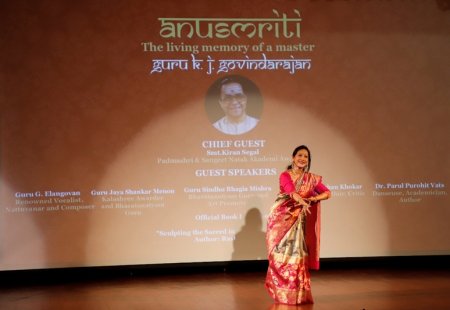 Ganesh Stuti by Rashmi Khanna The programme opened with the ceremonial lighting of the lamp, followed by a Ganesh Stuti composed by Guru K. J. Govindarajan and performed by Rashmi Khanna, with vocal accompaniment by G. Elangovan. Set in raga Hamsadhwani and adi talam, the invocation served as both a devotional offering and an artistic prelude, foregrounding the guru's musical sensibility and situating his creative voice at the centre of the seminar's narrative. An early highlight of the seminar was a documentary film created by Rashmi Khanna, tracing Guru Govindarajan's lineage, early life, artistic training, professional journey, and enduring legacy. Interwoven with rare photographs, archival reviews, and interviews with family members, disciples, musicians, and fellow artistes, the film functioned not merely as a biographical account but as a visual archive. It illuminated his multifaceted role as performer, composer, choreographer, and teacher, while underscoring the continuing relevance of his work across generations. In her welcome address, Rashmi Khanna, Director of Kalyani Kala Mandir, articulated the central impulse behind both the seminar and the monograph 'Sculpting the Sacred in Sound and Movement.' While Guru Govindarajan's influence has long been embedded in Bharatanatyam practice - particularly through his compositions and pedagogical approach - there exists no comprehensive scholarly study documenting the full extent of his contributions. Reflecting on her own encounters with his repertoire through performance and shared lineage, she spoke of discovering a striking gap between the reverence he commanded within artistic circles and his relative absence from academic and archival narratives. The seminar and the book, she explained, were conceived as acts of cultural recovery, bringing together family members, disciples, scholars, and practitioners to reclaim and contextualise a legacy shaped by music, innovation, devotion, and generosity. 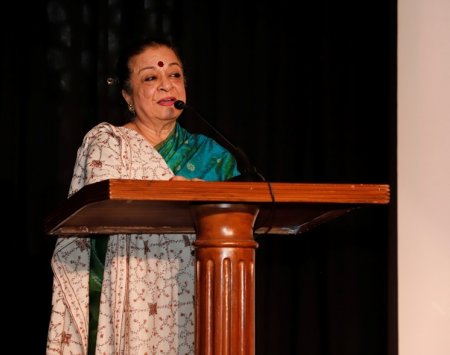 Kiran Sehgal 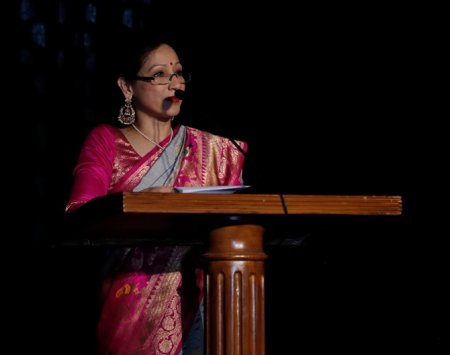 Rashmi Khanna giving the welcome address Kiran Segal opened the deliberations with an evocative and deeply personal portrait of Guru K. J. Govindarajan, fondly referred to as Anna. Recalling her association with him from the 1970s, she spoke of being introduced to him through Guru M.K. Saroja and of how this collaboration became a decisive turning point in her artistic life. Leaving Triveni Kala Sangam to work under his guidance, she encountered a teaching environment marked by calmness, trust, and devotion, distinct from the rigidity often associated with traditional training spaces. Learning unfolded without fear; mistakes were met with reassurance rather than reprimand. Her memories extended to shared tours and performances across India and abroad, revealing Guru Govindarajan's generosity as an accompanist and his extraordinary musical intuition. She recalled moments of instinctive dancing during performances, guided by an unspoken musical understanding, and his delight in such shared artistic intelligence. Speaking of his family, she reflected on the quiet pride with which he witnessed the artistic growth of his children, particularly his son Elangovan. Concluding her address, she acknowledged the enduring absence left by his passing and observed that the seminar brought together interwoven artistic lives across generations, affirming the living continuity of classical traditions. The seminar then witnessed the formal release of 'Sculpting the Sacred in Sound and Movement,' authored by Rashmi Khanna and edited by Dr. Parul Purohit Vats, and published by B.R. Rhythms. The monograph offers a rigorous scholarly examination of Guru Govindarajan's work as performer, composer, choreographer, and guru. Positioned at the intersection of practice and research, the book brings analytical depth to a body of work long transmitted through oral tradition and performance and underscores the importance of documentation in sustaining artistic lineages. 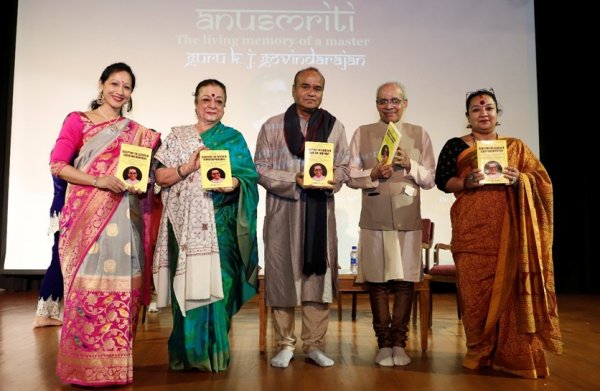 Rashmi Khanna, Kiran Sehgal, Guru G.Elangovan, Guru Jayashankar Menon, Dr. Parul Purohit Vats releasing the book G. Elangovan followed with a detailed and moving account of his father's life, weaving personal memory with historical context. He traced Guru Govindarajan's journey from his early career as a school art teacher in 1958 to his relocation to Delhi in 1960 alongside his guru, Sikkil Ramaswamy Pillai, and his eventual role as Head of Department at Triveni Kala Sangam. These choices, he noted, were shaped by responsibility and resilience, as his father supported his family while establishing himself as a central figure in Delhi's dance ecosystem. Detailing his father's prolific compositional output - ranging from prayers, pushpanjalis, mallaris, jatis, varnams, padams, tillanas, and dance dramas - Elangovan highlighted Guru Govindarajan's innovative approach to the Bharatanatyam varnam, including rhythmic sawal-jawab patterns and sensitive treatment of sahitya. Equally significant was his contribution to male-oriented repertoire, duet choreography, and the nurturing of dancers and musicians across genres. He concluded by affirming that his father's greatest legacy lies in the teachers and torchbearers he shaped. Guru Jayashankar Menon, Delhi's first male Bharatanatyam dancer, reflected on Guru Govindarajan as an enabling and transformative mentor. Initially trained in Kathakali and professionally employed at DRDO, he approached Bharatanatyam with uncertainty until Guru Govindarajan's quiet confidence dispelled his doubts. His training was marked by clarity, patience, and rigour, progressing systematically and without coercion. Encouraged by his guru, he eventually left his scientific career to commit fully to dance, a decision he identified as life altering. Through sustained guidance in performance, nattuvangam, and teaching, Guru Govindarajan enabled him to emerge as a leading performer and pedagogue, committed to preserving the integrity of the lineage. Dr. Parul Purohit Vats situated Guru Govindarajan within the framework of academic inquiry, emphasising the need for documentation that moves beyond personal reverence. Reflecting on the research process behind the book, she highlighted how understanding an artiste's personal, cultural, and historical context deepens interpretation and pedagogy. Legacy, she noted, is sustained not only through memory but through evolving lineages of ideas, ethics, and practice. 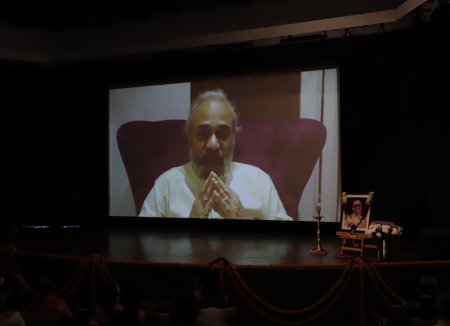 Ashish Mohan Khokar sharing his thoughts through a video Ashish Mohan Khokar recalled Guru Govindarajan's stature as a consummate nattuvanar and musician, closely associated with Guru M. K. Saroja during the formative decades of Bharatanatyam in Delhi. Soft-spoken, disciplined, and deeply musical, he elevated every performance through soulful singing and unobtrusive guidance, embodying a generation for whom music itself was the primary mode of communication. The seminar concluded with a Tillana composed by Guru K.J. Govindarajan, set to raga Hindolam and adi talam, performed by Sanjana Kumar and Arushi Bahl, senior disciples of Rashmi Khanna. The presentation offered a fitting artistic closure, embodying the musical vitality and choreographic clarity that defined the guru's legacy. In her vote of thanks, Rashmi Khanna expressed gratitude to the Chief Guest, speakers, artistes, scholars, and supporters whose presence enriched the seminar. She acknowledged the collective effort that made Anusmriti a space of remembrance, reflection, and renewal. 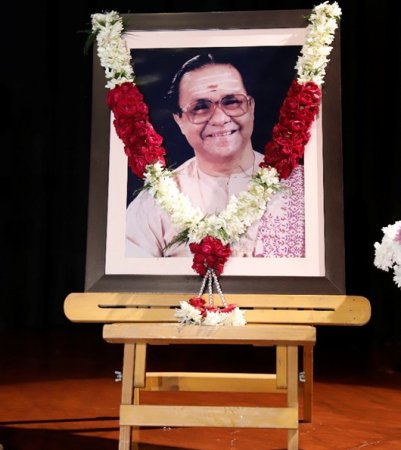 Late Guru K. J. Govindarajan 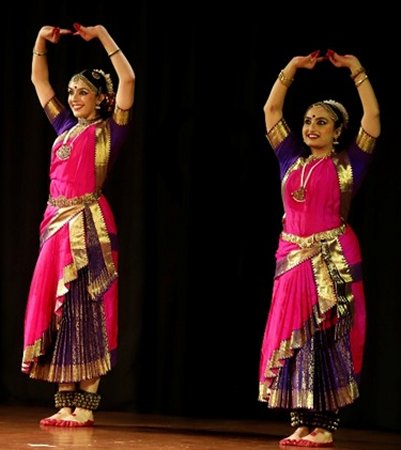 Sanjana Kumar and Arushi Bahl 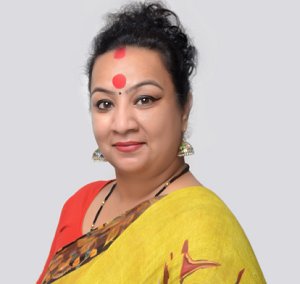 Dr. Parul Purohit Vats is an eminent Kathak dancer, choreographer, author, and educationist, currently serving as Dean, School of Performing Arts, World University of Design, Sonipat. A PhD in Music from Jai Narain Vyas University, Jodhpur, she is a recipient of various scholarships and awards. With over two decades of experience in arts education, she has led prestigious institutions including Sri Ram Bharatiya Kala Kendra. An accomplished academician, editor of international conference proceedings, and an active Hindi-English translator for scholarly and media publications, she continues to bridge classical tradition with contemporary pedagogy, shaping the future of performing arts education. |
