
|     |
|
| |

 Naivedyam: When offering becomes experience- Anurag Chauhane-mail: anuragchauhanoffice@gmail.com Photos: Humans For Humanity January 29, 2026 In the Indian spiritual thought, Naivedyam is the first act of surrender, an offering made before the self partakes. It is a moment of pause before possession, a recognition that nothing is first owned by the self. Rooted in gratitude and humility, Naivedyam acknowledges the conscious ordering of desire and intent. When translated into performance, this principle becomes an ethic of restraint and attentiveness, where movement arises from awareness rather than assertion, and offering precedes experience. Arundhati Patwardhan's presentation Naivedyam embodied this philosophy not as abstraction but as lived experience. Performed in the intimate, earth conscious setting of Navdanya Farm (Dehradun, Jan 17, 2026), the work unfolded not as a recital but as a consecration of space, body, sound, and intent. Freed from the formalities of the proscenium, the performance gained a rare intimacy. The open landscape, the quiet presence of trees, and the natural rhythm of the farm created a contemplative environment in which dance emerged as ritual rather than display. Nature did not serve as a backdrop but as an active presence, heightening the inward quality of the choreography and sharpening the viewer's attention. 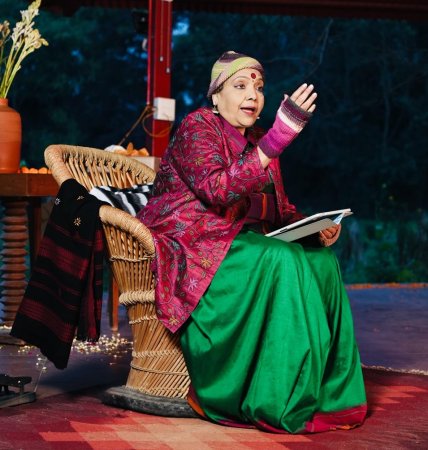 Dr Usha RK Conceptually anchored in the idea of Naivedyam as yajna, the work reminded the audience that consumption of food, art, or experience is preceded by offering. The philosophical framework of the presentation, conceptualised by Dr Usha RK, was articulated with clarity and restraint. In addition to shaping the conceptual arc of the work, Dr Usha RK also addressed the audience, explaining the significance of the mantras and chants used in the performance, allowing the ritual language to be received with awareness rather than abstraction. Meaning arose through movement, breath, and silence rather than exposition, allowing the ideas to unfold organically within the body of the dance. The choreographic language was firmly rooted in the classical grammar of Bharatanatyam while consciously engaging with the aesthetic framework of Nritya Ganga, envisioned by Guru Dr Sucheta Bhide Chapekar. Core principles of the form, including clarity of line, geometric precision, rhythmic integrity, and adherence to tala and laya, were maintained throughout. This was not an exploration that diluted classical structure but one that demonstrated how tradition can remain intact while expanding its expressive and musical vocabulary. The synthesis of Bharatanatyam's structured movement with the melodic expansiveness of Hindustani music was handled with intelligence and balance, allowing both traditions to coexist without compromise. 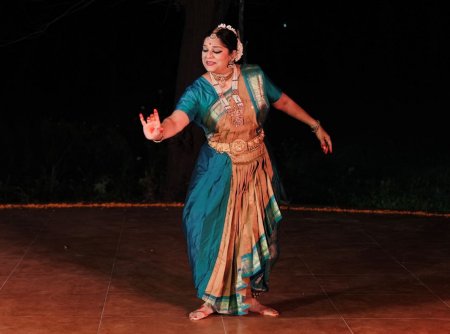 Arundhati Patwardhan Arundhati Patwardhan displayed a strong command over araimandi, weight distribution, and torso alignment, particularly noteworthy in an uneven outdoor setting. Her adavus were clean, grounded, and rhythmically precise, executed with economy and control rather than excess. Transitions were seamless, maintaining continuity of movement without disrupting the underlying geometry of the form. Hasta usage was articulate and contextually clear, while drishti anchored each phrase with intent, reinforcing narrative and rhythmic accents. The body remained responsive and alive within structure, reflecting mature training and internalised technique. Beyond her presence as a performer, Arundhati Patwardhan is a senior Bharatanatyam guru based in Pune and is closely associated with Kalavardhini Nrityashala and the Kalavardhini Charitable Trust, institutions founded under the visionary leadership of Guru Dr Sucheta Bhide Chapekar. Through her work across multiple centres, she has been deeply invested in pedagogy, mentorship, and the sustained transmission of the form. Central to her practice is an inclusive philosophy of education, extending access to classical dance to students from varied social and economic backgrounds. Her role as a guru reflects a commitment to continuity, discipline, and the idea of arts for all, where training is approached not merely as skill building but as ethical and cultural responsibility. Her abhinaya was marked by restraint and inward focus. Emotion unfolded through subtle modulation rather than overt dramatization, especially in the concluding Marathi bhajan where the idea of offering found its most intimate expression. The devotee asks Mahadev what he could offer him. If I offer you a diya, you carry Agni in your palm. If I offer you a necklace, you already wear the most beautiful sarpa around your neck. I can only offer you my aashru, my tears. This emotional culmination resonated deeply within the intimate audience setting. As the performance concluded, several viewers were visibly moved, with a few leaving the space quietly wiping tears. The response felt unprompted and sincere, arising not from theatrical excess but from the cumulative power of stillness, intention, and philosophical clarity. The emotion in the audience mirrored the offering on stage, completing the cycle of Naivedyam as shared experience. Her stance remained assured yet unselfconscious, suggesting a dancer grounded equally in rigorous training and contemplation. Moments of stillness were used with discernment, allowing the philosophical weight of the work to settle and resonate rather than being hurried forward. The musical ensemble comprising Hrishikesh Badve and Suranjan Khandalkar on vocals, Aashay Kulkarni on tabla, and Sunil Awachat on flute offered a sensitive and responsive accompaniment. The specially composed piece Naivedyam, with recording and mixing by Amod Kulkarni, complemented the choreography without overwhelming it. The music created a sonic space that supported reflection and inwardness, reinforcing the meditative quality of the performance. The residency was organised by Humans For Humanity, which for the past four years has been curating this annual engagement at Navdanya, bringing together artists, thinkers, and practitioners in dialogue with land, sustainability, and indigenous knowledge systems. Conceived as a space for reflection rather than production, the residency aligns artistic practice with ecological consciousness and social responsibility. Set within Navdanya Farm, founded by Dr Vandana Shiva, the world renowned environmentalist and advocate for seed sovereignty and biodiversity, the ambience itself shaped the experience. Surrounded by seed banks, open fields, and a living ecosystem consciously nurtured rather than curated, the farm offered a rare stillness. The air carried the quiet intelligence of a landscape that resists excess and values continuity. In such a setting, performance felt less like an event and more like a response, arising organically from the soil it stood upon. What lingered after the presentation was not a single movement or sequence but an overall sensibility. Naivedyam did not seek spectacle or immediate gratification. It invited attentiveness and presence. In a performance climate often driven by speed, assertion, and visual excess, this work chose depth, clarity, and quiet conviction. At Navdanya, surrounded by soil, seed, and an ethos of ecological consciousness, Naivedyam felt both contextually and philosophically inevitable. It served as a reminder that dance, at its most profound, is not an act of display but an act of offering, where the experience itself becomes prasada.  Anurag Chauhan, an award-winning social worker and arts impresario, combines literature and philanthropy to inspire positive change. His impactful storytelling and cultural events enrich lives and communities. |
