|     |
|
| |

 Soorya Youth Festival - A celebration of young artistes- Dr. Hareesh Narayanane-mail: haree@newnmedia.in Photos: Haree Fotografie January 24, 2026 In Kerala, the season of the School Youth Festival coincides with the Margazhi, and just ahead of the state-level finale in Thrissur, Thiruvananthapuram played host to another vibrant Youth Festival, organized by Soorya India as part of the 48th Soorya Festival. Though distinct in purpose and scope, Soorya's initiative holds particular artistic significance, offering aspiring dancers a meaningful platform to present their talent and demonstrate how they seek to carry forward the lineage of their respective gurus. Poised Bharatanatyam The Bharatanatyam presence at the festival included Gayathri Prasanth, a disciple of Kalakshetra Rakesh K.P., and Chippi Pillai, trained under Rajashree Warrier, among others. 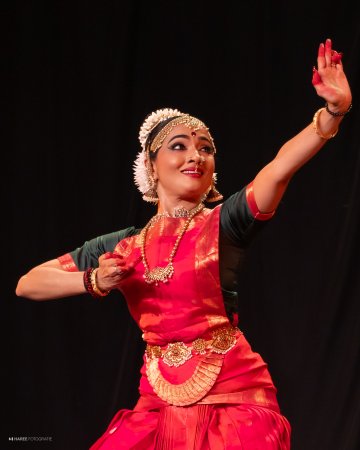 Gayathri Prasanth Gayathri opened with the expansive centerpiece "Sakhiye intha velayil...", a varnam in raga Ananda Bhairavi set to Adi tala. She allowed each adavu to unfold with measured grace, giving space for its beauty to flourish. Yet, transitions in the sancharis occasionally drifted from the rhythmic cycle, requiring a tighter alignment with the tala. While her restrained steps were charming, a touch more vibrancy and better use of the wider stage would have enhanced the presentation. The second piece was Jayadeva's ashtapadi "Kuruyadu nandana..." in raga Behag and Adi tala. Here, Gayathri conveyed the emotional depth intrinsic to the composition. Choosing to remain seated throughout lent intimacy, though it demanded greater effort to sustain audience engagement - which she managed to a considerable extent. Gayathri had the musical support of Uday Sankarlal on nattuvangam, Udupi Srinath on vocals, Sreerang C.T. on mridangam, Udupi Srijith on violin, and Sreejith Kammath on flute. 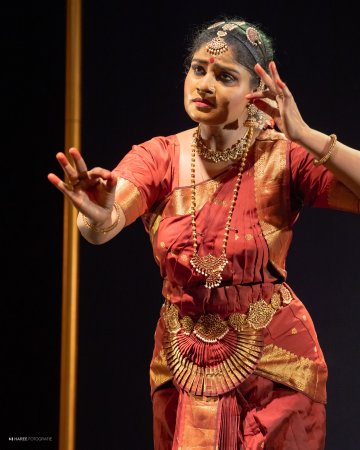 Chippi Pillai Chippi Pillai's recital reflected her guru Rajashree Warrier's sensibility for a gentler, nuanced approach that avoids excessive nritta. She began with the celebrated varnam "Mohamana..." by Ponnaih Pillai of the Tanjore Quartet, set in raga Bhairavi. The piece unfolded through layered emotional progressions, with the heroine's yearning and suffering expressed in fluid transitions of mood and intensity. Chippi's interpretation was noteworthy in abhinaya, though her nritta execution left scope for greater grace and sharper footwork. The use of a recorded track also seemed to limit spontaneity. She followed with "Saramaina...", a Swathi Thirunal padam in raga Behag, where the heroine conveys her deep reliance on Lord Padmanabha, and concluded with Lalgudi Jayaraman's vibrant Desh Thillana. Distinctive styles in Mohiniyattam The Mohiniyattam presence included Anghitha Pushpajan, trained under Methil Devika, and Uvika Aravind, a disciple of Sunanda Nair following the Kanak Rele tradition. 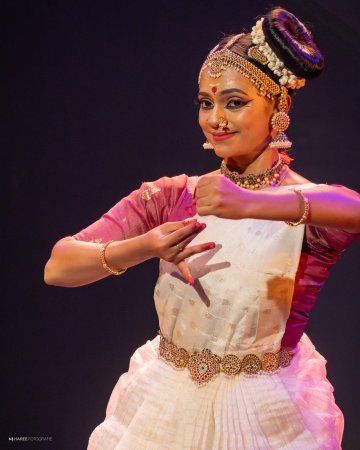 Anghitha Pushpajan Anghitha opened her recital with a cholkettu, composed and choreographed by Methil Devika. Beginning in perfect sync with the slow paced beats, she eased into the rhythm, allowing the piece to gather momentum and charm. This led into the Swathi Thirunal padam "Dhanyayayi njan innu..." in raga Navarasa and Khanda Chapu tala, where the heroine, reunited with her lover after long separation, conveys gratitude tinged with irony. Anghitha's portrayal was marked by innate grace, ensuring the subtle irony enhanced the joy of reunion. The recital culminated with "Hiranmayim Lakshmim...", a Muthuswami Dikshitar keertanam in raga Lalita, choreographed by Devika. Framed within an anecdote from Dikshitar's life, the piece underscored the futility of material pleasures. Anghitha enacted the characters with skill, then transitioned into a portrayal that honored the goddess through dance, distinguished by quiet elegance and steady control. She was supported by Methil Devika on nattuvangam, Ajeesh Menon on vocals, Mulamkadakam R.B. Ramjay on mridangam, Sajith Pappan on maddalam and idakka, Anandhu Krishnan on flute, and Nidhin Madhav on veena - together creating a rich musical experience. 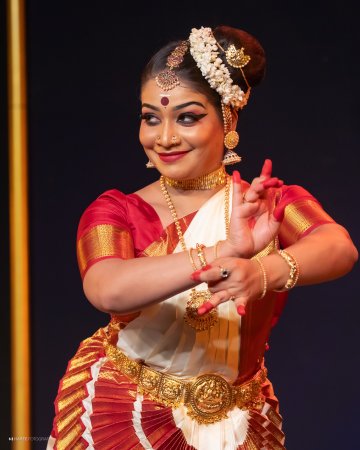 Uvika Aravind Uvika Aravind follows a totally different style, and her presentation titled 'Āmnāya' commenced with 'Ananda Ganapathi', a choreography of her guru Sunanda Nair. Though simple and straightforward in structure, the piece gained its appeal through Uvika's measured approach - never rushed, making full use of the stage space, and imbuing it with a quiet charm. The heart of her recital lay in two choreographies by the legendary Kanak Rele. The first, 'Ashtanayika', conceived decades ago, brings to life the eight archetypal heroines from Vasakasajja to Abhisarika. Uvika transitioned through each emotional state with remarkable ease, her expressions and movements shifting fluently to give every nayika a distinct identity. She concluded with Jayadeva's ashtapadi "Sakhi he keshi...". While such pieces are often presented with emphasis on lyrical emotion, here the dance was intricately woven into the sahithya, enriching its poetic essence. This integration is a hallmark of the bani, and Uvika adhered to the style with conviction and clarity, embodying Radha's yearning and her confiding in the Sakhi. Her recital was enriched by Sujesh Nair's soulful singing and nattuvangam, complemented by Prajesh Nair on mridangam, Sangeeth Mohan on violin, and P. Nandakumar on idakka. Kuchipudi extravaganza 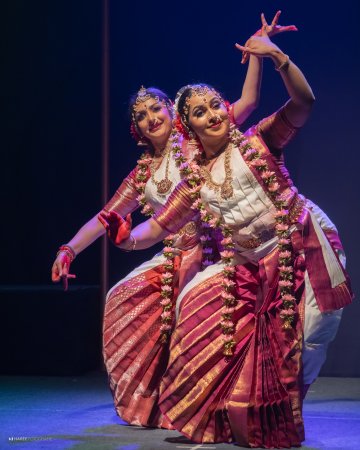 Rashmi Chowalloor and Vidhya Chandrika Audiences were treated to two Kuchipudi recitals, staged consecutively on a single day. The first, a thematic work titled 'Yadā', was presented by Rashmi Chowalloor and Vidhya Chandrika. Centered on the goddesses Lakshmi and Saraswathi, portrayed by Rashmi and Vidhya respectively, the production explored their debate on whether wealth or wisdom holds greater value. Their journey toward resolution formed the climax. With music composed by Bijeesh Krishna to lyrics by Bnim (Bhamidipally Narasimha Murthy), the work traced elements of a traditional Kuchipudi margam. The choreography was engaging, with shifts in mood between the goddesses mirrored effectively in the dance segments. Rashmi and Vidhya excelled in execution - their plate dance and footwork stood out for precision and clarity, complemented by expressive gestures. Subtle touches, such as Lakshmi questioning Saraswathi about carrying the veena while setting out to meet devotees, made the presentation more engaging. The use of vachika lent freshness, as the goddesses' dialogue reached into modern concerns - including accountability for AI's rapid rise. Yet the conclusion, where Brahma declares the ultimate truth, felt conventional. Much like the way the movie '3 Idiots' imagines passion as more vital than the pursuit of money, one could envision alternative endings where wisdom leads to wealth, or wealth is tempered by wisdom - perspectives that feel fresher than the familiar notion that the two must simply coexist. 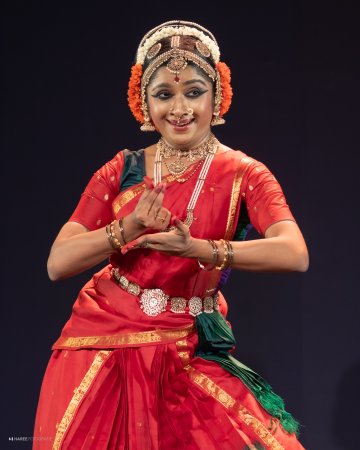 Aswini Nambiar Compared to the other performers, Aswini Nambiar enjoyed the luxury of more time, which she used to her full advantage. A disciple of Chinta Ravi Balakrishna, she adhered to the traditional margam format, presenting each piece with poise and authenticity. Following the customary invocation song, Aswini opened with "Vallabha nayakasya...", a Muthuswami Dikshitar composition in raga Begada, setting a dignified tone. She then moved into the sabdam 'Prahlada Pattabhishekam', narrating the tale of Prahlada and the Narasimha avatara. With vibrant footwork and expressive abhinaya, she captured the spirit of devotion triumphing over tyranny. The performance deepened with 'Madana Daruvu' from 'Bhamakalapam' in raga Anandabhairavi - a timeless Kuchipudi classic. Here, Aswini embodied Satyabhama's yearning for Krishna, bringing emotional intensity without losing composure. She continued with "Hariye gati...", a ragamalika keertanam by M. Balamuralikrishna in Adi tala, weaving through the Dasavatara and the tale of Bhasmasura, before concluding with a graceful mangalam. Her agile footwork and deft execution of dancing on the brass plate once again underscored her command of technique. Musical support was integral: Rachana Narayanankutty's energetic jathis on nattuvangam and Sruthy Chandrasekhar's melodic vocals provided a strong foundation, enriched further by Naveen Anandh on mridangam, Nikhil Aynoor on flute, and Muralee Krishnan on veena. Together, they created a vibrant soundscape that elevated Aswini's performance into a memorable experience. The performances unfolded at Ganesham Soorya Nataka Kalari during the opening weeks of January 2026. In addition to the artistes highlighted here, many other young talents also took to the stage, adding to the festival's vibrant mosaic of artistry. Together, these presentations reinforced the enduring spirit of the event and affirmed its place as a vital platform for nurturing the next generation of classical dancers. 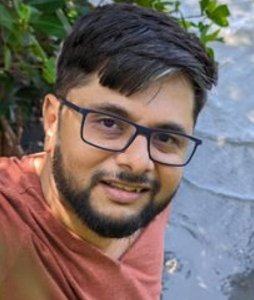 Dr. Hareesh Narayanan is a design and digital media consultant, author, photographer, director, and art enthusiast with a PhD in Computer Science. He founded NEWNMEDIA, Concept Studio, and Haree Fotografie, focusing on dance productions and photography, and also launched Artograph, a bi-monthly e-magazine dedicated to classical arts. He regularly writes about performing arts, has done several video productions, and has held dance photo exhibitions. |
