
|     |
|
| |

 The legacy of Manipuri Dance: Tradition, Evolution, and Global Relevance- Dr. Amrita Sengupta Duttae-mail: dramritasenguptadutta@gmail.com Photos: Gopinath Roy January 22, 2026 National Seminar on Manipuri Dance titled 'The Legacy of Manipuri Dance: Tradition, Evolution, and Global Relevance' by Guru Darshana Jhaveri and Professor Dr Sruti Bandopadhyay. Organized by: Department of Dance, Rabindra Bharati University, Kolkata Date: 14th January 2026 Venue: Uday Shankar Hall, Department of Dance, Rabindra Bharati University. 1. Introduction A National Seminar on Manipuri Dance, themed "The Legacy of Manipuri Dance: Tradition, Evolution, and Global Relevance," was conducted by the Department of Dance, Rabindra Bharati University on 14th January 2026. The seminar aimed to explore the spiritual, aesthetic, philosophical, and historical dimensions of Manipuri dance, along with its transformation over time and its influence on other Indian dance forms - particularly Rabindranritya. In the inaugural session, two eminent scholars and practitioners - Guru Darshana Jhaveri and Professor Dr. Sruti Bandopadhyay, Principal, Sangeet Bhavana, Visva-Bharati University - graced the occasion as keynote speakers and delivered insightful lectures, complemented by discussions and live demonstrations. 2. Inaugural Proceedings 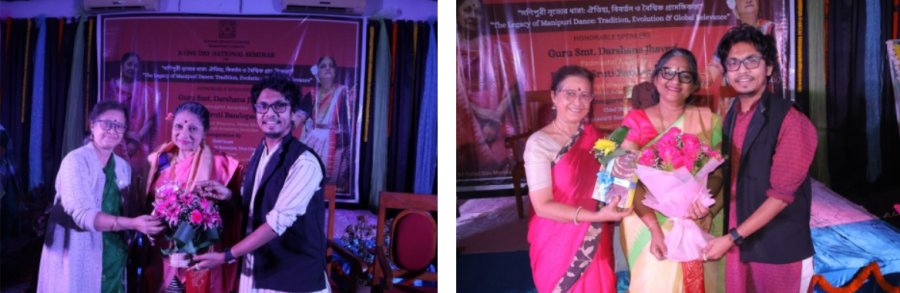 Felicitation by the coordinator Prof. Dr Madhuri Majumdar and convenor Prof. Rahul Dev Mondal The seminar commenced with the traditional lighting of the lamp, inaugurated by: Two honourable speakers along with Professor Dr. Madhuri Majumdar, Faculty Member, Department of Dance and Professor Rahul Dev Mondal, Convener of the Seminar, Teacher-in-Charge, Department of Dance and also present there were other teaching faculties. The programme was efficiently compered by Dr. Kaberi Sen, Guest Teacher of the Department. The organizational responsibilities were skilfully managed by Dr. Arpita Venkatesh, Dr. Debasmita Mukherjee and other faculty members, whose efforts ensured the smooth execution of the seminar. The active participation and cooperation of all faculty members, administrative staff, and students of the department played a significant role in the successful completion of the event. 3. Session I - Lecture by Guru Darshana Jhaveri 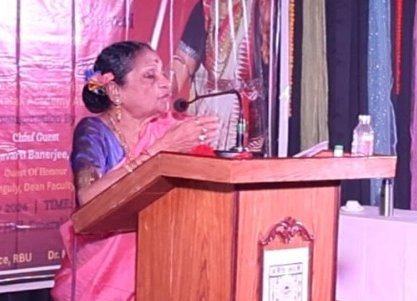 Guru Darshana Jhaveri Guru Darshana Jhaveri presented an in-depth lecture on the spiritual and ritualistic foundations of Manipuri dance. Her key points included:
4. Session II - Lecture by Professor Dr. Sruti Bandopadhyay 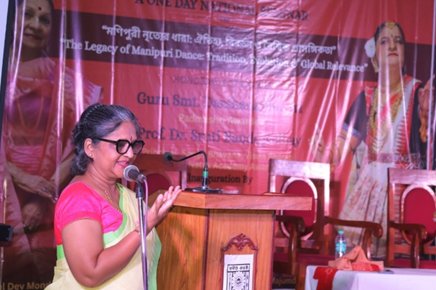 Professor Sruti Bandopadhyay Professor Sruti Bandopadhyay focused on the philosophical and aesthetic evolution of Manipuri dance. Her major areas of discussion included:
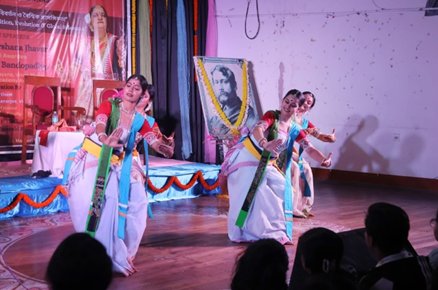 Practical demonstration by Visva-Bharati scholars under Prof Bandopadhyay's guidance. Professor Bandyopadhyay was further assisted by selected students and research scholars from Visva-Bharati University, including Shreya Mahato, Amrita Ghosh, Ratri Manik, Rajlakshmi Ghosh, and Samapti Chattopadhyay who also played a significant and constructive role in the session. 6. Outcome of the Seminar The seminar successfully:
The National Seminar on "The Legacy of Manipuri Dance: Tradition, Evolution, and Global Relevance" by department of dance, Rabindra Bharati University, was an intellectually enriching and artistically inspiring event. It served as a significant academic platform for dialogue between tradition and modernity in Indian classical dance. The lectures, discussions, and performances collectively contributed to a deeper understanding of Manipuri dance as a devotional, aesthetic, and evolving classical art form. Data courtesy: Meghna Thakur, M.A. 3rd Semester, Dance Department, RBU 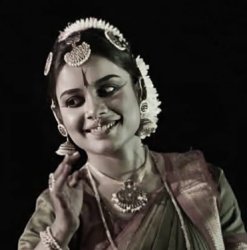 Dr. Amrita Sengupta Dutta is a scholar, performer, and Guest Faculty in the Department of Dance at Rabindra Bharati University, Kolkata. A Ph.D. holder and UGC-NET-qualified academic, she has served as a Senior Research Fellow at RBU. A recipient of the National Scholarship from the Ministry of Culture and a B-graded artist of Kolkata Doordarshan, Dr. Sengupta Dutta has authored three books and numerous research papers on Indian dance and culture. She is currently engaged in a research project funded by the Ministry of Culture, contributing significantly to the preservation and evolution of Indian performing arts. |
