
|     |
|
| |

 Gautam Marathe: The eye-level God- Rajiv Rajamanie-mail: rajivrajamani@yahoo.com Photo: Sejas Mistry January 22, 2026 Bharatanatya Manjari Endowment Program Madras Music Academy - Jan 10, 2026 In the hallowed, high-ceilinged silence of the Madras Music Academy, tradition sometimes feels heavy. But for Gautam Marathe, making his debut on this prestigious platform, tradition was less a burden and more a launchpad. Marathe didn't just perform; he recalibrated the space, bringing a high-definition, athletic urgency to the Bharatanatyam form that felt startlingly current. The evening ignited with an invocation to Shiva - "Shankara Sri Giri Natha Prabho" - that served as a definitive statement of intent. Marathe treated the stage not as a sacred pedestal, but as a kinetic playground. His training in contemporary dance was perhaps the evening's "secret sauce." When he extended into a Natta Adavu it bloomed into a Karana. To see a straight leg raised to the side with such effortless poise - devoid of the shaky "effort" often seen in other dancers - was nothing short of a thrill. 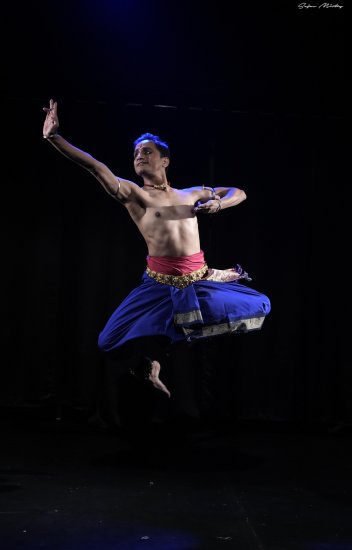 His coverage of the floor was predatory; he moved in leaps seeming to rise in slow motion, suspended at the apex of his jump, only to land with surgical precision exactly on the beat. The "trick" here - one known to elite ballet dancers - is the concealed, raw power of the lower body. The sheer torque of his launch was so refined that the resulting movement appeared weightless, a deceptive ease that only comes from gruelling conditioning. This prompted a veteran artiste in attendance to remark after the performance: "Gautam, even the grand proscenium of the Music Academy seemed too small for your leaps." The gravitational center was the Varnam, "Anjaneya Raghurama Dutam" (Saveri). Originally choreographed by the legendary Guru Kanak Rele for Marathe's mentor, Vaibhav Arekar, in the 90s, the piece felt reborn in Marathe's musculature. While his lower body operated with the rhythmic mechanicality of a high-performance engine, his sancharis (narrative segments) possessed the immediacy of an insta reel. Transitions were seamless - a frantic leap following the Golden Deer dissolved instantly into the chilling tension of Sita's abduction; the tragic slump of a fallen Lakshmana transitioned into a breathtaking visual of Hanuman lofting the Sanjivani mountain, executed as a soaring arabesque against an imaginary sky which left a trail of visual energy. If there was a minor fracture, it lay in the occasional literalism of a puffed-cheek simian face - perhaps a helpful signpost for some, but unnecessary for an audience already captivated by his metaphorical depth. Where many of the new generation rely on the artifice of "method acting" to mimic devotion, Marathe belied that notion with a genuine, searching Bhakti. His portrayal of Hanuman seeing Rama for the first time was the result of a personal pilgrimage to various Hanuman kshetras, seeking an internal epiphany he eventually found at a shrine in Andhra. In that moment, all physicality melted; it wasn't a performance, but a reflected truth that gave the work a rare, lived-in quality. This vulnerability carried into "Krishna nee begane baaro". Perhaps the evening's most subversive breakthrough was Marathe's refusal to lean on the "affected dalliance" of mother and child. In traditional Bharatanatyam, Vatsalya (parental love) is often performed through a hyper-stylized, almost saccharine lens - a series of "mothering" tropes that can feel performative and dated. He channelled a millennial realism, shrinking his presence to meet the diminutive Udupi Krishna. Ending each stanza on the floor - chin resting on hands, gazing eye-level at the deity - he stripped away the "Super God" tropes for an intimate, peer-to-peer connection. It was a reminder that sometimes the most powerful statement a dancer can make is to simply sit, look, and love. The program concluded with a Thillana in Ahir Bhairav, bringing a scintillating, atmospheric closure to the evening. Gautam Marathe represents a sophisticated evolution of the male dancer: possessing the technical rigor of the old guard, the conditioning of an athlete, and a meditative depth that meets the Academy's legendary standards. He proved that the classical form remains a living entity - as intellectually profound as it is physically spectacular. Perhaps most refreshing is Marathe's pragmatism; there was no time to bask in the debut's glow. Within twelve hours, he had packed and moved to his next performance in another city. In an ecosystem often criticized for its reliance on patronage and social influence, Marathe operates as a true full-time professional. By treating his craft as a rigorous, self-sustaining career rather than a side-interest, he offers a vital blueprint for the next generation. His success provides a rare, grounded hope for the sustainability of classical arts in the twenty-first century. 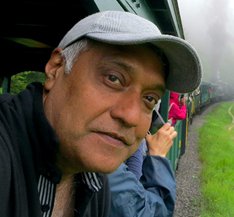 Rajiv Rajamani is a film maker, author and connoisseur of classical music and dance based in Bombay, Auckland and Chennai (during the season). |
