
|     |
|
| |

 Kintsugi: Golden fractures of the Mahabharata- Satish Surie-mail: satishism@yahoo.co.in Photos: Thunderstream Media January 22, 2026 On the evening of December 18, 2025, Chowdiah Memorial Hall in Bengaluru was filled with a quiet, concentrated intensity as Sampradaya Dance Creations presented the final stop of its international tour, Kintsugi. Conceptualised by Lata Pada and co-choreographed with artistic director Suma Suresh, this dance-theatre work drew inspiration from the Japanese philosophy of Kintsugi - repairing broken pottery with gold - to reimagine ruptured relationships from the Mahabharata. Rather than seeking catharsis through resolution or erasure, the production proposed healing through acknowledgement, where fractures themselves became sites of illumination and strength. 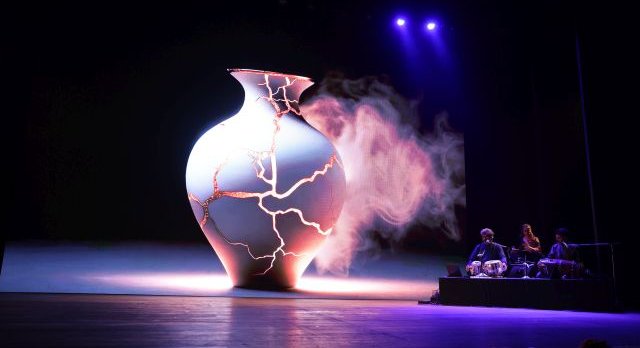 The choreographic language blended Bharatanatyam's sculptural precision with contemporary fluidity and eloquent abhinaya, creating a textured movement vocabulary that carried both gravitas and tenderness. Gestures of anguish softened into tentative embraces; bodies splintered and reassembled across the stage, mirroring the idea that vulnerability, when honoured, could become luminous. Golden lighting accents, metallic threads woven into flowing costumes, and seamless transitions between Bharatanatyam and Kathak formed visible "seams" across the stage - glinting reminders that pain need not be concealed to be transcended. 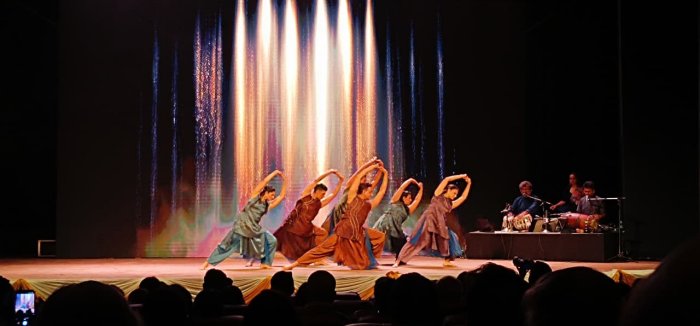 Animating this vision were six exceptional dancers: Atri Nundy, Purawai Vyas, Rachana Joshi, Harikishan Nair, Arun Sreekumar, and Tanveer Alam, rigorously trained in Bharatanatyam, Kathak, contemporary movement, and martial arts, who brought to life untold narratives of conflict, loss, and reconciliation. The epic's familiar fractures - familial betrayals, the anguish of war, and the relentless weight of dharma - were reimagined not as wounds to be merely mourned, but as golden seams revealing deeper resilience and unexpected beauty. The choreography unfolded as a masterful kinetic vocabulary: sharp, angular lines evoked moments of shattering rupture; fluid spirals suggested the slow, tender act of mending; and explosive group formations mirrored the chaos and moral disarray of Kurukshetra itself. Strategic moments of stillness - punctuated by spoken word and live music that fused Carnatic rhythmic structures with contemporary soundscapes, allowed the emotional weight of each episode to settle with quiet force. 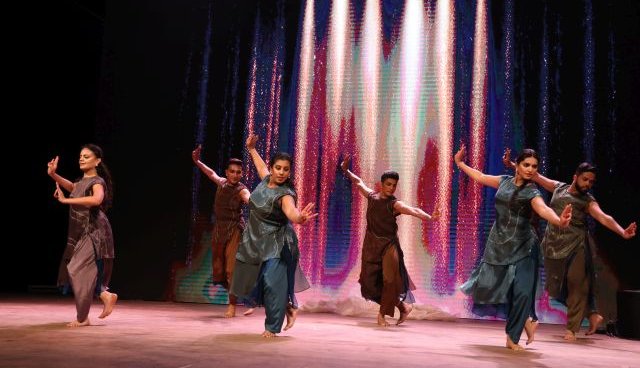 One of the evening's most arresting sequences was the retelling of Ekalavya's sacrifice. In a hushed, forest-like solitude, Arun Sreekumar embodied Ekalavya with grounded intensity and unwavering devotion, his movement reaching toward an absent guru with both reverence and resolve. Harikishan S. Nair's Dronacharya appeared in commanding silhouette, authority etched into sharp, uncompromising gestures. The climactic offering of the thumb was rendered symbolically rather than literally: fingers folding inward and extending in surrender, as crimson light traced golden pathways across the stage. Even in loss, Ekalavya's spirit remained undefeated, dissolving into swirling patterns that suggested eternal mastery. The scene laid bare the tensions of privilege and exclusion, transforming denial into a moment of gilded defiance rather than defeat. Equally compelling was the confrontation between Draupadi and Yudhishthira in the shadow of the dice hall. Rachana Joshi's Draupadi cut through the space with fierce angularity, her movements sharp with accusation as she questioned the silences that enabled her humiliation. Opposite her, Tanveer Alam's Yudhishthira appeared physically diminished, regal lines fractured into hesitant, guilt-laden reaches. Spoken word interwove seamlessly with abhinaya, heightening the emotional charge as Draupadi's body coiled and unfurled in waves of reclaimed dignity. Subtle shifts in golden light suggested the fragile mending of a bond scarred by betrayal, humiliation transmuted into shared reckoning. 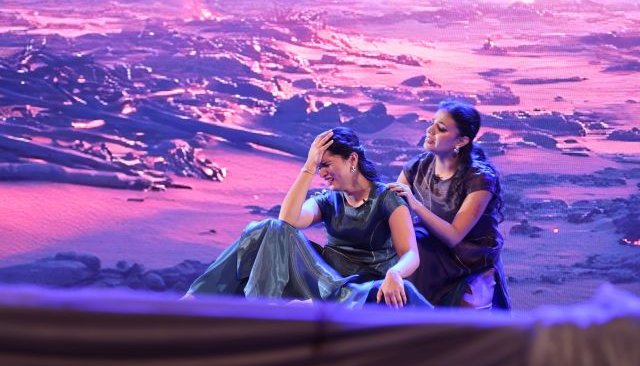 Kunti's eve-of-war revelation unfolded with poignant restraint. Atri Nundy portrayed Kunti as a mother suspended between love and duty, her body moving through fluid spirals that imagined sons united not as enemies but as kin. Facing Arjuna, she revealed the long-concealed truth of Karna's birth, her trembling hands articulating the weight of secrecy and maternal anguish. As inevitability closed in, gestures reached outward toward harmony and then recoiled in resignation. When golden light finally flooded the stage, it felt less like redemption and more like an acknowledgement of longing - the deepest of fractures gently illuminated. The emotional apex arrived in the final sequence centred on Dushala, the often-overlooked daughter of Dhritarashtra and Gandhari. Emerging from the ensemble with visceral force, Rachana Joshi embodied Dushala's grief and fury through trembling mudras and a body wracked with sobs. Her confrontation with Gandhari, portrayed with austere stillness by Purawai Vyas, was devastating in its intimacy. Blindfolded, Gandhari sat enclosed in rigid devotion, while Dushala pleaded - not only for sight, but for acknowledgement and shared grief. As the blindfold was finally removed, the choreography slowed to an agonising crawl: hesitant fingers, convulsing torsos, and then collapse, as golden light washed over visions of carnage. Mother and daughter fell into each other's arms, their fragile embrace offering a momentary mending amid swirling images of fallen warriors and mourning widows. The hush in the auditorium was palpable; many in the audience were visibly moved. 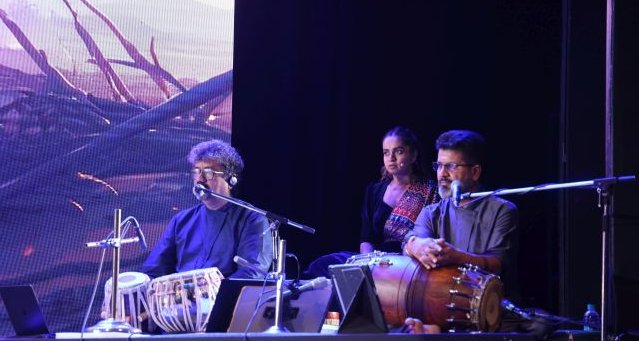 The music ensemble Trayam provided a richly layered aural landscape, with Praveen D. Rao on the tabla, B.C. Manjunath on percussion, and Varijashree's evocative vocals anchoring the emotional arc of rupture and repair. The score's seamless dialogue between Carnatic rhythmic frameworks and contemporary textures deepened the work's introspective tone. Lighting design by Bharat Vyas was integral rather than ornamental, sculpting mood and meaning with restraint and insight, and reinforcing the visual metaphor of scars transformed into gold. Kintsugi ultimately stood as a quiet yet profound meditation on healing. By refusing to smooth over the epic's wounds, it illuminated how brokenness - when faced honestly - could reveal new patterns of strength, resilience, and shared humanity. Like pottery repaired with gold, the Mahabharata's fractures were not hidden, but honoured, emerging as luminous testaments to endurance and grace. The program was presented by Param Foundation.  Bangalore based Satish Suri is an avid dance rasika besides being a life member of the Music and Arts Society. |
