|     |
|
| |

 Silver Jubilee year of Nritya Parva- Tapati Chowdhuriee-mail: tapatichow@yahoo.co.in Photos: Arup Jyoti Kalita January 22, 2026 The annual Nritya Parva was celebrated between 15th to 18th November 2025 at Srimanta Sankaradeva International Auditorium of Srimanta Sankaradeva Kalakshetra, Guwahati. This year marks the 25th year since Assam's Sattriya dance was granted the status of an Indian classical dance form. For Assam's cultural heritage it was a historic achievement. Renowned Assamese artiste Dr. Bhupen Hazarika played a key role in securing this recognition for Sattriya. Bhupen Hazarika (8 September 1926 - 5 November 2011) was a versatile genius - singer, a song writer and a film maker. He was blessed with a voice sweeter than a nightingale. He wrote lyrics in his mother tongue on humanity and universal brotherhood. His songs have been translated into many languages. He is a recipient of many prestigious awards such as the Sangeet Natak Akademi Award (1987), Padma Shri (1977), and Padma Bhushan (2001), Dada Saheb Phalke Award (1992) and Sangeet Natak Akademi Fellowship (2008) to mention a few. Though he was into singing Borgeet (the traditional classical Assamese devotional songs written by Srimanta Sankaradeva), he envisioned to bring about social change through his music. Considering the popularity of his songs, his success in this field is evident. As a singer, Hazarika was known for his baritone voice; as a lyricist, he was known for poetic compositions and parables which touched on themes ranging from romance to social and political commentary. During his lifetime, a full-length documentary titled Moi Eti Zazabor ('I am a Wanderer') jointly directed by Late Waesqurni Bora and Arnab Jan Deka was launched in 1986 at his Nizarapar residence in Guwahati city. 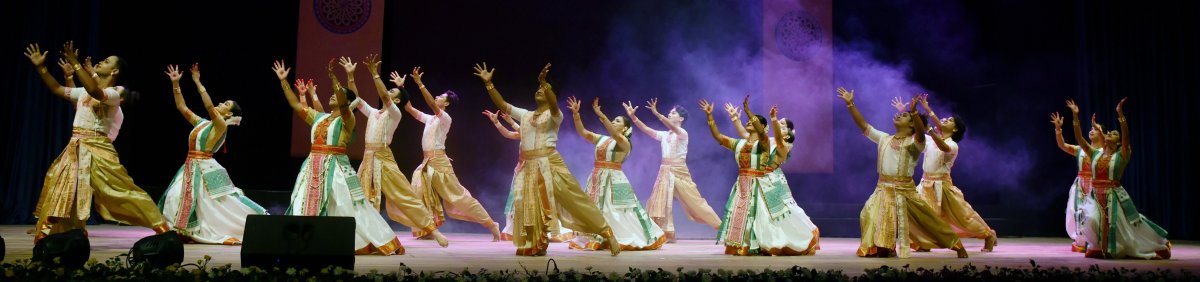 Jajabor Bhupen Hazarika It was for a good reason that Sattriya Kendra Centre for Sattriya Dance, Music and Theatre Traditions, Guwahati, of Sangeet Natak Akademi dedicated their Silver Jubilee year of Nritya Parva to Dr. Bhupen Hazarika to observe his centenary year. To observe this great event, Sattriya Kendra, Guwahati, presented 'Jajabor Bhupen Hazarika', choreographing some of the most popular of his songs into Sattriya dance form, which has developed in leaps and bounds since its emergence from the Sattras to receive its classical status. Skillfully scripted by Anil Saikia, it displayed the great man's life flow through backdrop excerpts of films. The dances on the epoch making lyrics of Hazarika choreographed by Ramkrishna Talukdar and Anita Sharma exhibited the enhanced richness of the form. 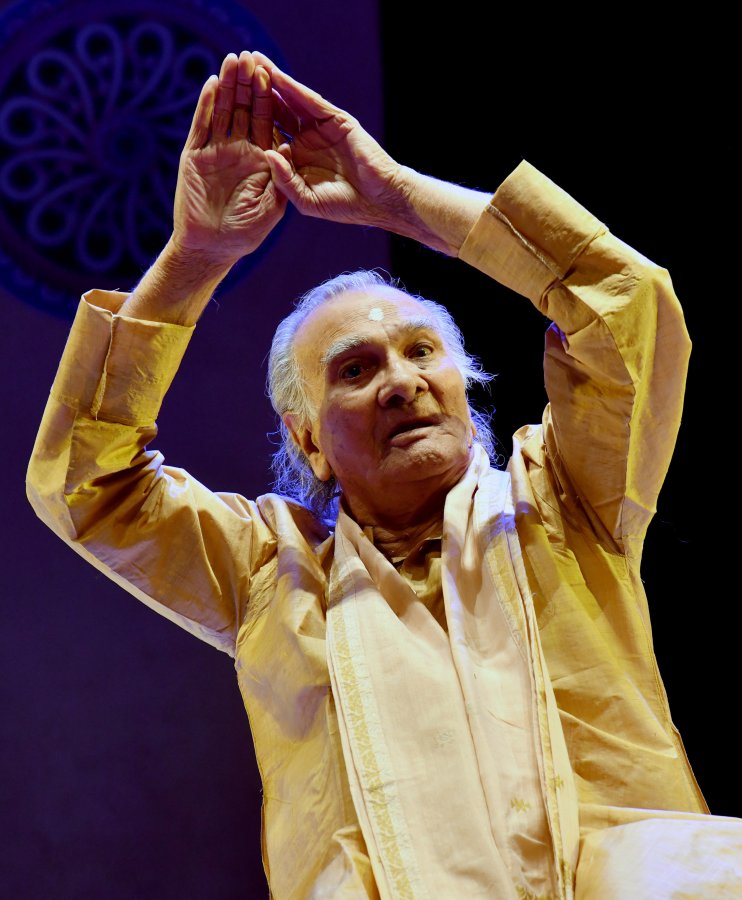 Guru Jatin Goswami In twenty five years, the dance form's treasure chest is brimming with phrases, idioms, sophisticated vocabulary and stylized expressions. Talking about the form and its development during this quarter century, Guru Jatin Goswami said that there has been a plethora of dancers engaged in enriching the form, in the truest sense of the word. Sustained in the element of intense bhakti, a lot of heads have been racking their brains with fresh ideas for its further evolution as a thing of great beauty, in keeping with its roots of bhakti. He added that previously khol and taal provided all the music, but realizing the importance of what music does to the enrichment of a dance form, many more instruments have been included. In place of a fixed music, now-a-days other compositions are being incorporated too. Guru Jatin Goswami added that in place of ten or twelve taals or rhythm patterns that were in use, Sattriya dance now has more than two score taals. Whatever changes have been conceived in all spheres of Sattriya dance the ruling rasa, he said, is based on pure bhakti sringar. Choreographers and performers should keep in mind its aesthetic beauty and not tamper with it with unnecessary fast paced jumps and other acrobatic movements to attract crowd, was his opinion. 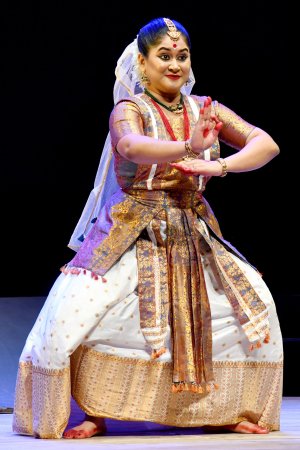 Seujpriya Borthakur Starting with a pure dance number as Chaali Nritya of female dance repertoire, set to thukoni taal and suta taal, Seujpriya Borthakur Goswami's solo performance reflected the genius of her Guru Jatin Goswami. Her presentation of 'Baanhi -The flute' explored the divine mystery of Krishna's flute and the reason for its being. Nature is the first element through which eternal rhythm causes the universe to move with its wave of melody and the seven holes of the flute represent the seven vital elements of nature. When Krishna places the flute to his lips and his gentle fingers move over it, the universe begins to dance. Seasons change, nature rejoices, and life feels complete. His touch breathes life into the lifeless bamboo, turning it into a soulful melody, which is the very reason to live. It is melody that sends vibrations across the universe and that is Krishna's divine magic. This divine truth was beautifully expressed by Mahapurush Sri Sri Madhavdev in his sacred Borgeet, "Hariro bangkhire bhai huniyo karono, Jihetu bongkhiro swore muhe tribhubono." The piece concluded with a shloka taken from Sangeeta Ratnakara written by Sarangadeva, where creation of swaptaswar is mentioned. There is a belief that the seven notes in Hindustani music were conceived from the sounds of nature. It is said, Shadaja (Sa) comes from the rapturous sound of the peacock when rain clouds gather in the sky. Rishabha (Re) is the bellowing of a cow when her calf is separated from her. Gandhara (Ga) is believed to be the bleating of a goat in a flock, while Madhyama (Ma) is the cry of a heron. Panchama (Pa) is the sound of the Indian Kokila (nightingale) in spring and Dhaivata (Dha) is the neighing of a horse. Nishada (Ni) is the trumpeting of an elephant. The beauty of the piece blossomed with the help of raag Borari and taal ek taal, sutkala, and saat taal woven into sonorous music by the musical ensemble of Arunabh Jyoti Malakar, Jyotishman Moran, Ripunjeet Bora, Rishi Barman and Nabajit Saikia, the khol player, vocalist, violinist, the artiste who kept rhythm and the flautist respectively. 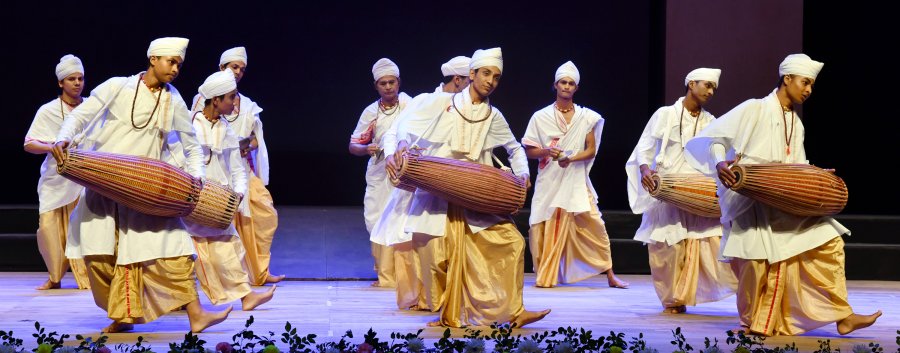 Gayan Bayan, Majuli 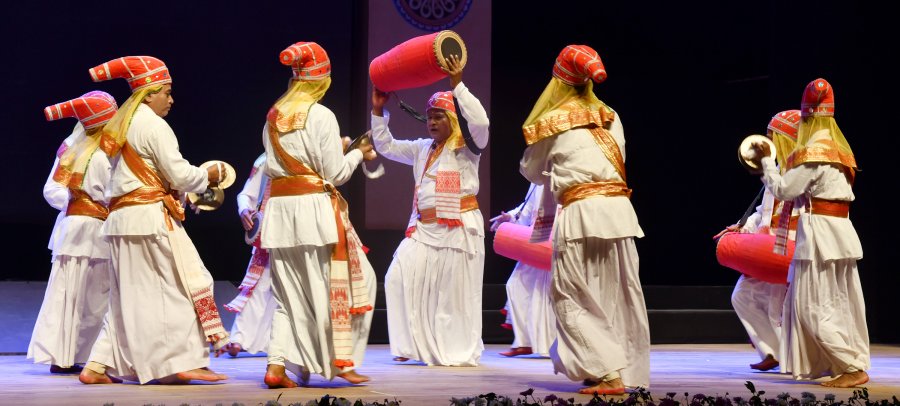 Mridangiya Gayan Bayan Gayan Bayan in Assam plays a vital role in the uplift of their culture. It is a religious dance performed by the disciples of Sankaradeva in Sattras. The phrase basically means singer and drummer. Bayans mainly use khols and cymbals. Interestingly Gayan Bayans differ according to the different Sattras and sects. The evenings' programs were launched with the performances of the Gayan Bayans. Sri Sri Dhuwahat Beloguri Sattra Kristi Kendra Narayanpur established in 1986 with an aim to propagate Sattriya Nritta, Borgeet, Natak etc. performed Gayan Bayan and commenced the festival. Kamalabari Sattra established in 1673, one of the oldest Sattras, set the ball rolling on the second evening. Tankeswar Hazarika Borbayan led the group in displaying a number of intricate talas and setting the mood of the festival on the third day followed by Janji Maranchiga Mridangiya Gayan Bayan group of Shivsagar under the supervision of SNA, New Delhi and Sattriya Kendra Guwahati on the final day's presentation of Kala Deeksha under the guidance of Haricharan Bhuyan Borbayan. The Silver Jubilee celebrations of Sattriya Dance Festival provided the serene beauty of Sattriya dance and its eternal devotional spirit. It reminded one of the Bhakti movement of Mahapurush Sankaradeva; a saint-scholar, poet, playwright, dancer, actor, musician, artist social-religious reformer and a figure of importance in the cultural milieu of Assam. The Bhakti movement that he started in the 15th and 16th century A.D. is as relevant today as it was then. I present here some of the highlights of the festival. 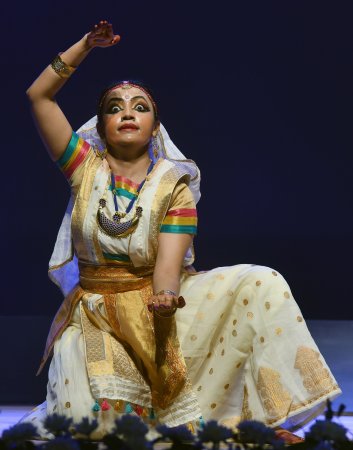 Anwesa Mahanta Anwesa Mahanta who is a name to reckon with in the field of Sattriya made the festival proud with her solo performance of Madhura Muruti. It began with a Nada in raga Reponi and a shloka penned by Srimanta Sankaradeva celebrating the enchanting music of Krishna's flute. Then came the Ramdani sequence of Chali Nach. Subsequently, she presented the Geetar Nach with a composition by Sri Sri Madhavdeva celebrating the mellifluous music of Krishna and its magical spell that changes the law of nature by enlivening the lifeless, and makes one who is in motion become motionless, thus evoking rasa sudha, entrancing the entire universe. The dancer concluded the presentation with Mela as a symbolic and philosophical representation of joyous liberation. In a celebratory note of Madhura Muruti, Anwesa displayed the significance of Krishna's flute and how the notes of his flute evoke prana shakti encompassing the panchatatva that gradually enlivens the chakras of the human body. The piece was in raga Ashavari and the talas used were parital, ektal, rupganjal. 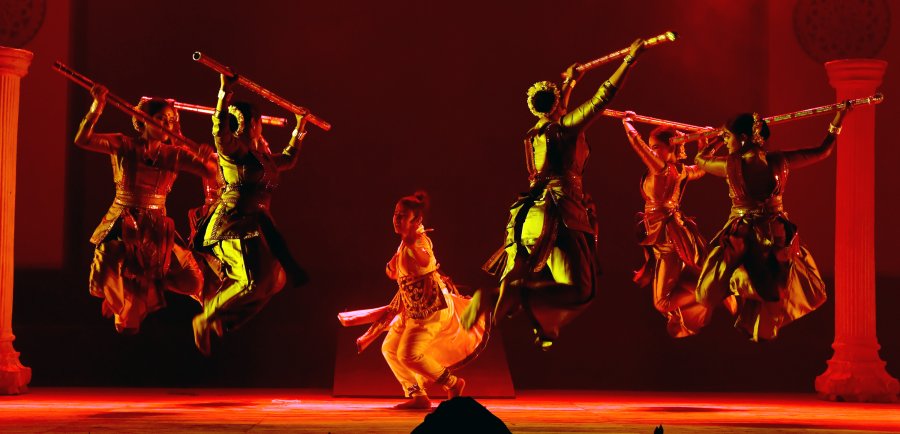 Narasimha Stories after stories were woven around our Puranic tales and mythology to celebrate this grand occasion. Manikanchan Kala Manjari, a recognized cultural institute established by Dipjyoti Dipankar had people waiting with bated breath for their performance of Narasimha, the half man and half lion incarnation of Vishnu. The dance drama was the mythological tale of Bhakta Prahalad, an ardent devotee of Lord Vishnu and his father Hiranyakashipu who was granted with the boon of immortality by Lord Brahma. None in the entire three worlds could kill him. As it goes with most boon recipients, Hiranyakashipu became arrogant and ultimately met his end in the hands of Narasimha, an avatar of Vishnu. The music of the piece was composed by Kusha Mahanta and Bhupen Nath. Dipjyoti Das excelled in the role of Narasimha while Dipankar Arandhara was Hiranyakashipu. A very dramatically told story as one might expect was savoured by the audience. 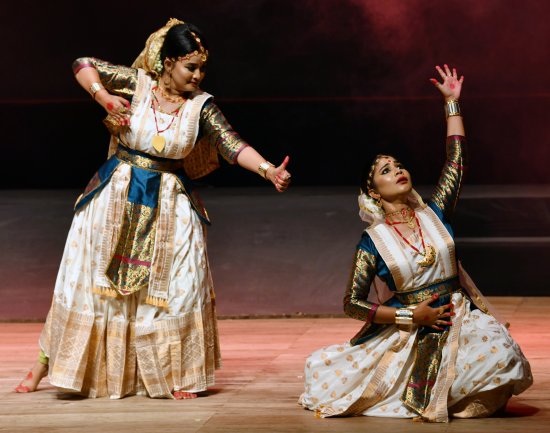 Sonika Hazarika and Krishna Tamuli Duet dancers Sonika Hazarika and Dr. Krishna Tamuli performed Ojapali, Shri Rama Shlokam and Ramdani Chali Nritya in chuta taal. Ojapali is the art of telling narratives. In the abhinaya part, they performed the Borgeet Xuno Xuno Re Xuno written by Srimanta Sankaradeva where they depicted the epic tale of Rama, Sita and Lakshman's exile in Panchavati. They portrayed the love, devotion and courage of the trio while they confronted Ravana's machinations. They told the story of the miracle maker monkey and Ram's victory over Ravan. 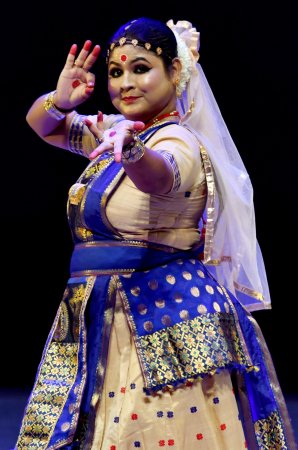 Himashri Medhi Kalita Himashri Medhi Kalita stayed on safe grounds with Gopi Nach and an abhinaya piece "Krishna kaita pao"- a sloka from the tenth canto of the Bhagavata Purana, concluding with a sloka from the Sri Krishnakarnamritam. The story was all about an example set by Krishna to shun arrogance and pride. The piece had a touch of the genius of Guru Jatin Goswami whose choreography and direction it was. 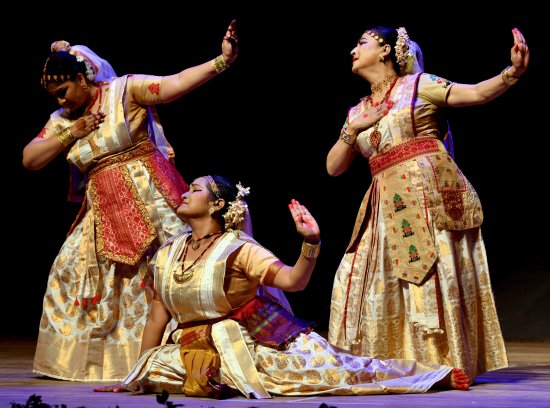 Mallika Kandali, Meernanda Borthakur, Gayatri Mahanta Scholar performer Dr. Mallika Kandali directed an out-of-the-ordinary piece of unique storytelling method to a composition of Bhupen Nath, directed by Murari Mohan Sarma. The Nayika Varnan was performed by Meernanda Borthakur, Gayatri Mahanta and Mallika Kandali. Nayika Varnan described three of the ashtanayikas based on the Natya Sastra in Sattriya style. Three Nayikas portrayed were - Vasakasajjika performed by Gayatri Mahanta, Khandita performed by Meernanda Barthakur, while Mallika enacted the most difficult role of a Proshitabhartruka Nayika who mourns for her husband who has gone away from her for some business and does not return on the appointed day. A Vasakasajjika is one who eagerly awaits the hero's arrival, while a Khandita Nayika embodies the complexities of love and betrayal, reflecting the various emotional states a woman may experience in her romantic relationships. The nayikas expressed their emotional states of mind according to each one's merit and experience. Meernanda's portrayal of a Khandita Nayika was very realistic, as was the portrayal of Proshitabhartruka by Dr. Mallika Kandali. Nayika Varnan was based on borgeet and natar geet from Ankiya nat composed by Srimanta Sankaradeva. 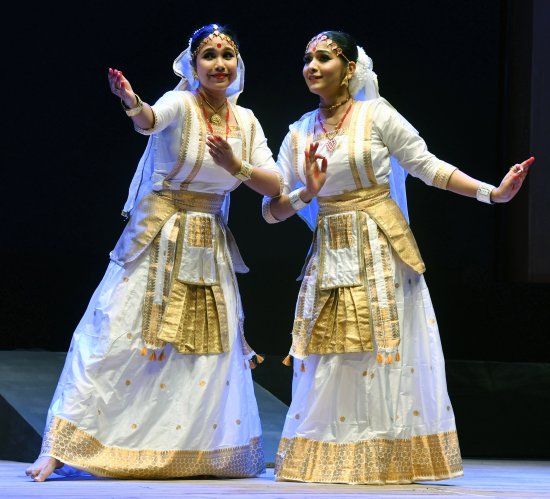 Jayamoni Gayan & Gitima Pathak Gitima Pathak and Jayamoni Gayan performed Madhavdeva's composition Shuddha Chali Nach. The Ramdani segment included Thukuni and chuta taal. Two verses from Krishnakarnamrit were presented, followed by the abhinaya based on Madhavdeva's Borgeet, "Dekhu mai awata nandakulaa" where the captivated gopi describes the divine beauty, charm, grace, and loving nature of Lord Krishna and their love for him. The Borgeet section depicted the devotional aspects of the gopis with Lord Krishna's divine appearance and sweetness. The song started with Parital, transitioning into Dharamjati taal, and concluded in Chutkala. The dance was chiselled by Nrityacharya Jatin Goswami. 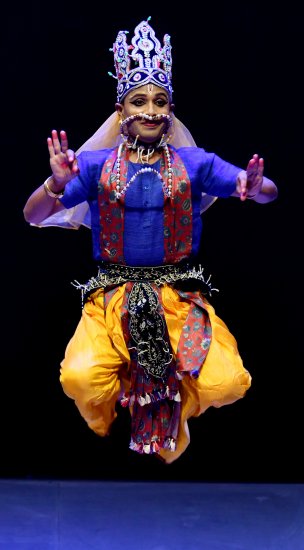 Ranjan Bora Ranjan Borah Borbayan of Shri Shri Natun Kamalabari Sattra in Majuli possesses a strong sense of artistry and forward thinking with strong roots in tradition. Growing up in the Kamalabari Sattra and learning Sattriya tradition under the guidance of eminent adhyapaks from the Sattra, Ranjan Borah has gained expertise in Sattriya dance, Khol (percussion), Sattriya music, Sattriya Ojapali, and Ankiya Bhaona. He performed Kaliya Daman, Bahar Nach, Ramdani and Geetor Nach. Bahar Nach is believed to have been performed by Lord Krishna himself along with Gopa balaks and the songs used in the Geetor Nach part depict Krishna's lila and cheerful interactions with Gopa balaks in Brindavan. Abhinaya piece was based on the story of Kaliya Daman. Literature used in this part was primarily taken from Srimanta Sankaradeva's Bhagawat along with Kirtan and Kaliya Daman Naat. Inspired by the melody of Sattriya Ojapali, music of the abhinaya piece was a composition of Ranjan Borah himself. 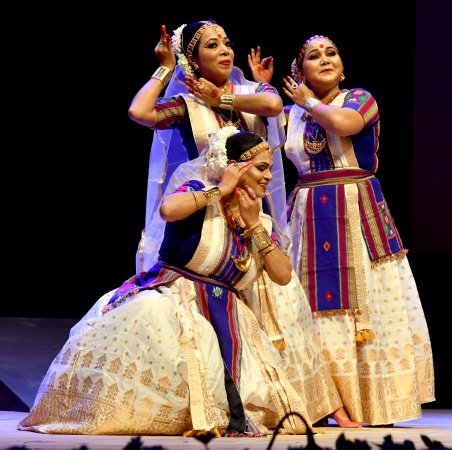 Bobby Rani Talukdar, Tarali Das, Aparajita Dawka Tarali Das, Aparajita Dawka and Bobby Rani Talukdar began with the Ghosha "Ami jata jiva tumara palana" composed by Srimanta Madhavdeva, followed by a performance of Chali Nach. The presentation concluded with an abhinaya based performance, "Koru Hari birinda bipin bihari" composed by Madhavdeva in raag Basanta and suta taal and poritaal. The artistes enthralled the audience with their flowing movements and the art of storytelling. 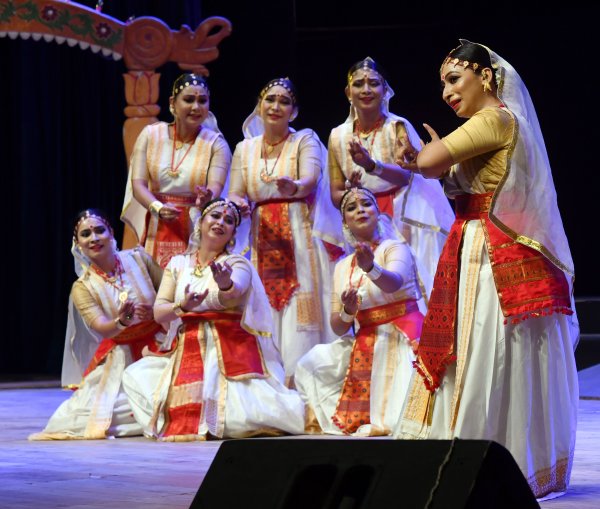 Sangeet Sattra, Guwahati Sangeet Sattra began with their story of saluting to Krishna followed by Chali Nach and ending with a Madhavdeva composed Borgeet abhinaya, "Dekho re nayana duho bhoriye" where the Gopis were amazed to see the captivating beauty of Lord Krishna using a galore of rhythm compositions like the Thukoni taal, Ektaal, Rosso Ektaal, Rupganjal taal, Chutkala taal, Kharman taal, Suta taal, Rupak taal and Poritaal in raag Bhatialo and Belowar. The group dancers were well trained and well-coordinated. It was conceptualized and choreographed by Ranjumoni Saikia and Rinjumoni Saikia, who through their hard work have carried forward the legacy of their father, Raseswar Saikia. 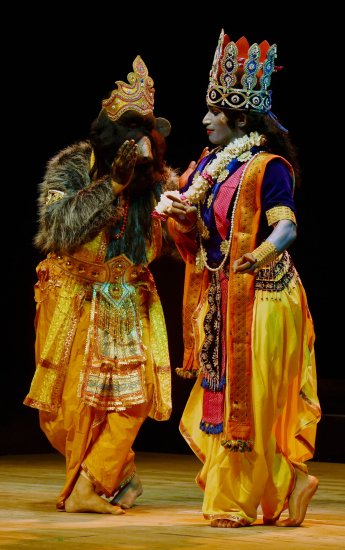 Shyamantak Haran Kashinath Krishnapriya Institute of Performing Arts, Tezpur, presented Shyamantak Haran, a masterpiece rooted in Srimanta Sankaradeva legacy. King Satrajit had received a gem from Surya, but its mysterious disappearance had many suspects including Krishna. To unravel the truth, Krishna finds the slain Prince Prosenjit in a forest, a mighty lion and the cave of Jambavanta, the wise bear king whose cubs are at play with the lost jewel. Krishna fights Jambavanta for retrieving the jewel. When Jambavanta realizes who his adversary is, he makes truce and returns the jewel. Satrajit gets back his kingdom and truth prevails. The festival had very diligently initiated seminar cum lecture demonstrations every morning with eminent and knowledgeable speakers taking part in it. Scholar Pradip Jyoti Mahanta of Guwahati delivered the keynote address. Mahesh Champaklal of Gujarat spoke on 'Natyashastric concept of nritta'; Shantana Saikia's 'An exploration of the legendary and possibility of their translation into the dance form' was valuable to practitioners and writers present; 'With my dance train on it fifty years of engagement with Sattriya' by Dr. Arshiya Sethi was proof of the indelible mark of the form on her; 'Sattriya dance: Devotion and aesthetic expression' by Karuna Bora Majuli and 'From monastic roots to modern academia: Advancing Sattriya dance through education' by Devika Borthakur of Pune were very educative. 'Ojapali collection in Sattriya dance: A brief study' by Manik Bora Barbayan, Titabar, was illuminating as was 'Understanding emotional release through classical dance movements' by Arhee Kaushik. Last presentation, an overview of Missing Folk Dance style by Pabitra Pegu of Guwahati was both knowledgeable and entertaining. In spite of all the happiness and merriment centering around the Silver Jubilee celebrations of Sattriya dance, a tragic incident spread its shadow over the people of Assam and art lovers globally. Born on 18 November 1972, Zubeen Garg was a prodigy. He was an Indian musician, singer, composer, songwriter, instrumentalist, actor, director, filmmaker, poet and philanthropist who primarily worked and sang in the Assamese, Bengali, and Hindi language films and music industries besides singing in many other languages and dialects, including Bishnupriya Manipuri, Adi, Boro, Dimasa, English, Goalpariya, Gujarati, Kannada, Karbi, Malayalam, Marathi, Mising, Nepali, Bhojpuri, Odia, Sadri, Sanskrit, Sindhi, Tamil, Telugu, Tiwa and Urdu. He also was a multi-instrumentalist and played many instruments including anandalahari, dhol, dotara, drums, guitar, harmonica, harmonium, mandolin, keyboard, tabla, and various percussion instruments. He was regarded as one of the influential musicians in Assam. His passing away under mysterious circumstances on 19th September 2025 plunged music lovers all over the world in shock more so to the people of Assam. His tragic end was remembered with the observation of a minute's silence, for the repose of his soul at the behest of SNA Secretary Raju Das.  Tapati Chowdhurie trained under Guru Gopinath in Madras and was briefly with International Centre for Kathakali in New Delhi. Presently, she is a freelance writer on the performing arts. She is the author of 'Guru Gopinath: The Making of a Legend.' |
