
|     |
|
| |

 7th Dual Margam by BIC Bangalore- Madhuri Sarkare-mail: sarkarmadhuri88@gmail.com Photos courtesy: BIC January 21, 2026 Odissi and Kuchipudi, two eminent classical dance traditions of India, exhibit both shared foundations and distinctive artistic identities shaped by their regional, historical, and aesthetic contexts. Both Odissi and Kuchipudi are deeply rooted in ancient Indian aesthetic theory, particularly the Natyashastra and the Abhinaya Darpanam. They place strong emphasis on abhinaya (expressive storytelling), intricate hand gestures (mudras), and a close relationship between movement, music, and rhythm. Mythological and devotional themes - especially narratives drawn from Hindu epics and Puranic lore - form the core of their repertoires. Additionally, both styles demand rigorous training, refined body control, and a nuanced balance between nritta (pure dance) and nritya (expressive dance). Despite these commonalities, the two forms differ markedly in technique and visual grammar. Odissi, originating from Odisha, is characterized by its sculptural quality, most notably the Tribhangi posture, fluid torso movements, and lyrical grace that evoke temple sculpture. Kuchipudi, from Andhra Pradesh, is comparatively more dynamic and theatrical, marked by brisk footwork, rounded movements, and a strong dramatic impulse inherited from its roots in dance-drama tradition. While Odissi often emphasizes introspective devotion and subtle sensuality, Kuchipudi foregrounds narrative vitality and performative exuberance, sometimes incorporating spoken dialogue and dramatic improvisation. 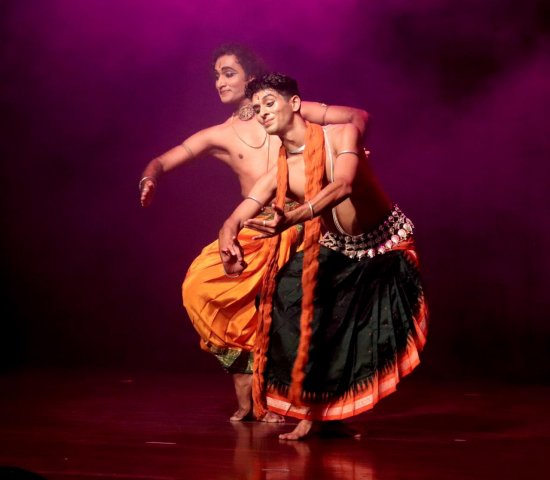 Such similarities in dissimilarities were well presented by the two young male dancers, Gururaju N and Shubham Ojha on Dec 18, 2025, at the 7th event of the Dual Margam series organized by BIC Bangalore. This was probably my last watched dance program of 2025 and it was a bliss watching the duo. Both dancers opened the repertoire with a Mangalacharan followed by Surya Tillana. Mangalacharan was based on Odissi as it is invocation to Lord Jagannatha where Gururaju followed Shubham's steps and showed similar footwork and movements in Kuchipudi dance style, whereas, in Surya Thillana it was vice versa. The 3rd item of the evening was Dasavatar in Kuchipudi by Gururaju N choreographed by Guru Vyjayanthi Kashi. Very crisp, well defined and balanced gestures with rich music made Gururaju's performance evocative and entrancing. Subham then presented a piece from Sundarakand choreographed by Guru Aruna Mohanty. He was able to portray a promising dance career through his performances. 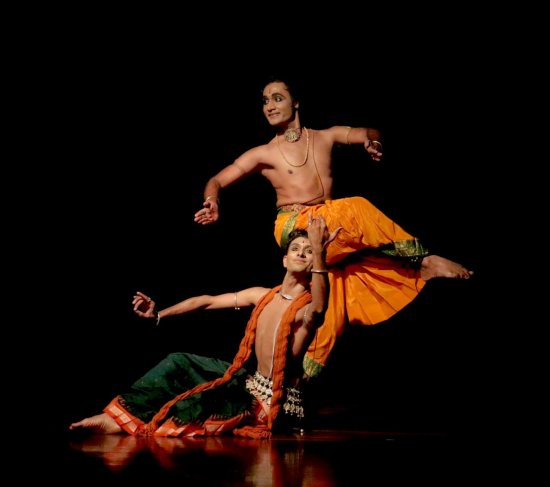 The next presentation was Krishna Tarangam "Neela Megha Shareera" by Gururaju. I have watched his Tarangam many times earlier and I must say, he has mastered the art of dancing on the brass plate with growing experience. It was elegant, poised and hypnotic. They concluded with a 'Yugmadwanda Pallavi'. Rooted in the same margam, Odissi and Kuchipudi embark on a shared artistic voyage, each revealing its unique aesthetics and expressive voice. In this Pallavi, the two styles enter into a lively dialogue, exchanging ideas through movement in a manner reminiscent of a musical sawal-jawaab, well said by the host, 'Is it Dual or a Duel!'. This piece was originally choreographed by Guru Kelucharan Mohapatra for Sanjukta Panigrahi and music by Pt. Raghunath Panigrahi. The captivated audience gave a standing ovation. 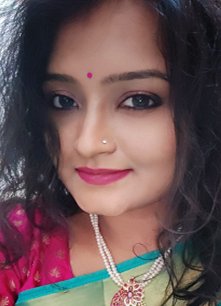 Madhuri Sarkar is a Bharatanatyam and Kuchipudi practitioner (Bangalore). She's a disciple of Sarbani Ghosh and Vyjayanthi Kashi and is Founder/Director at Nigamsudha Performing Arts. |
