
|     |
|
| |

 Reformatting Kathak solo: The Idea of Sahridayi- Arohi Munshie-mail: arohimunshi@gmail.com January 17, 2026 Premiered in Delhi, at the Triveni Kala Sangam in December 2025, "Sair-e-Motorcar", undertakes a rare reformatting of the Kathak solo by Navina Jafa, cultural strategist and sustainability advocate Kathak artiste, one that neither abandons classical grammar nor submits to novelty for its own sake. The work is entrenched with the idea of the sahridayi, the sensitive, receptive viewer who completes the aesthetic experience through empathy and experience, memory, and imagination. This production is not merely performed for the audience, but it engages their emotional and intellectual pursuit. At the heart of Sair-e-Motorcar lies a conceptual risk. Automobiles, machines of speed, modernity, and colonial encounter are not obvious companions to Kathak, a form historically shaped by courtly aesthetics, poetic subtlety, and rhythmic abstraction. Yet Jafa's dramaturgy reframes the automobile as a vessel of memory, a carrier of human longing, obsession, humour, and loss. In doing so, she restores the Kathak solo to its older role as katha: a storytelling practice where movement, word, rhythm, and reflection are inseparable. 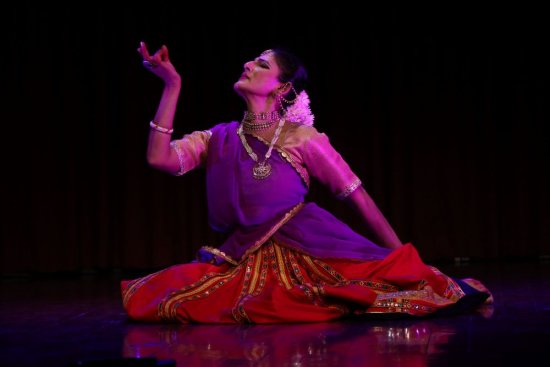 Photo: Arijeet Mukherjee The guiding figure of Firdausi Mirza, the wandering poet, is central to this reframing. He is not a conventional narrator but moves fluidly between time and space, between eras, sites, and sensibilities. His voice invites the audience into layered worlds: royal garages that resemble Wunderkammern, childlike fantasies of "Dinky Car Trees," eccentric attendants, haunted tombs, and moonlit riverbanks. These stories are not illustrative backdrops for dance; they generate the emotional and temporal conditions in which movement unfolds. Kathak here becomes memory, where gesture gives story and rhythm carries the history. Jafa's abhinaya is the fulcrum of this experience. Her strength of abhinaya lies in subtlety and restraint. The subtle shifts of gaze, the measured play of irony, and the moments of quiet humour reveal a performer intensely harmonised with the rasika. The audience is left to feel the very nuance of it. This trust is the ethical core of the sahridayi framework, meaning it is co-created rather than imposed. Rhythm becomes a story telling narrative. The echo of the Ford's revived engine into a fourteen-beat cycle is perfectly aligned with classical tala Dhamar. In Scene 2, the whimsical "Phat-Phat" episode, the rhythm plays with sensuality and senselessness, while the moonlit emergence of the dancing maiden delays time altogether. Scene 3 darkens the tonal palette, trembling metal, haunted histories, vanishing musicians—where movement fractures into unease and spectral suggestion. 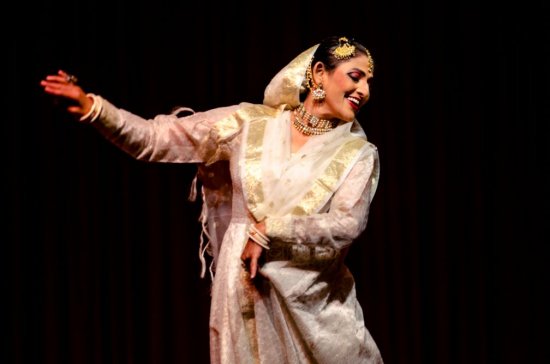 Photo: Sangeeta Banerjee The final Sufi piece, "Kangna," marks a pivotal inward turn, creating a crescendo for the production. The production moves beyond anecdotes to deeper reflection reaching philosophical depths. The stolen bracelet becomes a metaphysical pivot, the desire dissolves into devotion, play transforms into surrender. Dr. Jafa's Kathak in this moment is pared down, almost austere, the symbolic narrative resonates fully. The personal dissolves into the cosmic, the narrative curve that mirrors the classical journey from shringara to bhakti. Equally significant is the collaborative intelligence of the evening. The presence of master accompanists on tabla, sarangi, flute, voice, grounds the work in musical authority, while the parhant and storytelling expand the sonic and semantic field of Kathak without diluting its integrity. The direction by Dr. Maya Kulkarni and technical design enhanced the performance without overpowering it. At certain moments, however, the synchronisation with the accompanists could have been more finely balanced; in particular, a softer articulation from vocals and more precision with the tabla may have helped the dancer's subtle interpretive nuances to emerge with greater clarity. Sair-e-Motorcar production presents Kathak as a solo without museumising or commercialising it. Weaving heritage studies, oral histories, sustainability thinking, and performance practice into a coherent aesthetic vision, Dr. Navina Jafa reclaims Kathak as a living, thinking art. At the same time, the other part of the production could have benefitted from a more resolved costume combination, particularly in the last sufi piece. While the red lehenga made by Sua sapera (a Kalbelia, folk dancer, from the De-notified tribe Sapera, traditionally known for their engagement as snake charmer's community) worked effectively in the third piece, the purple dupatta paired with a golden blouse did not sit harmoniously with the red lehenga. This visual dissonance stood out within an otherwise carefully crafted aesthetic. The production also adopts an unconventional approach in response to an unconventional commission by Diljeet Titus, addressing an audience markedly different from that of a conventional Indian classical dance programme, and fine tuning, framing, and addressing accordingly. In reformatting the Kathak solo through the lens of the sahridayi, she reminds us that classical dance endures not because it resists change, but invites the empathetic to travel across time and space, memory and meaning, together with the artiste.  Arohi Munshi is a young Bharatanatyam dancer from Bhopal, Madhya Pradesh, who moved to Delhi three years ago. Apart from being a performing arts professional, she has taught dance appreciation as an Assistant Professor at IILM University, Gurugram. She is now freelancing and curating festivals in collaboration with various universities and organisations of Delhi NCR. |
