
|     |
|
| |

 Enlightening Margazhi Fest in Mumbai- Lata Surendrae-mail: kalashrilata29@gmail.com Photo credit: Suresh Subramanium January 16, 2026 The 13th edition of Margazhi fest organized by Guru G V Ramani Natyakala Foundation Come December and all feet seek to move towards Sahitya Mandir Sabhagriha,Vashi, Navi Mumbai, where the director/founder of Guru G V Ramani Natyakala Foundation, the very endearing Gayatri Subramanian rooted in heritage yet forward thinking, becomes a torchbearer curating festivals that blend ancient forms into platforms for seasoned and emerging dancers fostering a spiritual connection to art, and ensuring these powerful storytelling traditions thrive for future generations. 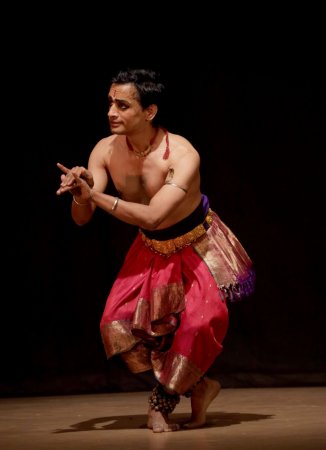 Gautam Marathe The festival on Dec 25, 2025 opened with Gautam Marathe, the first recipient of the V.P. Dhananjayan & Shanta Dhananjayan Endowment Award, instituted by Shobana Bhalchandra in the last year and an accomplished disciple of Guru Vaibhav Arekar. There was anticipation in the air as the spotlight fell on the mentor Vaibhav Arekar intent on reaching out with the process that went into the choice of a Varnam to set the prelude for the evening. With the assured air of an artiste at home on stage, his voice urged the arty crowd to feel for the demanding Varnam that his disciple was to reach out with through its coloring layers of growth tempered by the inculcated aesthetics of Guru Sounderrajan at Nalanda, the myriad hues flowering through performance at the hands of Guru Thangamani Nagarajan and changes that were enhanced by the vision of legendary Dr Kanak Rele. What is it that makes an oft explored Varnam by dancers still stir your heart? Is it the choreography, the electrifying nritta, the desire to impress with innovations or is it the growth of the dancer within that has a Varnam grow so large that it humbled you so with its inherent potency? I awaited the exploring of Thanjavur Ponniah Pillai's Varnam, 'Manavi chekona,' in ragam Shankarabharanam and talam adi that had the Nayika pleading with Brihadeeshwara to awaken to her relentless entreaty. It was presented with stirring sancharis minus melodrama and frills. A beautiful tempo that had one feel as if seated on a canoe to have life frames caress one's soul. A placid connect celebrating its climax through the complimenting support strength of the crisp nattuvangam by Kalishwaran Pillai, stirring vocals by R Raghuraman, the mridanga nadam by acclaimed mridangam artiste Harsha Samaga, supportive violin by B Anantharaman Ravi. It was an absolutely chaste exploring that impressed with its technical virtuosity. Gautam has evolved as a dedicated purposive dancer and a choreographer with a vision for the dance as was visible in the Mohana Kalyani Thillana of legendary violinist Lalgudi Jayaraman choreographed by him. It was a command performance of well-rehearsed moves and a practiced ease that was ever so visible. With time, when a relatable empathy touches the dancer, I am sure a greater spontaneity will come in to have the soul connect with its unique eloquent silence and have meanings flow with ease to impact with that profound human experience that has the artiste transform from becoming to being. 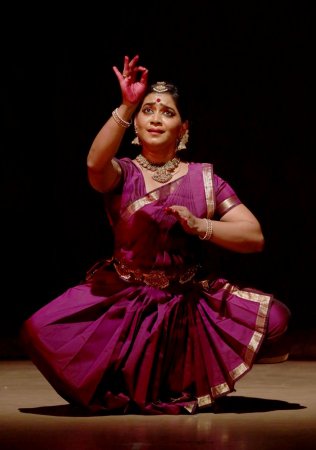 Keerthana Ravi The next dancer was Keerthana Ravi, disciple of Guru Padmini Ramachandran and pursuing her learning under Rama Vaidyanathan, the foremost Bharatanatyam dancer of her generation in our country. Keerthana presented 'Aakar se nirakaar thak', from form to formless, from structure to subtle, from external to internal realization through three compositions that endorsed in the first the physicality of the dance that was stirred by the external urging the body to breathe in a discipline if only to transform it in time to a temple. This was elaborated through an ode to the lord of Tanjavur Brihadeeshwara temple, 'Perum kovil konda Perumane' - Oh Lord who resides in the grand temple - a devotional piece by Ponniah Pillai to express prayer and supplication through the inherent dignified and reverential mood of Sree ragam. The dancer protagonist, struck by the architectural brilliance of the temple, urges the Lord to bless her with vitality, stamina, laya and shakti. The mood then shifted when through years of sadhana, the journey of the protagonist transforms from outside to within to a journey 'inside out ' wherein the dance is the dancer at that 'still point of time' and this was brought out through a Thumri - 'Radhika Kanha ko dhyan dhare' by the mediaeval poet Dev. A very evocatively explored piece where Keerthana came into her own as Krishnamayi Radha and Radhamayi Krishna. Ultimately natyam shifted to become a pathway to see the divine as the 'formless, timeless and spaceless reality' explored through a Nirguni composition, 'Ud jayega hans akela' - a profound Kabir Doha about the soul's solitary journey at death, emphasizing life's impermanence, the transient nature of the world as a fair or mela, and the need for spiritual realization. I have seen Keerthana grow performance to performance from mime to a spontaneous delineation and 'Aakar se nirakaar thak' in a way endorsed her own artistic growth. One just wished that the poetry of lighting was better in complimenting a lofty theme as the artiste seemed perennially shrouded in sepia mode. 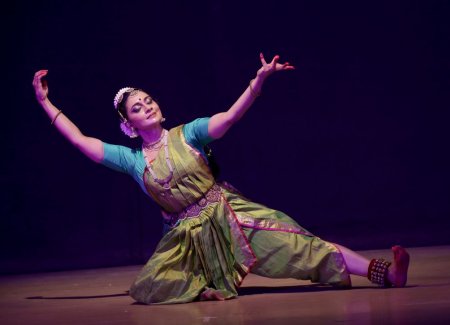 Divya Ravi The journey to Nirakar opened out absolutely with the most awaited artiste of the evening, Divya Ravi, a senior disciple of Mavin Khoo, who had received initial training from Gurus Kiran Subramanyam, Sandhya Kiran and Dr. Soundarya Srivathsa. The poetic and abstract absolutely culminated in a flowering emotive moment as she stood there 'appareled in celestial light... a soul clad in turquoise blue seeking to endorse glimpses of her tryst with poetry and literature. I have always been stirred by the acclaimed artiste's unique awareness of the importance of musicality which is ever so inherent in each of her choreographed concepts. There seems innate within her an urge to integrate form and music. She commenced with Maharaja Swathi Thirunal's lesser known works - Uthsava prabandam in Manipravalam. The prabandam divided into ten sections called stabakas, deals with the legendary history and festivals of Sri Padmanabha Swamy temple in Trivandrum. Taking verses from the 10th uthsava prabandam formatted brilliantly into a chastely choreographed Malhari in Panthuvarali and adi talam, the artiste visually etched the Brahmothsavam at the Ananta Padmanabha Swamy temple with the 'Aarattu' - holy bath ceremony where the procession goes from temple to the Arabian sea with the stirring nadaswaram, resonance of mridangam, flute, cymbals music pervading all around and the munificence of the utsava murthis Krishna and Narasimha lighting up the journey. The audience witnessed the entire procession coming to life with the stride of horses complimenting the waves, the beautiful damsels leading the way engulfing the soul as it were through the senses. A chaste and command delineation by a mature artiste absolutely complimented by the musical support and complimenting vocals of her husband Sharan S. It was indeed a fluid symphony, of a complimenting togetherness of music and dance through a shared composition. Divya's central piece was the Varnam in ragam Behaag by a lesser known composer Veenai Kuppayyar, 'Vanajaksha ninne namithi' - O lotus eyed Lord in whom I have placed my faith, can't you see my life breath is you alone - elaborated through evocative sancharis by the dancer. As dancer/choreographers, we are bringing to life what actually inspired a composer to etch a particular line and very evocatively Divya brought to life the lines 'Sanakadi muni vandita pada' - Those feet that restored cosmic balance as Vaman, feet that accorded moksha to Ahalya as Rama and those feet that danced on Kalinga. With those two feet won't you dance within the penury of my heart too? - The charanam with 'Satileni marakoti sundara rupa', a master creative exploring described the unparalleled munificence of the Lord that paled out even a thousand Manmadas. The Nayika recounts the supremacy of her Lord when she sculpts his opulence to woo him with. Manmada has one kundala but you have two… he has one bow string but you have two arched bows on your forehead... his string of honeybees is nothing compared to the many bees that are your curling crowning strands... he needs to pick flowers to aim at hearts, but your entire form embraces the fragrant poetry of flowers! Divya concluded her performance with Dayaram's composition tuned beautifully in Bhageshri, Madhuvanti and Shudha Saranga by her talented husband Dr Sharan Subramanium where Krishna and Radha exchange clothes endorsing their shared existence. Enthralled by the stirring vocals and soulful performance, what stood defined was a command performance where the dancer danced the dance in abandon transforming the energized dust that is the body to light through meanings shared through the didactic potency of a dance that obviously is her very soul's breath. 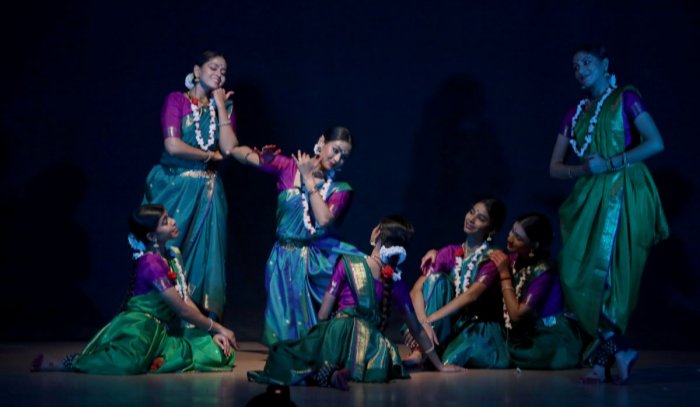 Project Sanskriti The concluding performance of the evening was by Radhe Jaggi (disciple of Leela Samson) and Project Sanskriti's Anumargam, an exploration with the synergy of two diverse forms coming together. Bharatanatyam, with its emphasis on abhinaya and fluid grace, finding a powerful counterpoint in the robust geometry and kinetic energy of Kalaripayattu, a traditional martial art from Kerala. The performance commenced with 'Paramapurusha anuyamavayam sakhi,' a composition by Shri Narayana Teertha (a tarangam from his magnum opus, the Sri Krishna Leela Tarangini) that beautifully captured the essence of bhakti yoga, where the soul, through intense love and devotion, seeks merging with the divine Lord (Paramapurusha). Vrindavan Bhuvi, the spiritual realm where divine pastimes occurred, symbolizing the heart or the world opening out as a stage for spiritual experience. The song expressed the desire in the poet to experience the ecstasy of gopis to follow and attain the Supreme Lord, whose opulence and prowess was made explicit through his youthful pranks. Krishna's prowess in vanquishing Kuvalayapida, the mad elephant, was very evocatively choreographed. The dancers brought to life the euphoria of his magical flute transforming Vrindavan to a parenthesis in eternity and his divine form meditated upon by yogis urging a quest for stillness in the moving symbolic canvas of Vrindavan. The quest transformed to bhakti through battle and realization through conflict with the episode of Arjuna confronting the boar Mukasura, only to realise he is battling Shiva himself in the form of the forest hunter. Presented primarily through Kalaripayattu, the drama was conveyed more through movement than words. The ankathari in Kalaripayattu and the bare-hand techniques (verumkai), included strikes, kicks, grappling, and vital point attacks (marma), in which Kirata overpowers Arjuna. Through the stylized movements, animal stances, and the use of various weapons integral to the Kalaripayattu repertoire, the epic episode emphasized perseverance, divine power, and humility. 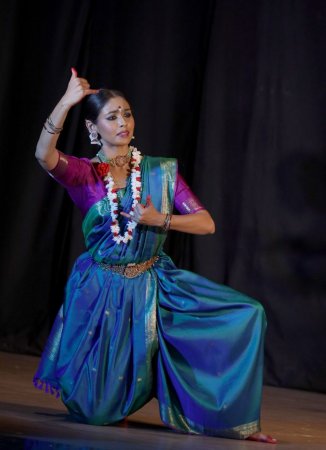 Radhe Jaggi Bhakti towards the 'one' moves to the 'one in all' was endorsed by Radhe Jaggi through the story of the Gorakh saint who offers his eyes to awaken another's inner vision. Alak niranjan is what resonates within as he hopes for the inner eye to awaken and assimilate the one in all and all in one. The nullifying of the ego through Ravana was brought out through the poem, Kiratarjuniya, where the poet Bharavi paints with words the grandeur of Mount Kailash as the eternal, divine abode of Lord Shiva. The tussle between Bhakti and ego was endorsed through the vanquishing of Ravana's pride crushed with him under Kailasa. However, the Lord seeing his devotee's tragic plight accords an Atmalingam with the crucial condition of not placing it on the ground until he reached Lanka. The Shiva Tandava Stotram of Ravana in praise of Lord Shiva through kalari and Bharatanatyam impacted visually although in medium tempo. The episode of Ganesha interceding to trick Ravana and having it sanctified at Gokarna was dealt humorously with Ravana exaggeratedly sprinting and chasing Ganesa out. My heart went out to the sensitive choreographer Radhe Jaggi as she recounted the disadvantage of the choreography planned for a mammoth dimension adapted to a smaller cosmos in a more truncated version. Kudos to the sensitive Mumbai audience because each dancer's ephemeral journey met with their understanding gaze. A sea of faces they were, mirroring the transient ecstasies and sorrows, of a thousand stories spun in light and shadow, and the language of the body. They drank in their sweat and spirit, a profound communion of art and soul, their stillness a sensitive echo to the vibrant motion of the stage. They were bound to all artistes as a single heart, attuned to the kinetic calligraphy of the stage.  Dr. Lata Surendra is a performer, mentor, an imaginative choreographer, a sought after curator, a dance journalist, a committed independent researcher, a sensitive poet and in the field of dance for over six decades. |
