
|     |
|
| |

 From Mangala Gitam to Moksha: The narrative arc of Natya Katha-Krshna- Bijoy Shivrame-mail: bijoyshivram@gmail.com Photos: IGNCA Vadodara January 12, 2026 Natya Katha-Krshna unfolded as a sublime confluence of devotion, scholarship and artistry - a luminous offering to the many splendoured life of Shri Krishna, where the divine and the deeply human coexisted in effortless harmony. The air vibrated with spiritual fervour and cultural depth as live music, soul-stirring bhajans and verses in multiple languages interwove seamlessly, creating a pan Indian tapestry of sound, movement and rasa. The moment Sonal Mansingh stepped onto the stage, the atmosphere transformed. Here stood not merely a performer, but an erudite scholar, a master storyteller and a living archive of India's classical inheritance. For over six decades, she has carried the weight and wonder of tradition with grace and that evening, Ahmedabad stood blessed to receive her artistry. Her presentation flowed effortlessly across languages and idioms - her voice narrating and singing even as her body sculpted meaning. Each gesture, glance and pause bore the wisdom of long sadhana, where discipline ripens into freedom. What distinguished Natya Katha-Krshna was its rare synthesis of narration, song and movement. Anecdotes from Krishna's life - playful, philosophical, tender and transcendent - were animated through a vibrant ensemble of dancers who brought precision and vitality to the narrative. Together, they created living tableaux that moved fluidly from mischief to majesty, from lila to loka, revealing Krishna as child, prankster, lover, guide, friend and cosmic force. The evening began not with spectacle, but with sanctity. A deep, primordial conch resounded, slicing through silence like a benediction. As Sonal Mansingh stepped onto the stage, applause rose - not as mere welcome, but as sacred acknowledgement. The space seemed to still, as invocation gave way to remembrance. 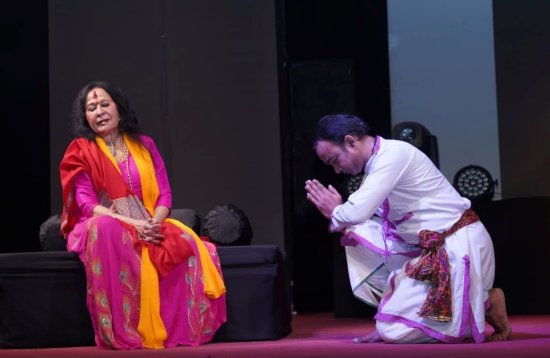 Salutations first arose to Krishna himself: Shri Krishnaya Vasudevaya Devaki nandanaya... A hymn gathering his many identities - divine and filial, pastoral and eternal. This was followed by a surrender to grace itself: Mukaṃ karoti vacalaṃ, Panguṃ langhayate girim... A humble bow to that compassion which grants voice to the voiceless and strength to the frail - Paramananda Madhava, the source of all expression and movement. The invocation culminated in complete sharaṇagati: Tvam eva mata ca pita tvam eva... A quiet yet profound declaration that the Divine alone is mother and father, friend and kin, knowledge and wealth - the very totality of existence. Thus, even before narrative unfolded and movement took form, both stage and spectator were anchored in bhakti, gratitude and grace. The sanctified space then resonated with select stanzas from Jayadeva Goswami's Srita Kamala kucha mandala from the Gita Govinda, a devotional mangala gitam invoking auspiciousness with the recurring refrain "Jaya jaya deva hare!" - an exultant glorification of Lord Hari. 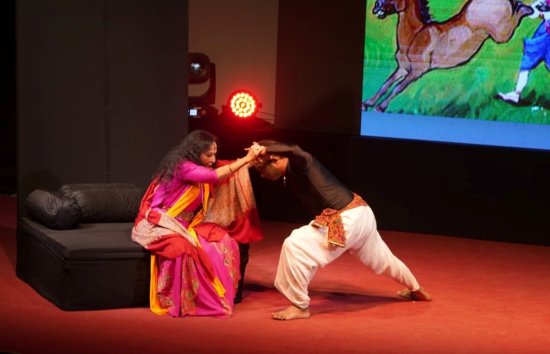 From this sacred opening emerged the katha of Krishna's early life. Kamsa hears of the wondrous child in Vraja and sends demon after demon - Bakasura, the crane-like menace; Keshi, the fearsome horse; Dhenukasura with his mighty horns and Putana. The inhabitants of Gokul remain unaware, Yashoda herself confused, as danger circles the child who remains untouched by fear. Each demon episode was rendered with crisp movements - never overstated, yet deeply evocative - revealing Bala Krishna's effortless triumphs, not as displays of power, but as revelations of truth and darsana. Krishna grows, and with him grow his pranks - stealing butter, breaking pots, creating lovable chaos, only to protest innocence with disarming charm. Saint-poet Narsinh Mehta's beloved Gujarati pad, "Jashoda tara Kaṇuda ne..." found tender expression as Yashoda's affectionate exasperation unfolded. This flowed naturally into Sant Surdas's immortal composition, "Maiya more main nahi makhan khayo..." - one of the most cherished portrayals of Krishna's childhood, suffused with vatsalya bhava, humour and devotion. Butter smeared everywhere, little Krishna insists on his innocence, while Yashoda cajoles, questions and finally surrenders - her maternal love eclipsing all reason. As Krishna grows older, the narratives deepen. Episodes of playful provocation - teasing the gopis by the Yamuna and the story of Kaliya Naga, poisoning the waters where lotus blooms, birds drink and travelers rest. The Yamuna darkens, becoming Kalindi and Krishna decides it is time. His subjugation of Kaliya unfolded as both cosmic justice and compassionate resolution. Narsinh Mehta's evocative verses, "Jala kamala chanḍi jaṇe bala, Svami amaro jagaśe..." and "Taṇḍava gati mudana par nachad panvari..." brought alive the ecstatic abandon of divine dance - movement surging with rhythm, poetry and devotion. 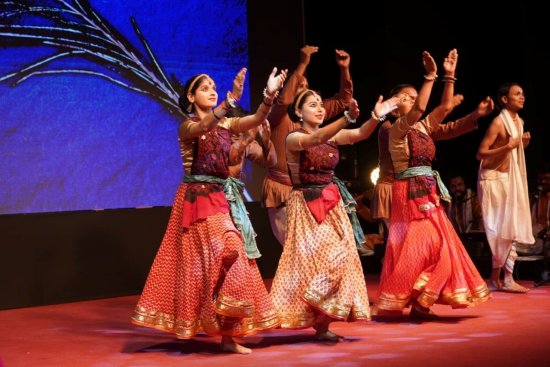 The rasa lila - not a spectacle, but as spiritual intimacy. Gopis of Vraja - Sunaina, Madhavi and others from Barsana - took form, their beauty mirroring inner longing. Barsana, Radha's home, came alive through playful exchanges - Krishna teased for his dark complexion, Radha retorting with affectionate wit: "Hum kale hain to kya hua...". Jayadeva's ashtapadi, "Yahi Madhava, yahi Keshava..." revealed the unique metaphysics of Vaishnava thought - Radha turning away in mana, Krishna seated at her feet, pleading. Only in Sanatana and Vaishnava traditions can such divine vulnerability exist - where God bows before love. Sonal Mansingh then spoke of the Rath Yatra at Jagannath Puri - Jagannath, Balabhadra and Subhadra returning in procession, Lakshmi's servitors barring entry and from within the temple rising the strains of "Yahi Madhava..." and outside, the pandas respond with Jayadeva's poignant line: "Vadasi yadi kincit api..." - a ritualised dialogue of love, longing and reconciliation. The narrative then turned to Mathura. Kamsa sends Akrura to invite Krishna and Balarama. Akrura beholds Krishna's Vishvarupa. The city waits in anticipation - "Darshana do Ghanshyam..." Krishna slays Kamsa, reunites with his parents, ascends the throne - and then leaves Mathura, journeying through Rajasthan to Gujarat. From the sea rises Dwarka, the golden city of destiny. 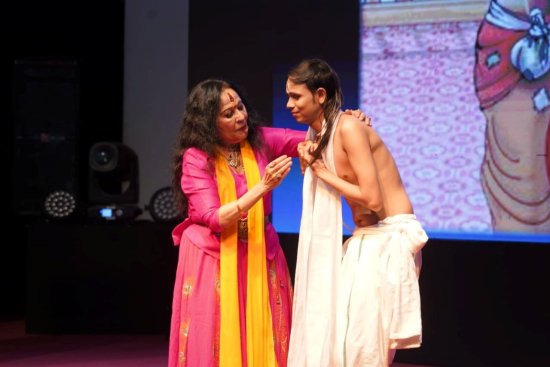 The evening found its emotional crest in the poignant episode of Sudama, where an Ashta Chhap poet's verse laid bare poverty not as spectacle, but as quiet dignity - etched with aching tenderness. In Dwarka, Krishna reclines in effortless splendour - Rukmini gently fanning him, Satyabhama in attentive service, Jambavati sprinkling rose water in a ritual of grace. Yet the utterance of a single name alters the rhythm of the palace. Sudama. In an instant, the Lord rises - forgetting throne and protocol - rushing barefoot to the gates. He washes his friend's dust worn feet, embraces him with unguarded joy, seats him beside himself and speaks not of gifts, but of memories. Sudama, tongue-tied and overwhelmed, returns with empty hands and a fuller heart - yet along the long road home, a familiar doubt creeps in. 'Krishna, ever playful, has tricked me again,' he thinks with a wry smile. No riches, no words of assurance - only affection, laughter and an embrace. Perhaps that was all. But at the threshold of their humble dwelling stands Susheela, whose vision reaches beyond appearances. Before Sudama can speak, she understands. She sees in her husband's softened gaze, in the quiet radiance that now surrounds him, that true wealth has already arrived. Krishna's gift was never meant to be carried - it was lived, felt and bestowed in grace. What the world calls poverty remains unchanged; what the heart recognises as abundance stands transformed. The performance concluded on this luminous note - friendship over fortune, humility over grandeur, love over power. Organised by the Gujarat State Sangeet Natak Akademi, under the Sports, Youth & Cultural Activities Department, in collaboration with Sonal Performing Arts and supported by Gujarat University, the evening commenced with a dignified lamp-lighting ceremony by Dr. Neerja Gupta, Vice Chancellor, Gujarat University; Dr. Arupa Lahiri, Regional Director, IGNCA; Sonal Apal Shah, Director, Sonal Performing Arts; Dr. Paavan Pandit, Director, GUCPC; Dr. Shailesh Modi, Asst. Registrar, GU and Sunil Shah, Founder, Tagarwala Foundation. 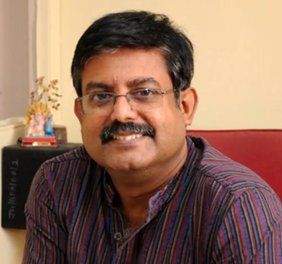 Son of journalists K Shivram and Amni Shivram, the first Malayali woman English journalist, Bijoy Shivram is an accomplished Indian classical dancer trained in Bharatanatyam and Kuchipudi. A passionate promoter of the arts and a skilled graphic designer, he currently serves as the Vice Principal of JG College of Performing Arts and the Assistant Director (Operations) overseeing 17 JG colleges. He is also the founder of Preksha, an organization dedicated to the promotion of art and culture in Ahmedabad. Since 2020, Bijoy has curated the YouTube series 'Gurudakshina - An Ode to our Gurus,' celebrating the legacy of mentorship and tradition. |
