
|     |
|
| |

 Three very distinct performances- Rajiv Rajamanie-mail: rajivrajamani@yahoo.com January 10, 2026 NMACC, Mumbai 28 Dec 2025 Sooraj Subramaniam The Geometry of Instinct Sooraj Subramaniam is an Australian-Belgian artiste of Malaysian-Indian heritage. Trained in Bharatanatyam, Odissi, Ballet, Kathak and Contemporary, he utilised this vast vocabulary to navigate the space between ancient carved stone and drifting modern air. In the Odissi Pallavi, Sooraj was exquisitely gentle in his bhangas, yet uncompromisingly hard in his stamping, striking the floor in a manner that felt ancient and grounded. There is a restrained, smoking rawness that simmers just beneath a surface of high classical refinement. In Priye Charushile, Krishna was cracked by a very human grief; he stood not as a playful trickster, but as a sovereign of desire finally humbled by the wreckage of the heart he broke. A younger dancer often plays Krishna's "infidelity" as a light-hearted mistake (Lila). But here was a lover who has exhausted all distractions and found them wanting. He has moved past the "pantomime" into the internalization of abhinaya. Sooraj next performed an abstract Odissi choreography. It was cradled by Hamsika Iyer's soulful rendition of a Telegu lullaby Raave Chandamama, in the deep, nocturnal hues of raga Bageshri. Her voice provided a sonic landscape where time felt non-linear, allowing the dancer to explore without the rush of a ticking tempo. This choice highlighted his incredible muscular control - holding a bhanga or completing a slow, spiralling turn exactly as a vocal phrase decayed into silence. In Mandala, the dancer moved beyond the literal, transcending into a fusion of Odissi and Contemporary Dance. This was a study of the Tibetan Buddhist Mandala - centered, circular, and obsessive - using traditional idioms of "forgotten expression" to weave a new grammar entirely by instinct. The technicality was hypnotic: just as the sound bent into fluid gamakas, his body curved into evocative bhangas, his eyes following his hastas with precision along previously un-trespassed lines. Every movement was a completed thought, replicating and expanding until the stage felt filled with myriad fractals, a visual echo of the infinite. Without the safety net of a traditional narrative to anchor the performance, the burden of engagement fell entirely upon the dancer's presence. It is a profound responsibility to carry the Rasika through such abstract territory - to demand they feel without being told a story. It was a sacred trust Sooraj did not betray. 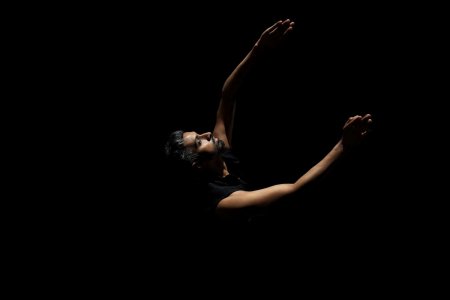 Sooraj Subramaniam in Nimbus (Photo: Tom Decuyper) In the final piece, Nimbus, the stage dissolved into an abstraction of the sky. This was a study of clouds - not as soft fluff, but as atmospheric power. We witnessed the same statuesque body reconfigured through a startling new kinesthetic, discovering joints and dynamics that seemed to defy his classical training. There was a deliberate form to the randomness, a logic to the vaporous drift, breathtaking to watch. Hard, whip-fast turns that melted into extreme atibhangas, vibrating with a duality that was simultaneously light and airy, yet viscerally muscled. It was a physical metamorphosis that forced a jarring, silent question upon the audience: Was this truly the same artiste? In shedding the familiar skin of the deity and the devotee, Sooraj revealed a dancer so transcendent that he was no longer bound by his own history - only by the boundless reach of his own breath. Pravaha Dance Festival, NCPA, Mumbai 18 Dec 2025 Pavitra Bhat Choreographic Shapeshifting Pavitra Bhat's Bharatanatyam recital was a sophisticated exploration of the Mother Goddess's primordial duty as Palini: The Protectress. This young virtuoso commanded the stage with a florid style that bridged the gap between the statuesque and the fluid. Powerful and broad, sweeping adavus signalled the strength of a protector, masterfully tempered with a profound grace, proving that the spirit of the Mother transcends gendered constructs. 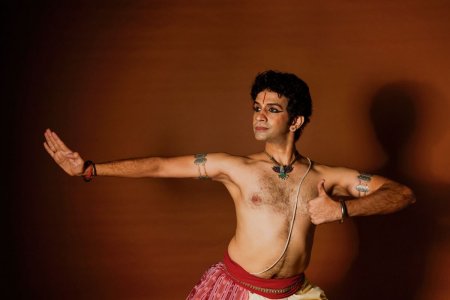 Pavitra Bhat The stage was transformed by a Sri Chakra design meticulously crafted through overhead lighting, placing the dancer at the literal and metaphorical center of the cosmos. As he moved, the geometry of the lights seemed to pulse with the rhythm of creation. Accompanying this visual feast was the music of Sridhar Vasudevan. His erudite compositions provided a complex, scholarly depth to the performance. Verses from the Lalita Panchakam of Adi Shankaracharya acted as a lush tapestry that was woven together with traditional ragas. The dancer navigated the complex iconography of Palini through a series of vivid, kinetic sculptures. His ability to toggle between the ferocious and the sublime was most evident in his transitions from the terrifying to the serene. The raw power of Durga's lion chariot shifted instantly into the delicate flight of bees, where his fingers fluttered, mimicking the nectar-seekers drawn to the Mother's lotus-like presence. Through undulating movements, he suggested a shoreless sea of grace, only to suddenly go still, embodying the supine form of Shiva as "Shava" (corpse). When he channelled the emergence of Kali; his eyes flashed with primordial fire as he rose from the fire, illustrating the kinetic energy of the Shakti that animates the Universe. The technical core of the recital was anchored in the jathis, which were a masterclass in cross-rhythms. The narrative climax of the encounter with Bhandasura saw the Saptamatrikas (the Seven Mothers) come to life. In an ingenious piece of choreography, he depicted each of the seven goddesses - Brahmani, Vaishnavi, Maheshwari, and the others - appearing atop their respective vahanas (mounts). Each transition was seamless, a testament to his versatility as a storyteller who could evoke an entire pantheon through a single, disciplined body. NCPA, Mumbai Keerthana Ravi Punitavati's Unmaking In a breathtaking Bharatanatyam recital, Keerthana Ravi reimagined the hagiography of Karaikal Ammaiyar not as a conventional narrative of piety, but as a deliberate deconstruction of the feminine archetype. By shedding her "beautiful" flesh for a skeletal form, the performer used angika abhinaya to dismantle social constructs of domesticity and gender. Ragam Shankarabharanam shed its ornaments to become an aching Dhenuka with a contrasting set of swaras, even as the choreography eschewed traditional grace to embrace the bibhatsa (disgust) and raudra (fury) in Punitavati's transformation into Karaikal Ammaiyar, from penn (woman) to pey (ghoul). 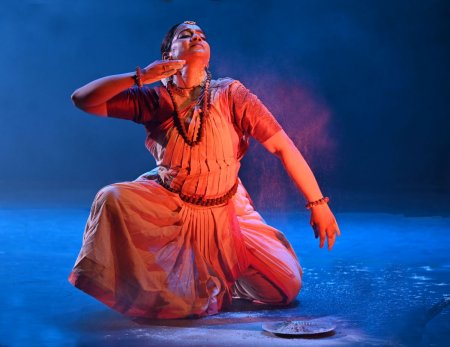 Keerthana Ravi The narrative was anchored in the raw, guttural power of the Thiruvalangadu Pathigam. These pure Tamil verses provided a linguistic landscape for the dancer to interrogate the vanity of the physical shell. The imagery of the banyan grove of Thiruvalangadu was haunting; the clacking of bones, goblins and gargoyles, amidst the desolate beauty of the cremation grounds. The performance peaked in the ascent of Mount Kailasa, where the dancer's movements became increasingly fragmented - a visual "decentring" of the self. This was not merely a story of a saint, but a social commentary on the radical liberation found in being "othered." The final samarpana (surrender) to Shiva at Thiruvalangadu was a profound void, where the deconstructed ego dissolved into the eternal rhythm of the Lord's feet. Dancing with uninhibited joy, Keerthana highlighted the folk origins of the Nayanmar tradition. Her interpretation of Papanasam Sivan's evergreen film song "Yenappan Allava" (raga Punnagavarali) effectively bridged the gap between classical rigor and the accessible, communal spirit of Bhakti. In the shattering climax of the performance, the dancer transcended the boundaries of traditional abhinaya through a visceral, ritualistic immersion in Vibhuti (sacred ash). The dancer cast handfuls of Vibhuti into the air, creating a spectral mist that hung over the stage. She collapsed into the ash, her movements becoming fragmented and heavy, the stage became a cremation ground - a Smashana - where the binary of life and death was dissolved. This "white-out" climax served as a powerful metaphor for the "ultimate unmaking."  Rajiv Rajamani is a film maker, author and connoisseur of classical music and dance based in Bombay, Auckland and Chennai (during the season). |
