
|     |
|
| |

 Dr. Sunanda Nair: A legacy of 4 decades- A.M. Hari Shankare-mail: hshankar252@gmail.com Photos: Bivin Lal January 9, 2026 Mohiniyattam, with roots in the Devadasi tradition that existed in Kerala, had a long series of improvisations and redefinitions over the past century. Amongst the revivalists, the veteran dancer Dr. Kanak Rele's name stands tall for evolving it into a distinct style, over the years, to be known as 'Nalanda Bani' or 'Kanak Rele Style of Mohiniyattam'. Whether Banis were there in Mohiniyattam or not, as distinctively as in Bharatanatyam is a matter of question, but the non-documentation of the earliest dance styles and its other allied features, has led the dancers to understand and assimilate as per their research and blend in accordance with their convictions and beliefs, all exceptional and magnificent. Amongst them, Dr. Sunanda Nair stands out for her strict adherence to the style of her Guru, Dr. Kanak Rele and is generally hailed as the "Ambassador of Mohiniyattam" for her numerous contributions in popularising the dance form around the globe through Sunanda's Performing Arts Centre (SPARC), Houston, USA. This year's Mohiniyattam segment, as part of Soorya Dance and Music Festival, Thiruvananthapuram, had inaugural performance by Dr. Sunanda Nair with a double bonanza of celebrating the 40th year of her dancing career. 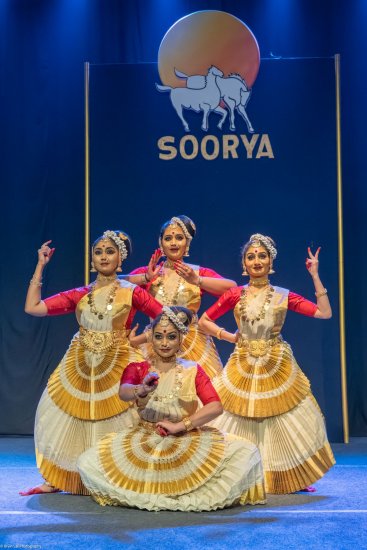 Dr. Sunanda Nair's disciples The commencing presentation had Sunanda's senior disciples coming up with an invocation to Lord Ganesha based on choreography by Kanak Rele, set in indigenous Ganapathi talam and Nattakurinji ragam. From the very entry to the stage, it resonated the very evident Kanak Bani, both in music, dance and the aharya. One could spot all the features like the distinctive vaytharis, the hairdo, the wide spaced aramadalami, the non-conventional vardhamanaka position with hands at the lower centre of the upper torso, the side gold pleat of the costume, all very conspicuous. This piece had vaytharis (phonetic syllables) rendered in blend with the ragam, the tuning of which had a reflection of Kerala music in it. The footwork on these rhythmic patterns in Vilamba, Dhrutham, Atidhrutam and again back to Vilamba Kaalam like a crescendo, is a peculiarity of Kerala's Sopana Sangeetham tradition, which Sunanda and her Guru had imbibed from Kavalam Narayana Panicker, one of the foremost authority of Sopana Sangeetham then. 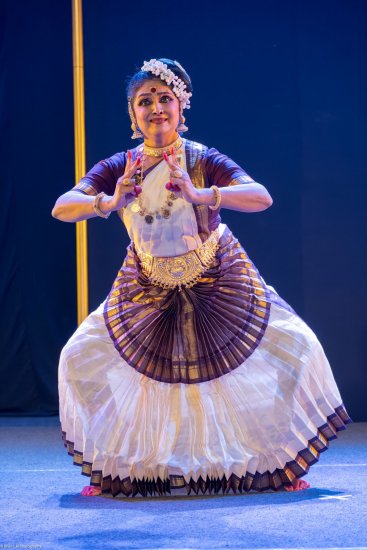 Dr. Sunanda Nair Draped in a maroon themed Mohiniyattam costume, Sunanda made her appearance with a choreography on Annamacharya composition "Sriman Narayana" set in Bauli ragam and talam Adi. Beginning with a Narayana rendition invoked a contemplative mood for the audience. The episode of her Vaikunta Darshanam had a comprehensive detailing for seven rounds of Pallavi with an impressive rendition by the flautist. Stretches of akaaram in accordance with the emotion by the vocalist added more gravity to the scene. In the "Kamalaasanahita Garudagamana Shri", her vigorous flapping of the mighty divine eagle was subtly delineated. In "Paramaatmaa Paramaanuroopa Shri", she preferred to take Prahlada Charitham for sanchari. This scene invigorated the audience for the herculean portrayal of the formidable Narasimha and the acts further, with a stentorian support from the orchestra, was an awe-inspiring moment of the recital. The whole episode, the bhava outlook in particular, was a testimony to Sunanda's stronghold in her Kathakali training, which, of course, is an avowal to the fact that Kathakali and Mohiniyattam shared a common evolutionary trail. Sunanda's prowess as a soloist was greatly appreciated by her rasikas. The entire accompanying artistes' full strength was flaunted for this item, particularly for the last charanam. The high-powered act was succeeded by Madhurashtakam of Vallabhacharya, as a group presentation with usual scenes of Gopis, Gitopadesham, Viswaroopa Darshanam. The lucidity in the choreographic skills of Sunanda with her able disciples' strong command over rhythm and expressive skills, aided with the group's synchrony and comradeship was a delight to watch. The narration of the story of Shabari from Ramayana set in ragam Shyama and Panchari talam, a composition of KN Panicker, which was a part of group choreography by her guru, was an exceptionally emotive piece. The ragam selected was apt for the story line which deals with the yearning of Shabari, known for her selfless service and unwavering faith in Lord Rama, who has been waiting years as per the advice of her Guru Matanga, preparing ashram, clearing thorns from the path leading to her ashram, collecting the sweetest fruits, tasted by herself to offer her Lord, proclaims that divine love is beyond status, norms and eventually meeting him and receiving his blessings to leave her mortal body to be in unison with the Supreme soul. Sunanda's transition from a young Shabari to the dotage, portrayed so effortlessly got the viewers immersed in the purity of devotion. Sunanda and her group concluded with her usual Madhyamavathi Mangalam of her repertoire along with the 10th Shloka of the 100th Dasakam of Narayaneeyam (Yogeendraanam...) eulogising Lord Krishna that elevated the connoisseurs to a feeling of contentment. 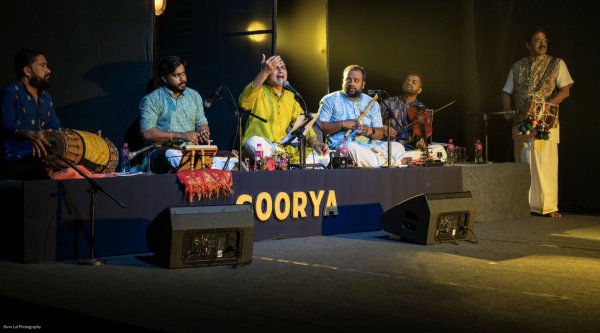 Orchestra Sunanda's accompanists had RLV Hemanth Lakshman on nattuvangam, Kalamandalam Gireesan on vocal, Sangeeth Mohan on violin, Bharat B on flute, Kalamandalam Harikrishnan on mridangam and Irinjalakuda P Nandakumar on edakka. She was accompanied by dancers Uvika Aravind, Avani Santhosh, Binduja Nair, Athira Anand. A comparatively thin audience for Soorya, being a busy working day, turned out as a boon for the engrossed dance lovers to fully relish the performance and enjoy the recital at its best. Sunanda's disciples, with profound fine tuning under their guru, assure us of contributing much to the field of Mohiniyattam. 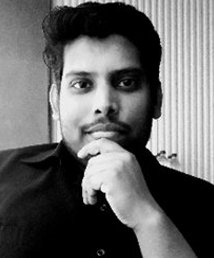 A.M. Hari Shankar, an art enthusiast, percussionist and a connoisseur of Indian Classical Arts is a Biologist-Educationist by profession, based in Delhi. Recipient of the Ministry of Culture Scholarship, his areas of interest include Life Science, Indian Arts and Spirituality. Some of his articles have been published in leading journals and newspapers. |
