
|     |
|
| |

 Variegated terrains of sringara- V. Kaladharane-mail: vkdamaru.eda@gmail.com January 3, 2026 Shobana, the multi-talented actor cum dancer has always been keen on revisiting the organic framework of Bharatanatyam with an individual perspective oriented towards its revitalization in the performative context. Yet she holds in high respect the traditional margam, the key elements of which are appropriately adhered to in her recitals. Just recently at the Krishna Gana Sabha on Dec 27, 2025, Shobana presented a full-fledged concert in front of a packed audience. Her Guru, Chitra Visweswaran, was one of the dignitaries present during the occasion. 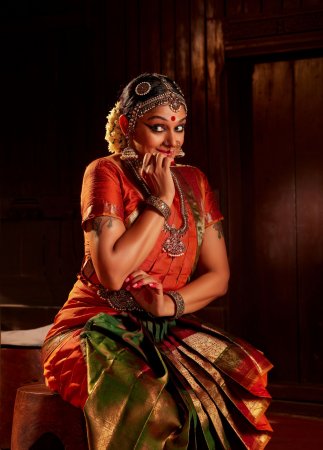 Shobana Shobana started with Anjali, a composition of the violin maestros, Ganesh and Kumaresh. It was in essence a garland of swaras in raga Hamsadhwani set to tala Adi. She was entirely at ease with this pure dance piece. She immediately moved on to the Annapurnnashtakam of Adi Shankaracharya eulogizing the appearance and the divine qualities of Goddess Parvathi. Shobana translated in vivid visual phrases the many splendored Annapurneshwari whose presence invokes both material well-being and spiritual perception. Most of the noted dancers of the day seem to have a disinclination towards the traditional Varnams, especially those of the Tanjore Quartet as their themes close in on to the different facets associated with sringara rasa. Shobana doesn't belong to this tribe. She opted for the widely applauded "Dani ke," the composition of Sivanandam of the Tanjore Quartet, in raga Thodi set to tala Rupakam, as the piece de resistance of her recital. It involves the king of Tanjore, Shivaji, and two courtesans. As one of the courtesans is making a fervent plea to the king to acknowledge and appreciate the intense longing of the other courtesan for him, she herself is incredibly drawn to the irresistibly charismatic king. This situation appears to be a wee bit bizarre and poses a challenge to the dancer. Shobana persuasively portrayed the gross and subtle layers of sensuality entailing the two courtesans. The adavus she executed complemented the rathibhavas that blossomed on her upangas. Several karanas intermittently appeared in the nritta segment. The adavus she did in the charanaswarams, invigorated by the singing of Radha Bhadri and the deft fingerings of Ananth R. Krishna on the mridangam, were marked by eloquence and spontaneity. Two Padams followed in ragas Kamboji and Surutti and in talas Rupakam and Mishra Chapu respectively. "Padari Varuguthu" of Pattanam Subbarama Iyer is again centered on love with Lord Muruga as the hero whom a devotee cum lover aspires for. "Eduthukittanai Modi," a Nindasthuthi composed by Marimuthu Pillai, involves the Nayika and Lord Natesha as the Nayaka. Shobana treated these two padams effortlessly. The next one was the Thillana of the Tanjore Quartet in raga Sankarabharanam set to talas Thisram and Adi. Shobana often relishes in Thillanas composed in the ghanaragas. This one was no exception. She completely rejoiced in it. In the keerthanam "Balagopala" of Dikshithar that followed, the dancer unfolded the anecdotes that avowed the invincibility of Lord Krishna. She depicted the dice game, the attempt of Dussasana to disrobe Draupadi and Lord Krishna's timely intervention employing theatrical overtones. The final segment of the recital was Poothana's entry as Lalitha praising child Krishna as "Omanathingalkkitaavo?", her switching back to her true self and redemption. Sreevidya on the Nattuvangam, Eswar Ramakrishnan on the violin and B. Muthukumar on the flute augmented the tone and intensity of each and every visual frame with their admirable artistry. 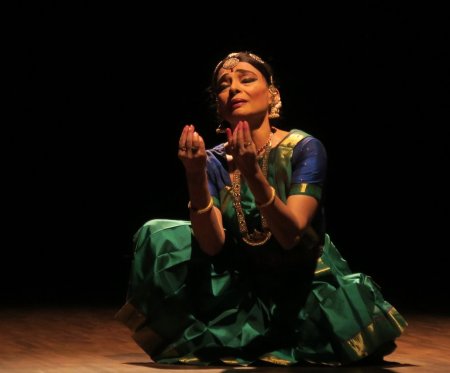 Malavika Sarukkai (Photo: Kalpana Metayer) On the following day, Malavika Sarukkai's stellar performance of Bharatanatyam was attended by an almost different constituency of spectators. Lords Nataraja and Krishna and goddess Ganga have for several years been a motif in Malavika's artistry on stage. She commenced her recital with Mahesha Tandavam, an excerpt from Karthika Thirunal Balavarma's treatise, Balaramabharatam. Its theme is refreshing. In the course of his dance, Lord Siva's anklet gets loosened and it rises up to the sky. The Lord becomes apprehensive of the shock it can inflict on the Earth, if it falls down directly. So, he receives the falling anklet on his body and then it falls down rather mildly. Thus, born the syllables, Tha thi thom nam; the uthpathi (source) of the rhythms that blossomed henceforth. While unfolding this leitmotif, the solid aesthetic frames she created with her face, body and the limbs, defy description. Towards the end, she stood, facing the backdrop, in the dancing posture of Nataraja tapping the damaru. For the Prekshakas, she looked like a divine sculpture carved in the sky. Several years back, I could watch Malavika performing the excessively well-known Padavarnam "Sumasayaka" of Swathi Thirunal. I still do have memories of how she defamiliarized its performative structure. After a fairly long interlude, Malavika did the same Varnam at the Krishna Gana Sabha comprehensively transforming it into an invaluable aesthetic treat. Right from the awe-inspiring thrikalajathi, no words can capture her brilliant execution of each and every adavu independently and in consonance with the text and the subtext. The intoxicating effect of her movement dynamics - horizontal, vertical and diagonal - exuded a high degree of discipline, rigor and an infinite grace. One could experience the thrill of stillness too in her body-kinetics. In the vinyasa linked to the charanam, ramani manishayane! thava rathi lalasa, her emotive acting vied with the meaning of the lines concerned. For samayam bahubadhaya, Malavika touched upon the contrast between the Nayika for whom each moment is intolerably protracted while for Lord Padmanabha reclining on the serpent bed, Anantha, time is infinite and is ever in command of it. While Kruthika amazingly negotiated the nuances of the raga Karnnataka Kappi, in relation to the Sthai (enduring) and vyabhichari (transitory) bhavas of the Nayika, Neela Sukanya's immaculate rendition of the jathis and Nellai Balaji's astounding fingerings on the mridangam catapulted Malavika's performance to uncommon heights. The mellifluous fingerings of Shubham Venkat Subramaniam on the violin furthered the musicality of every composition pertaining to the performance. 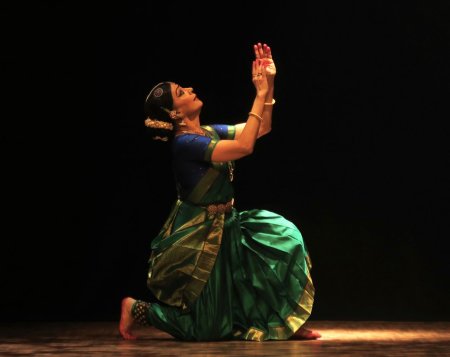 Malavika Sarukkai (Photo: Kalpana Metayer) From the romantic realms of the above Varnam, Malavika then shifted her focus on the story of Thimmakka, a precious piece in praise of nature, more precisely, our ecosystem. Realizing that she cannot give birth to a child, Thimmakka turns her complete attention to flora and fauna that are an inexplicable blessing to the planet. Kruthika's singing of the lyrics in ragas Subhapantuvarali and Yaman Kalyan illuminated Malavika's portrayal of Thimmakka's initial grief giving way to an unconditional attachment towards the Mother Earth. She deftly depicted Thimmakka listening to the whispers of the nascent seeds underneath the earth and her boundless joy watching the plants grow day by day. The concluding item was Krishna in which she brought to life the features of the season Greeshma, the river Kalindi turning toxic with the venom of the serpent Kaliya, Gopas drinking the water and falling down, dead fishes floating in the water, birds falling into it so on and so forth. Finally, child Krishna arrives at the scene, climbs on the Kadamba tree, jumps from it into the river, dances on the hoods of Kaliya and subdues him. A story known to one and all. Yet, Malavika made it memorable with her inimitable idiom and ingenuity. Murugan, the veteran light designer’s sensibility and propriety contributed quite a lot in augmenting the glow of each and every item Malavika performed. 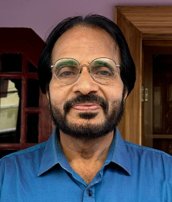 Former Deputy Registrar of Kerala Kalamandalam, V Kaladharan is also an art critic. He has published several articles at the academic level. 'From Meditative Learning to Impersonal Pedagogy' was published in an anthology 'Qui Parley' initiated and released by scholars and writers from the University of California, Berkeley. His articles on Indian performing arts and literature regularly appear in magazines and journals, and in the Friday Page of The Hindu. |
