|     |
|
| |

 Pratistha Samaroham of Natyasastra Gurukulam and Vande Mataram 2025- Chandra Anande-mail: chandra6267@yahoo.co.in December 29, 2025 The function of an art presentation is to evoke aesthetic experience called rasa in the audience. This rasa is brought up to one's consciousness with help of rhythm and good thoughts conveyed through performing arts, particularly dance. As this experience is comprehending of a sentiment, it is identified as a spiritual experience; where the spirit is the innate object that depicts life in all living beings. According to Indian philosophy of life, the spirit is supposed to be a spark of the Ultimate Being. Now the belief in art processes is that, a transformation in the audience is felt through rasa experience. The motto "education through entertainment" communicates the main aim of developing Natyaveda. Then, the essence of all Indian art forms is the belief that rasa experience evokes a sentiment of righteousness with a sense of devotion to the Ultimate Spirit pervading this universe. Thus, through art, messages can be conveyed to the society that uplifts its conscience for good. Certainly, it leads one to see in the propagation of art and culture, a certain constructive path towards nation building. Two programs that reflected above values, brought out the immense work that can be done with the classical dance styles of India as tools for the promotion of the society and development of the country towards better governance and citizenship. NATYASASTRA GURUKULAM Photos courtesy: Natyasastra Gurukulam "Pratistha Samaroham" of a new dance centre named "Natyasastra Gurukulam" was held on November 23, 2025, at Shree Subramania Seva Samaj, Navi Mumbai. The institute was based on the idea that arts "belongs not only to auditoriums, but to everyday corners of public life". For this it required an atmosphere "where presence is pedagogy, and governance flows from inner rhythm." Meaning "through art forms, one's mind is channelized in the righteous direction and then the governance of the country flows with confidence, leading to Ramrajyam". Easily said dispersing of arts, "where pedagogy becomes transformational, not transactional", could work towards building righteous minded citizens which in turn will develop the country and make it prosperous. 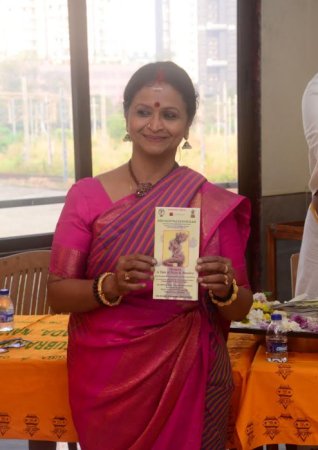 Dr. Padmaja Suresh presenting the Natyasastra Gurukulam brochure This constructive idea is about 8 years old, stirred mainly in the mind of the institute's director, Rohit Vishwanath. These deep stirrings were further strengthened by his meetings with Dr. Mrityunjay Atreya and Dr. Padmaja Suresh, who are ordained as the official mentors of this Gurukulam by their contribution towards pedagogy advice and determining further "steps, actions and offerings". The Gurukulam is blessed by the silent guidance of respected nonagenarian K.V. Subrahmonyan of Sri Ramanasramam, Tiruvannamalai, whose presence gently anchors its journey "in surrender and sastraic depth." The story of Menaka, a dancer, was read out. Her experiences were a mirror reflecting the dilemmas faced by today's practitioners of natya, who are caught between career ambition and the deeper call of sadhana. The story embodied the vision of the Natyasastra Gurukulam, to "re-anchor public life in rasa, rhythm and dharma. At its heart lies the timeless polarity of Shiva and Shakti - transcendence and creative energy. When Shakti is unanchored, creativity risks dissolving into anarchy - movement without meaning, form without purpose. Dharma arises only when Shiva steadies Shakti, and Shakti enlivens Shiva. This union is the essence of Natya and the guiding vision of the Gurukulam". Pratistha Samaroham for the 'Natyasastra Gurukulam' was done to set the designed "yagna yatra" running. The gurukulam firmly believed in education "rooted in Natyasastra and its allied disciplines" and reiterated that "Natya will foster Dharma, fame, longevity welfare and the growth of intellect and will educate the people. There is no wisdom, art, learning, device yoga or action that is not found in Natya". 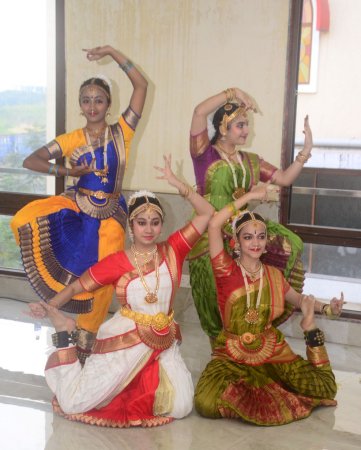 Sitting - Rucha and Medini, standing - Anvita and Vrinda A dance performance added to the ritualistic ambience of the samaroham. Rucha, Anvita, Vrinda and Medini performed a traditional Ganesha kavuthvam, adapted for group choreography, in pure Bharatanatyam and 'Gitopadesham' in dance drama format with costumes, in which 5 slokams from Bhagawad Gita were chosen and composed in pancha jaatis and Ragamalika. The natya darshan was choreographed by their teacher Charanya Gurusathya, artistic director, Natyashala Academy of Fine Arts, Pune, the music composition was by Rohan Pillai. The recorded musical ensemble consisted of Charanya Gurusathya on nattuvangam, Rohan Pillai on vocals, Pancham Upadhyay on mridangam, Gurusathya Rajasekar on ghatam and rhythm pad and Sanjay Sasidharan on flute. A panel discussion was held on topic "Natya Sadhana" where the panel members all affirmed in their own way the importance of disbursing the art of dance to one and all and its far reaching effects in the psyche of the community and the cultural ethos of the country. 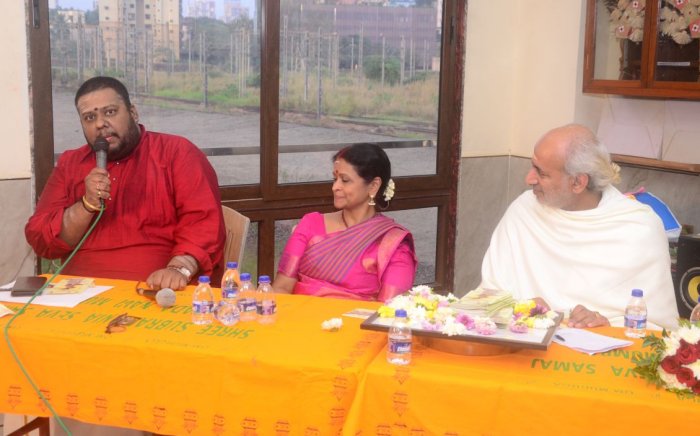 Dr. Sriram Narainswamy, Dr. Padmaja Suresh and Acharya K. Ramasubramanian The chief guest for the samaroham was Acharya K. Ramasubramanian, professor at the cell for Indian Science and Technology in Sanskrit, Indian Institute of Technology, Mumbai, who said that natya was said to be the highest yagna for it has all elements of sahitya, music and dance. So it is more appealing. But it is of no use if there is no devotion to god involved. Also it is superior, as when the rasa experience is shared, the egos of the conveyer and the receiver are snuffed out. So it is a meeting of pure souls gathered to confirm a truth. Thus, he expressed the sanctity and sacredness of arts and its importance for the cultural ambience of a nation. Natyasastra gurukulam is a noble and humble vision that started in 2018, passed through seven years of slow emergence, through advice and confirmation of many elders instead of one founder, through correspondence, corrections, yagnas, and civic experiments, and finally through Pratistha samaroham as confirmation, not beginning; towards building a society based on mores of Ramrajyam. Wishing all success to this yagna yatra - of a module of education, through which to re-anchor public life in rasa, rhythm and responsibility, through the timeless wisdom of the Natyasastra; to have a great journey. VANDE MATARAM 2025 Photos: Sandeep Mankavle (Sun Video) Vande Mataram 2025, a dance festival "celebrating Youth - Honouring tradition - Serving a social cause", running its sixth edition, was held on October 25, 2025 at Prabodhan Thackeray Mini Auditorium, Mumbai. The vision and mission of Vande Mataram-2025 is the brain child of Shila Mehta, a Kathak exponent and artistic director of Nupur Zankar Academy of Performing Arts and Research Centre, Mumbai. According to her, this festival is to experience not only the spiritual joy of dance on stage, as envisioned in Natyasastra, but also to carry that joy beyond the stage -by linking it to meaningful causes and make a beneficial impact on the community. Accordingly, the vision of this festival was not only to provide a worthy platform to the young talented artistes of our country who have achieved excellence in Kathak; but also combine 'performing arts and culture' with 'social causes to serve mankind with far- reaching effects'. In the past, this platform has been effectively used to raise awareness about various social causes such as Autism, Thalassemia (in partnership with Inner Wheel, Rotary Club), education of the underprivileged (in partnership with Angel Xpress foundation) through cultural outreach, interactive sessions and unique choreographies. For this year's mission, efforts were made to encourage 14 young dancers to present traditional repertoires and also use their dance knowledge for a social cause. The performing artistes not only showcased their creative excellence but also spoke about their commitment to serving a specific social cause, optimistically, thereby also inspiring others to leverage arts for societal good. According to Guru Shila Mehta, "Human life unfolded along two essential journeys: One is outward - into the world of action, interaction, and responsibility. The other is inward - a journey of reflection, purpose, and search for truth. Both are vital. Each has its own significance, and one nurtures the other. When we turn inward, we gain clarity, resilience, and inner strength to navigate the outer world. Success in both these journeys is essential. And when we engage with the external world with awareness and purpose, we create the balance .... have the experience of wholeness... which is the true purpose of human life. Our classical dance arts are carefully designed to serve both the inner and the outer journey. As we all know, they are not merely art forms, but pointers to the Art of Transcendence and they are spiritual disciplines. It is Vidya - sacred knowledge. And like a river, it must flow. It is essential to remember that classical dance is not merely to be preserved or promoted. It must be positioned as a tool for meaningful impact. Impact on the practitioner's well-being, on the broader process of human development and on society on the whole." Unquestionably, according to Shila Mehta, it was important that art education reaches every corner of our society, improves the awareness of the people to the idea of Higher Consciousness that would bring equality among people from all walks of life. She continued that, "The true measure of a person is not in what they gain, but in what they give. Across cultures and generations, service to humanity has always been recognised as one of the highest path of giving back something to society that nurtures all - a way to transcend the ego and to refine oneself into something truly humane. When classical dance is viewed through this lens, it becomes a sacred offering - one that nurtures well-being, healing, awareness, and compassion within society. In essence, Sadhana (dedicated practice) and Seva (service to humanity) together form the very heart of India's classical dance traditions - a union of devotion, discipline, and divine purpose. Vande Mataram is a small but deeply sincere step in that direction as it seeks to awaken the spirit of selfless service (Seva Bhava) within every young practitioner of the classical dance arts, by serving the cause for humanity". When the program concluded, the young artistes took pledge to involve themselves to the service of humanity, to work towards building a better developed society. In fact, they had already secured spaces to teach dance to the needed, to help improve their life through the benefits of learning dance like building of good health and empower each one to recognise and relish freedom of expression. 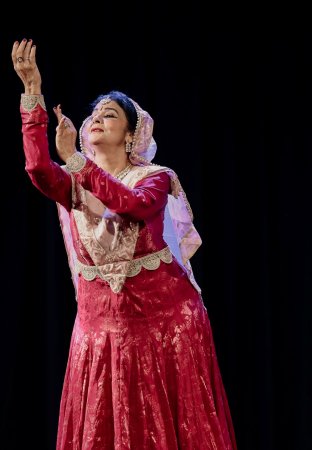 Shila Mehta The evening commenced with a stirring invocation to Lord Shiva by Guru Shila Mehta, as a tribute to her Gurus. Nirvana Shatakam was a composition attributed to Adi Shankaracharya where basic teachings of Advaita Vedantam is summarised. "Chidananda roopam shivoham shivoham", expressed the true nature of the being as the spark of God, a state that is without a form and ego, a state where one experiences attachment with awareness and practises attachment with detachment. A truth that all humans should aim to realize. This item was recorded, beautifully sung by legendary Kathak scion Pt. Birju Maharaj and choreographed by herself. This rare composition Nirvana Shatakam was a befitting initiation into a magical evening that showcased 7 flavours of the Kathak idiom, and that resonated the sentiment of the vision. 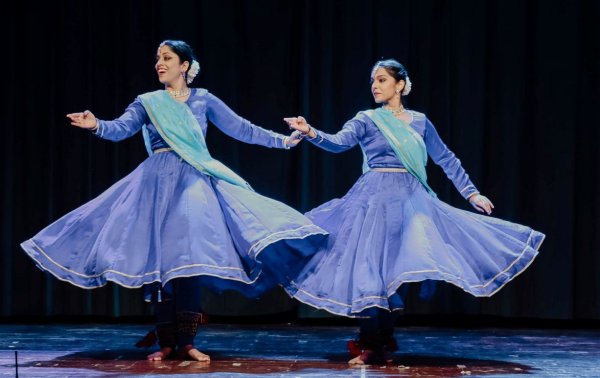 Sumana Sachidananda & Mansi Somaiya Mansi Somaiya and Sumana Sachidananda presented a traditional composition in Jhaptaal and raag Adana, on Lord Shiva describing various facets of Lord Shiva such as Shambho, Mahadev, Mahabali and Aadi-Anant which was choreographed by their guru, Shila Mehta. Music was by Debashish Sarkar with inputs from Guru Shila Mehta. The technical nritta part was light and interspersed with Shiva icons. The dancers showed good dexterity and grace in their movements.  Gauresh Shetkar and Swaroopa Bhonde The segment of Gauresh Shetkar and Swaroopa Bhonde explored intricacies of Taal Shikhar, a rare and complex 17-beat rhythmic cycle composed by Guru Shambhavi Dandekar. This pure nritta segment showcased the richness of Kathak vocabulary from thaat to amad, toda, tihai, paran, and tatkar culminating in a crescendo of chakkars, demonstrating the beauty of both form and technique. They covered the stage well and alternately told padanth. Their technical virtuousity shone as they danced with clear body lines. For abhinaya they presented "Radha khelat Shyam sang hori". The piece showcasing the tender shringar between Radha and Krishna, gradually unfolded into a vibrant celebration of love and joy. Subtle nuances of taal and laya captured the vivid imagery of Gopas and Gopis immersed in color, dance, and divine bliss, offered the audience a wholesome experience of Vrindavan's eternal play. The item was interspersed with tatkars that ended with excellent tihais and poses. Both items were choreographed by their teacher Amruta Paranjape. 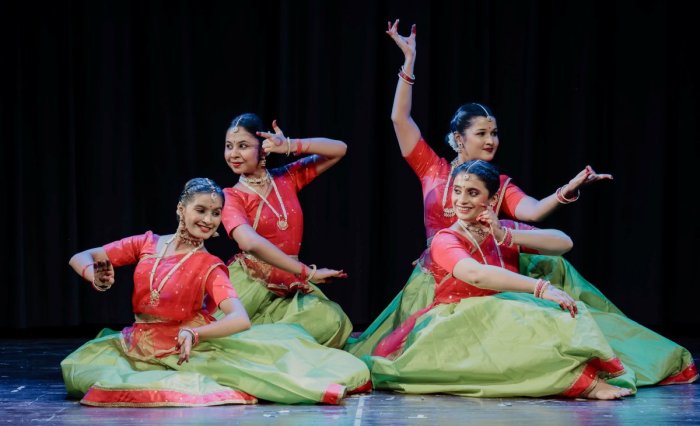 Rutuja Kulkarni, Aarya Mahajan, Girija Wadikar and Nidhi Kabir Rutuja Kulkarni, Aarya Mahajan, Girija Wadikar and Nidhi Kabir, disciples of Vaishali Dudhe, through their Kathak presentation explored the divine duality and unity of Shiva and Shakti, the cosmic principles of consciousness and energy. They performed Ardhanarisvara, (Champeyagauraya), the half-male, half-female form that symbolized the inseparable oneness of Shiva and Shakti. It had superb choreography and good formations. In nṛttanga performance, a taal composition, they showcased the balance between vigour and softness and weaved together the essence of masculine and feminine energies through intricate bandishes and precise footwork. Dhrupad conveyed complementary forms of the divine: Shiva - fierce, ascetic, and transcendental; Shakti - radiant, compassionate, and life-giving and revealed many intricacies of laya. They all were equally strong and well adapted to their chosen style of Kathak idiom. 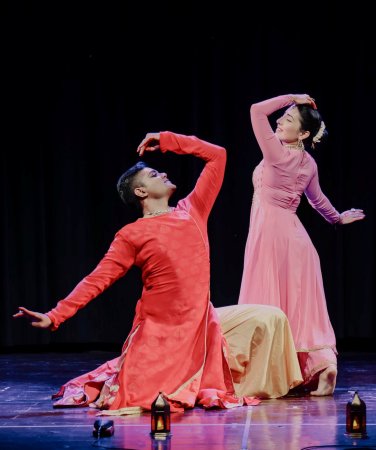 Pooja Bhattad and Aditya Sharma Pooja Bhattad and Aditya Sharma presented "Rooh", a creation that paid homage to the timeless legacy of the Lucknow Gharana, a tradition celebrated for its refinement, grace, and lyrical beauty. A pure technical bandish, set in teentaal, "Piya tore bal haaru" - "Oh Beloved, I am yours" - explored the delicate interplay of Hindu and Islamic iconography, reflecting the syncretic cultural ethos that defined courts of Lucknow. Sargam, preceded by a poignant rubaai by the evergreen Pt. Birju Maharaj unfolded through layered rhythmic structures and refined technical virtuosity. This poetic interlude blended timeless melodies of raags Yaman and Malkauns - favorites at darbaars - encapsulating their grandeur and the elegance of the dance, showcasing the divine strength of Shiva and Parvati. Their dance movements were measured to the tee. Their stances and finishes were perfect. From their costume style, one was reminded of 'Mughal-e-Azam' times, but the costume could have been a bit more dignified for stage presentation. 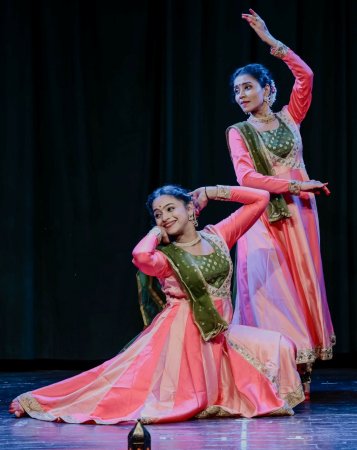 Tejashree Muley and Sakshi Bhosale Tejashree Muley and Sakshi Bhosale presented Shiv Dhrupad "Damaru har kar baaje", set to taal Rupak, depicted Shiva, in his 'sagun' and 'nirgun' form, as the god of dance with a damru and trishul in his hands, and also as Ultimate Truth of the universe since its inception. The recorded music was sung by Shrirang Tembe accompanied by Atharva Kulkarni on tabla. Dhrupad set to taal Basant - 9 beats, learnt from Guru Nivedita Ranade was performed with rivetting energy. A very traditional tarana piece, of Banaras Gharana, composed and choreographed by Pt. Gopi Krishna in raag Sohoni, taal teental, was presented with aplomb. 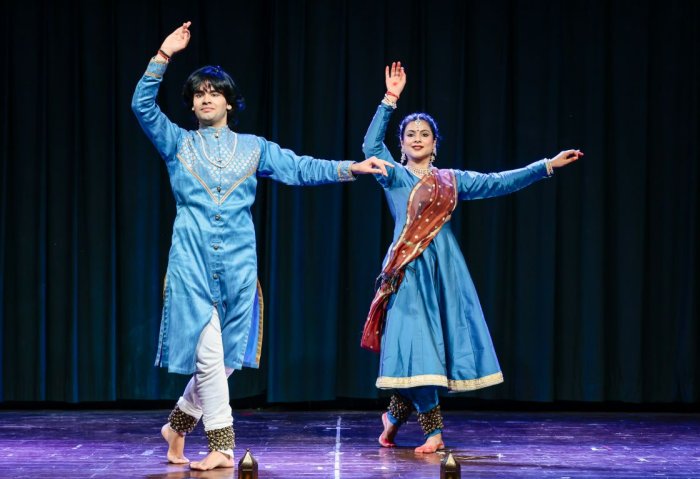 Akshar Tekchandani and Sakshi Damani Akshar Tekchandani and Sakshi Damani performed a Soordas Bhajan "Sharan gaye ko kaun ubaryo" in raag Yaman, sung by Pt. Jwala Prasad where they aesthetically delineated stories of Lord Vishnu depicting his graces. Followed it with Shuddha Nritya in teen taal composed by Pt. Rajendra Gangani and concluded with a tarana in raag Chandrakauns, composed by Guru Geetanjali Lal. They gave a brilliant performance showcasing dexterity and technical virtuosity. The festival was a wonderful display of Kathak idiom in 7 different styles but cohesive like the colours of a rainbow seen after a rain shower when the sun breaks through, fresh and colourful symbolizing youth, vibrancy and joy. 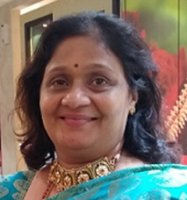 Chandra Anand is a Bharatanatyam artiste and teacher. She has an MA in Bharatanatyam from Tilak Maharashtra Vidyapeeth, and her series on 'Education in spiritual values through Bharatanatyam' is featured in narthaki.com. |
