
|     |
|
| |

 Aradhana Festival by Ambalam- Satish Surie-mail: satishism@yahoo.co.in December 23, 2025 "Aradhana" under the banner of Ambalam was a two-day festival of music and dance by vocalist T.V. Ramprasad and Bharatanatyam artiste Indira Kadambi, conceived as an intimate offering of gratitude to their respective gurus, S. Rajam and Kalanidhi Narayanan, and their artistic lineages, at Seva Sadan, Bangalore, on the 6th and 7th of December. It brought together performances, workshops, and discussions that wove personal memory with the ethos of guru bhakti, and allowed both artistes to publicly acknowledge the formative role their teachers had played in shaping their art. The curatorial tone was nostalgic and celebratory, and it turned the stage into a shared space of remembrance where concerts and dance recitals served as living tributes rather than mere showcases of skill. Day 1 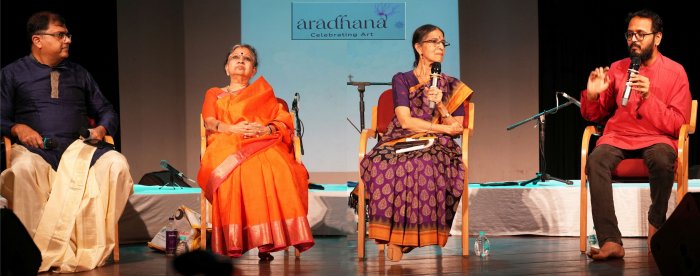 Panel discussion on S. Rajam (Photo: Prof.K.S.Krishnamurthy) Day 1 foregrounded music and paid rich tribute to the multifaceted genius of the late S. Rajam. The day moved seamlessly from remembrance and scholarship to performance and pedagogy. The day opened with a panel discussion on S. Rajam, moderated by Janaki Srinivasan and featuring Dr Prameela Gurumurthy, his daughter-in-law, alongside Lalitharam Ramachandran. The speakers threw light on Rajam's erudition and scholarship, interspersing their observations with warm, often humorous anecdotes. They recalled his legendary generosity, his willingness to share knowledge, compositions and resources without reservation. Janaki also highlighted his remarkable parallel career as a painter, evoking the image of Rajam seated on a simple stool, bending intently over his work - many of these paintings now adorn the walls of Sruti's office, standing as a quiet visual archive of his artistic sensibility. Musical tributes and mentorship 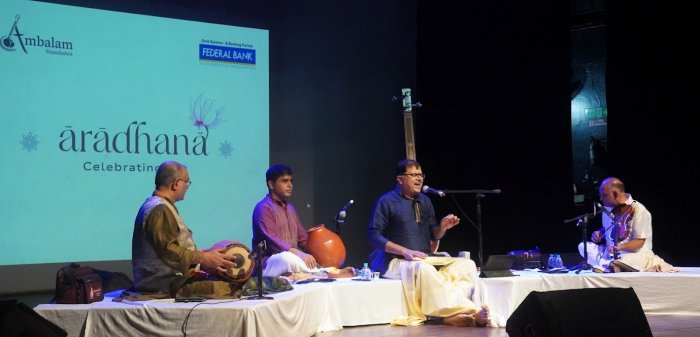 Music presentation by TV Ramprasadh and ensemble Photo: Prof.K.S.Krishnamurthy T.V. Ramprasadh offered a moving remembrance of Rajam as mentor and guide, blending narration with music to keep the tone both intimate and engaging. His presentation, in the presence of Rajam's two sons, gained an added emotional resonance. He rendered some of S. Rajam's own compositions alongside pieces by Koteeshwara Iyer, underlining Rajam's role in bringing these works into circulation and shaping their contemporary reception. The segment functioned both as homage and as a living demonstration of the musical lineage Rajam helped nurture. Post noon, the focus shifted to hands-on learning through parallel workshop sessions. On the dance front, Indira Kadambi led a workshop, presumably bringing her fine-grained approach to abhinaya and laya to the participants. In the vocal segment, T.V. Ramprasadh and Dr Prameela Gurumurthy conducted a joint workshop, allowing participants to engage more closely with aspects of manodharma, interpretation and stylistic detail that had been discussed in the morning. These interactive sessions ensured that the day did not remain only commemorative, but also pedagogically robust. The evening was devoted entirely to performance, opening with a Hindustani vocal recital by Abhijith Shenoy. His concert introduced a distinct sonic palette to a largely Carnatic-centric context, broadening the aesthetic spectrum of the day's programming. The finale featured the versatile percussion maestro Anoor Ananthakrishna Sharma with his ensemble, bringing rhythmic energy and collaborative dynamism to the close. With layered percussion dialogues and ensemble interplay, the concluding performance tied together the day's emphasis on tradition, experimentation and shared artistic inheritance. Day 2 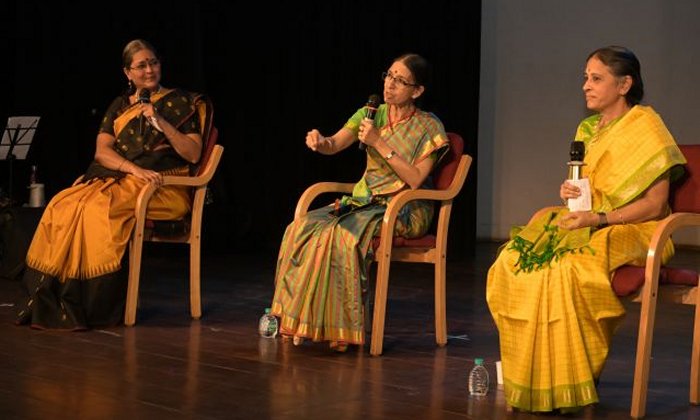
Panel on Kalanidhi Narayanan Jayanthi Subramaniam, Janaki Srinivasan, Nithyakalyani Photo: Shandilya Srivatsa Day 2 of the festival acquired a special gravitas as it became an occasion to celebrate the legacy of the legendary abhinaya guru, Kalanidhi Narayanan, whose birth anniversary fell on the same day. The day combined remembrance, reflection and rigorous artistic enquiry, setting the tone for a meaningful homage. The session opened with a short film on Kalanidhi Narayanan, tracing her journey from her early years in Bharatanatyam to her later emergence as one of the most sought-after teachers of abhinaya in the latter half of the 20th century. This was followed by a panel discussion moderated by Janaki Srinivasan, with senior dancers Jayanthi Subramaniam and Nithyakalyani, both of whom had the privilege of studying under "Kalanidhi Maami". They spoke candidly of the transition from the rigorously codified training they had received under their guru Adyar K. Lakshman to the more fluid, interpretive space that Kalanidhi Narayanan opened up for them. Moving from a largely nritta and structure-oriented pedagogy into a world centred on inner emotional truth demanded, as they put it, a conscious "unlearning". For Kalanidhi, abhinaya was never about embellishing technique; it began with a meticulous, almost forensic reading of the poem. The panellists described how she insisted that every word, image and emotional turn in the text be understood and internalised before a single gesture was attempted. Her classes often became close readings of sahitya, where meaning, subtext and character motivation were unpacked so that expression grew organically from comprehension rather than from stock bhavas. In doing so, she helped re-centre abhinaya in contemporary Bharatanatyam and became closely identified with the modern, process-oriented method of teaching expressive dance. Even as she encouraged interpretive freedom, Kalanidhi was uncompromising about discipline: punctuality, preparedness and complete presence in class were non-negotiable. She was known to observe films and everyday situations to study subtle facial shifts, constantly enlarging the repertoire of expressions she could transmit to students. The panel recalled her generosity - her habit of gifting books, nudging students towards reading, reflection and independent inquiry. Teaching, which she took up in mid-life after a long hiatus from performance, soon became her central vocation, and she went on to guide generations of dancers in India and abroad. Kalanidhi Narayanan's comeback as a teacher in her forties marked the beginning of a second, remarkably influential phase of her career, during which she conducted workshops worldwide and published significant material on abhinaya. The panel touched upon the annual programme she organised in memory of her parents, where younger artistes such as Praveen were invited to perform and were supported with meaningful honoraria, reflecting her belief in nurturing the next generation. 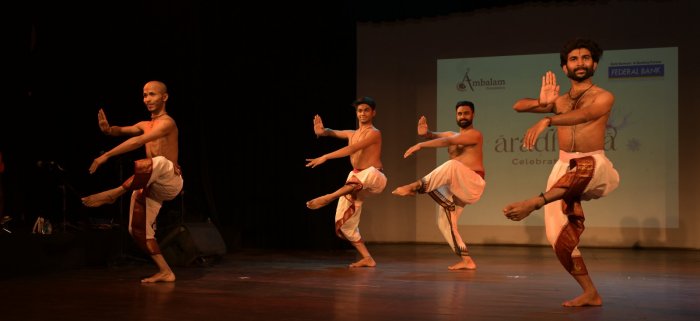 Mushika Vahana (Photo: Shandilya Srivatsa) Through such initiatives, she ensured that abhinaya remained a living, evolving practice rather than a museumised component of the repertoire. The sense of continuity she fostered - between gurus, disciples and emerging dancers - was palpable in the recollections shared on stage. Fittingly, the discussion opened with the recitation of "Mushika Vahana," the familiar Ganapati invocation that Kalanidhi Narayanan is remembered for using as a signature opening to her classes. For her students, this shloka was not merely a ritual, but an anchoring device that signalled a shift from the outside world into a concentrated space of sadhana. As the panel drew to a close, what remained with the audience was the portrait of a consummate artiste and teacher - deeply exacting yet abundantly giving - whose influence continues to inform how abhinaya is taught, learnt and experienced today. Meippattiyal In the vibrant tapestry of contemporary Bharatanatyam scholarship, few moments captured the renewal of tradition with such clarity as the presentation of Sai Kripa Prasanna's research paper 'Meippattiyal' during the Aradhana 2025 symposium organised by the Ambalam Foundation in Bengaluru. The event, conceived as an intimate confluence of art and inquiry, celebrated not only the rhythmic pulse of Indian classical dance but also the seriousness of intellectual pursuit. It was within this reflective milieu that Prasanna was conferred the Best Paper Award, a recognition she accepted with characteristic grace. 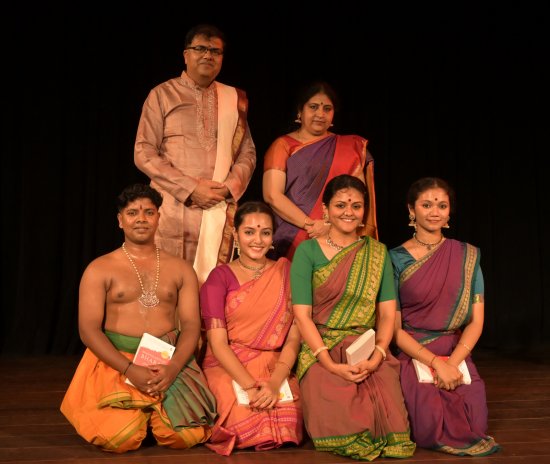 Meippattiyal (Photo: Shandilya Srivatsa) A disciple of stalwarts such as Urmila Sathyanarayanan and the late Kalanidhi Narayanan - whose enduring abhinaya legacy hovered gently over the proceedings - Prasanna brought to her presentation an articulate fusion of embodied practice and textual scholarship. Her paper Meippattiyal, grounded in the eponymous chapter of the Tolkappiyam's Porulatikaram, investigated the ancient Tamil grammarian's pioneering articulation of emotions as corporeal certainties. She unpacked the etymology of the term - mei (body, truth) and paṭṭu (to adhere or manifest) - to shed light on meyppattu, the outward blossoming of internal states that informs poetry, drama, and crucially, the expressive architecture of Bharatanatyam. Prasanna argued persuasively that Tolkappiyar's classifications - such as laughter born of ridicule or the delicate registers of fear manifesting as tremors - provided an early, pre-Sanskritic blueprint for the evocation of rasa, predating Bharata's Natyashastra by centuries. These meyppattu, she maintained, offered dancers tools to imbue nritya with psychological depth, enabling a fleeting glance to open into shyness, or a tremor of the hand to echo dread's interior quiver. What elevated the paper beyond academic exposition was its performative resonance. As the founder of Kripa's Centre for Fine Arts in Chennai since 2001, Prasanna intertwined theoretical argument with demonstration, Daya Sagari Vijayaraghavan, Padmashree Vijayaraghavan, RLV Prajit K.P. and Abhinaya Manivannan, enabling the audience to witness the subtle continuum between Tolkappiyar's conceptual insights and the dancer's physical articulation. She emphasised that rasa was not achieved through mimicry but through the dancer's ethical engagement with emotional origins, echoing Tolkappiyar's insistence on discernment. The paper's strength lay equally in its humility and accessibility. Far from an esoteric discourse, Meippattiyal invited practitioners to integrate its principles into pedagogy. Prasanna's narrative voice - shaped by her dual training as psychologist and performer - lent the presentation a warmth that grounded its scholarly rigour. In the end, Prasanna's Meippattiyal emerged as a luminous thread in Aradhana 2025's fabric, reminding the community that Bharatanatyam's grace has always been renewed through the generous sharing of knowledge. As noted in the Ambalam Foundation's felicitation, her dedication moved audiences and colleagues alike, underscoring art's ability to both humble and exalt. Her paper offered more than insight - it offered inspiration: a call to let inner emotions move outward with clarity, authenticity, and truth. Rangabhoga - Where word and movement embraced Conceived as an intimate interaction between Ramaa Bharadvaj and Indira Kadambi, Rangabhoga unfolded as a conversation in voice and movement. Ramaa Bharadvaj's narration - cradling the tender lilt of a nursery jingle, "eya eya yo," at once wry and affectionate, its humour shot through with a soft, searching quiet - unfurled like a lullaby turning inward, a hush of learning and rediscovery. In that afterglow, Kadambi's abhinaya rose like light catching on water, each glance and gesture etched in luminous precision, carrying emotion towards the eye until it flowered on the body's surface. This collaborative energy flowed directly into Indira Kadambi's solo abhinaya, which felt like the inward extension of her dialogue with Ramaa Bharadvaj. She offered a sequence of finely wrought pieces that reflected the expressive legacy of her guru, Kalanidhi Narayanan. 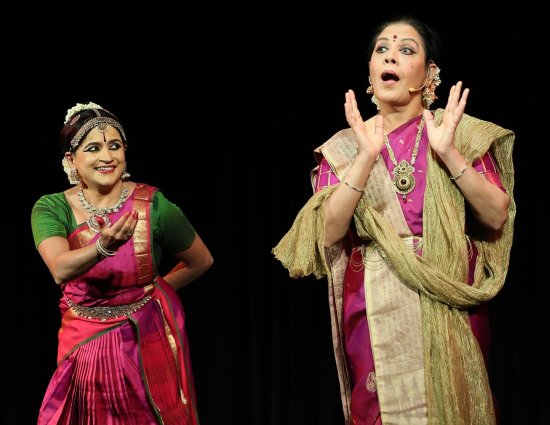 Rangabhoga: Indira Kadambi & Ramaa Bharadvaj (Photo: Biju) She opened with "Varugalamo Ayya" from Nandanar Charithram, embodying the saint's trembling plea at Chidambaram's threshold - eyes shimmering with defiance, gestures tracing unseen barriers of caste and fate. Pathos merged with unyielding bhakti in a masterclass of layered restraint. Her shift into "Netrandhi Nethrathile" (raga Huseni, adi tala), the first padam she learned from Narayanan, drew the evening inward. The virahotkanthita nayika's ache flickered through her fingers, trembled on her brow, and culminated in a korvai that pulsed like a heart remembering its own longing. A warmer breeze followed with Pattabhiramayya's Javali "Apaduraku lonaithani" (raga Khamas, adi tala), where Kadambi's artful coyness transformed the stage into a confidante's alcove, renewing a familiar favourite with the ease of seasoned insight. Mirth crowned the recital's finale. Kadambi crafted a sparkling hasyam medley. "Vagalaadi," "Chitiki vesethe" sparkled with coquettish scolding; "Tarumaarulada Bhajari" erupted in a whirl of domestic farce laced with marketplace wit - sharp as a vendor's banter, sly as monsoon mischief. Ramaa Bharadvaj embodied the defiant nayika, her glances flinty barbs refusing the distraught hero's every inducement, her hips a teasing sway that turned supplication to sparkle, farce blooming into the heart's defiant laughter; and the rare Kshetrayya padam Ososi revealed a lovelorn hero caught between swagger and despair. Humour became revelation - each laugh exposing a tender human truth. Buoyed by Ramprasad's playful phrasing, Vinay Nagarajan on the mridangam, Arti on the nattuvangam, Raghu Simha on the flute, and Ramaa Bharadvaj's sparkling wit, the work honoured bhoga as the relish of creation and ranga as the sacred space where joy becomes revelation. This thread continued into, where Kadambi revisited her 2005 teaching debut in San Antonio. Faced with linguistic and cultural diversity, she turned to the universality of Purandara Dasa's "Gokula dalli naan iralare gopamma kele" (raga Kanada, adi tala). Recreated at Seva Sadan, the episode became a quiet parable of pedagogy - abhinaya as bridge, not a barrier. In totality, Indira Kadambi's and Ramaa Bharadvaj's presence at Aradhana 2025 revealed an artiste renewing tradition in multiple registers - outwardly through shared storytelling, inwardly through introspective abhinaya, and pedagogically through accessible guidance. Her work reaffirmed that in the right hands, subtlety carries power, lineage becomes living breath, and Bharatanatyam continues to evolve without relinquishing its soul.  Aradhana ensemble (Photo: Prof K.S.Krishnamurthy) The evening session started with a musical interlude by the students of Ambalam Foundation under the direction of T.V. Ramprasadh. Vishnu joined with his delightful instrument, Navtar, to regale the audience with some of Rajam Bani's compositions. Sreelakshmi Govardhanan Sreelakshmy Govardhanan, disciple of the illustrious Guru Pasumarthy Rattaiah Sarma, unveiled a Kuchipudi recital in which each segment revealed her consummate command over nritta, abhinaya, and dramatic interpretation, shaping a journey that was at once exhilarating, meditative, and spiritually charged. The recital opened with "Tandava nritta kare Ganesha," a thunderous invocatory kautuvam that reimagined Ganesha as Shiva's fierce counterpart in a cosmic tandava. Sreelakshmy captured the deity's paradoxical essence - the playful disruptor and the annihilator of ignorance - through explosive rhythmic sequences. Layered jatis in crisp ta ki ta cascaded into booming dhi mi patterns, while her fluid kurmi spins evoked a churning vortex of creation and dissolution. Her fleeting abhinaya vignettes - especially Ganesha's gleeful intrusion into Shiva and Parvati's dance - added delightful nuance without breaking the kinetic momentum. Rooted in Telugu poetic traditions, this opener set a tone of auspicious frenzy, the resonance of her ghungroos awakening both gods and rasikas. 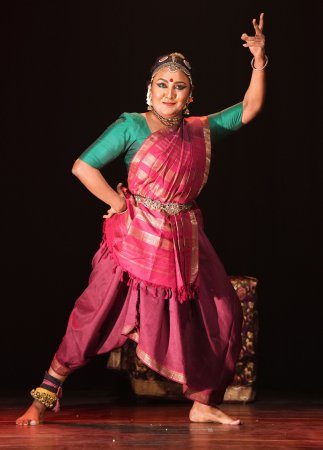 Sreelakshmy Govardhanan (Photo: Prof K.S.Krishnamurthy) Transitioning into dramatic terrain, Sreelakshmi next embodied Banasura in a galvanising daruvu excerpt from Usha Parinayam, the iconic Kuchipudi dance-drama by Vedantam Lakshminarayana Sastry. The stage seemed to transform into a celestial throne room as she stepped into the demon king's glittering vesham, its radiance mirroring his cosmic arrogance and calling himself Raju. Her vachika abhinaya excelled in the interpolated dialogue with the minister - a conspiratorial exchange rich in tyrannical swagger. Through eloquent gesture and vocal nuance, she articulated Banasura's proclamation that Shiva and Parvati would guard his impregnable realm, their third eye ready to annihilate all foes. Yet woven into this bravado was a muted vulnerability that lent the portrayal a rare psychological depth. Intricate footwork, aligned with the composition. The mood then softened into devotional lyricism with Vasudevan Namboodri's Krishna Stuthi, a Sanskrit invocation suffused with maternal yearning and flute-kissed leelas. Incorporating the Navarasas, Sreelakshmy's sringara abhinaya unfurled with shimmering delicacy: Yashoda's fraught encounter with Poothana dissolved into tender embrace, while Krishna's butter-stealing antics were rendered with impish charm through darting glances and refined mudra work. The melodic contours of the musical composition found expressive resonance in her undulating torso isolations, evoking the child-god's mischief as a conduit for both emotional ache and spiritual awakening. The finale erupted in a breathtaking tarangam, the quintessential Kuchipudi hallmark performed atop a brass plate. Sreelakshmy balanced with unwavering poise, her controlled spins dissolving into meditative cycles that blurred motion into stillness. The rhythmic dialogue between her anklets and the plate - ta dhi mi ripples expanding outward - summoned imagery of Krishna's rasa by the riverbank. It was a virtuoso close that encapsulated the evening's arc: from Ganesha's primal vigour to Banasura's troubled grandeur and finally to Krishna's eternal play. In totality, the performance affirmed Sreelakshmy Govardhanan's stature as an artiste of exceptional depth, capable of animating Kuchipudi's narrative, kinetic, and emotive vocabularies with rare sophistication. It was an evening where dance became prayer, myth breathed anew, and the divine felt profoundly within reach. The musical ensemble - Murali Sangeeth on vocals, Kalamandalam Sriram on the mridangam, Kavya on the nattuvangam, and Vivek Krishna on the flute - infused the recital with tonal flair and rhythmic vitality, shaping a soundscape that elevated each composition. Their cohesive synergy not only supported but propelled the presentation, amplifying its dramatic intent and spiritual resonance. Rama Vaidyanathan Rama Vaidyanathan unveiled a shabdam as her luminous opening gambit. Composed by the venerable Thanjavur Arunachala Pillai, this shabdam bloomed like a lotus within the golden hall of Chidambaram. The piece commenced with a rhythmic summons - thaa aa aaa thai thuh uh tha thaam - a percussive torrent that echoed Nataraja's damaru, drawing the audience into the celestial tumult. Rama's nritta passages gleamed with mastery: incisive adavus in teermanam crescendos erected a kinetic sanctum, her feet resounding like temple chimes upon the vibrant stage. The sollukattu - those mesmerising incantations - wove through her sinuous torso ripples, conjuring the coil of Adisesha beneath Shiva's eternal step. Technically sublime, her choreography, infused with her signature fluidity, exacted flawless precision in hastas depicting the agnikunda's flames and the vault of the cosmic ring, harmonising narrative and form in effortless grace. 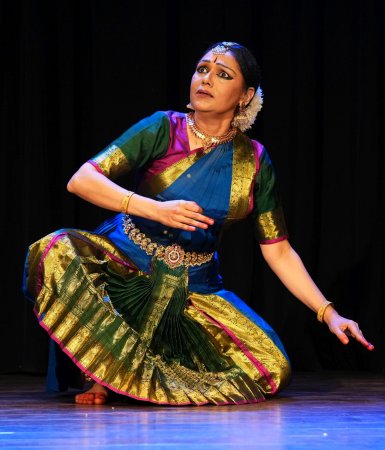 Rama Vaidyanathan (Photo: Prof K.S.Krishnamurthy) Yet it was Rama Vaidyanathan's abhinaya that propelled the shabdam into the sublime. As the nayika, her eyes brimmed with bhakti-laced shringara, imploring her sakhi, via subtle facial nuances: brows arched in entreaty, lips yielding to a breath of viraha (the pang of parting). "Thillai ambalam thannile natam seidhidum Nataraajan en ellai etra kaadhal nenjinnai eppo dhaan arivaaro dee?" she mourned - would the Sovereign of Chidambaram ever divine my infinite devotion? Rama Vaidyanathan incarnated this through virtuoso netra abhinaya, her gaze ascending to pursue elusive tattvas (cosmic essences), then folding inward in quiet devastation. Stanza upon stanza, the emotive ascent soared: from visionary glimpses of his celestial natam in Shanmukhapriya, to the soul's relentless clasp in Bageshri, cresting in Hamsaanandi's supplication for oneness - "Ardhan en ullaththaaduvon ingu aavalaai varuvaarodee?" - a lament that pierced the divide between earthbound and eternal. Rama then presented Dr M. Balamuralikrishna's masterful varnam "Saraguna gavumu," in raga Todi, which she transformed through an inspired synergy with the ensemble: Dr S. Vasudevan on nattuvangam, violinist Mattur Srinidhi, mridangist Sumodh Sridharan, and vocalist Viswesh Swaminathan's mellifluous, flowing rendition of the sahitya. From the opening pallavi "saraguṇa gavumu varaguṇa nilave", Rama summoned the Goddess Devi with an invocation that was both regal and intimate. Her four decades of stage experience distilled into a performance of effortless élan. In the anupallavi, as Viswesh's voice poured forth "karuna rasa purita hrdaye," the dancer's torso rippled like a heart brimming with compassion's nectar, her abhinaya layering subtle sanchari bhavas: a fleeting glance of the devotee's longing, eyes widening to mirror Devi's "vishala vilocana". From the outset, Vasudevan established an authoritative rhythmic architecture. His articulation of the jatis composed by Sumodh Sridharan - crisp, unhurried, and impeccably modulated - created a lattice of laya that both anchored and elevated Rama Vaidyanathan's choreographic choices. Each phrase unfolded with deliberate clarity: the sollus were enunciated with a mellow metallic timbre that revealed their inner grain, while the pauses he shaped between syllabic bursts lent the choreography room to breathe. In the chittaswara passages, his nattuvangam grew more assertive, chiselling the contours of the teermanams with a precision that allowed Rama to inhabit the rhythmic thrust with complete assurance. The chittaswara passages ignited the varnam's rhythmic core. Jatis in adi tala burst forth with scintillating energy; Sridharan's mridangam strokes expanded them into resonant orchestral textures, while Vasudevan's nattuvangam provided the axial clarity around which these crescendos cohered. Her footwork etched patterns of surrender across the stage, the ghungroo that whispered secrets of laya, stamped patterns of surrender, her pirouettes dissolving ego like the varnam's svarakshara "ga-da-dha-ri," shattering Kama's pride. Through sculptural stances, she embodied both seeker and Goddess, revealing a gallery of devotees receiving blessings under Devi's benevolent gaze. Srinidhi's violin lines threaded improvisatory filigree through the ettugada swaras, offering buoyant contours upon which Rama launched into a korvai that mimicked flute melodies - murali gana - her fingers dancing as if plucking invisible strings. Yet the most arresting moments emerged in the stillness between rhythmic peaks: a single, focused drishti that drew the audience into an experience where movement, shruti, and emotion were fused with meditative luminosity. Rama Vaidyanathan masterfully shifted to madhura bhakti. Concluding her program with a soulful shloka, recited with melodic clarity, conjured the enchanted autumn night on the Yamuna's banks and setting the stage for the magnificent Raas Leela. This prelude gave way to the crowning glory: Swathi Tirunal's sublime keertanam "Rasa vilasa lolo" in raga Kambhoji, adi tala - a vivid portrayal of Lord Krishna's joyous Raas Leela with the cowherd maidens. Alternating between Krishna's teasing vihasa and the Gopis' madhunatura yearning, the pallavi's ecstatic declaration - "rasa vilasa lolo lasati bhavan deva" - ignited pure nritta. Sanchari bhavas flowed like nectar from the murali - each maiden lost in surrender, sorrows obliterated by Jalajanabha's grace. Swift korvais evoked the multiplying Yadava hero, forming the divine mandala where every soul found union, as devas showered applause from above. This concluding piece not only showcased Vaidyanathan's technical brilliance but also her profound interpretive depth, reminding us of bhakti's liberating power. In balancing Devi's compassionate majesty with Krishna's playful allure, she offered a complete spiritual journey - a recital that will echo in rasikas' hearts long after the anklets fell silent.  Bangalore based Satish Suri is an avid dance rasika besides being a life member of the Music and Arts Society. |
