
|     |
|
| |

 Intersections and the making of a thoughtful dance conference- Dr. Deepa Mahadevane-mail: artistscholardeepa@gmail.com Photos: Dr. Deepa Mahadevan December 20, 2025 The 'Intersections' conference was held on September 27 and 28, 2025 in Boston, MA. This was co-presented by MIT Heritage Arts of South Asia (MITHAS) and the Lakshmi Mittal and Family South Asia Institute at Harvard University. Two young dance visionaries, Shriya Srinivasan and Joshua George, curated the conference. This review/report will serve to be a good way to understand the high level content of the conference along with how I felt as a conference attendee viewing it with my lived experience as a dancer, teacher and researcher in the Indian Diasporic space in North America. However, if you want to understand how the conference was structured and the list of selected speakers featured in each session, please consult the conference website. 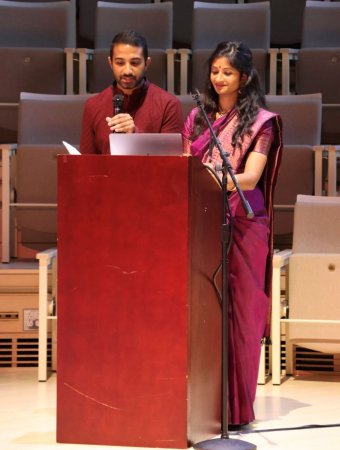 Joshua George & Shriya Srinivasan (Photo: Meera Ratnagiri) As a dance researcher who presents and participates at dance conferences in the United States such as those held by Dance Studies Association, National Dance Education Organization, American College Dance Association, Dance/USA, I was thrilled to see that the Intersections conference in their first year was meticulously curated and as an attendee I felt that, on many counts, it was at par with these conferences, which have been running for over forty years. The Intersections conference featured only those who were intentionally presenting a choreographic work, research paper on pedagogy, dance health or economic sustenance for the purpose of the conference. Thus, a presenter was featured at the conference because they filled in a 'Call for proposal' sent out earlier in the year with a clear rubric for selection and the presenters were selected from many such entries. Thus, every participant there, while they had worked their entire life for that moment, had specifically structured their presentation for the context set by George and Srinivasan for the conference. This, for me, stood out as one of the most defining themes of the conference because many conferences held in the Indian classical dance space skip the 'Request for proposal' process or it is kept blind to the public. Largely, only those who are known to the curators or who the curators have an exposure to through their years in the field are explored as presenters at the conference. While one could argue that there is value in this method as the curators typically have years of experience in the field and have seen a large number of artistes, it tends to be a more elitist or covert selection process. However, the presenters and artistes featured at the Intersections conference ranged from young college graduates like Keerthana Venkatesh, who is an avid Bharatanatyam performer and is a second year student of Biomedical engineering. She presented her compelling research on 3D motion capture technology and its usefulness in understanding Bharatanatyam's biomechanics. On the other end, the conference also featured artists like Sujata Srinivasan, a Bharatanatyam teacher and dancer in the diasporic space for over 40 years who presented her choreographic exploration in her work, 'Manas - the charioteer within.' Both papers were well prepared, timed, read out and not rambled on respecting the conference's guidelines. This I noticed across all the presentations of the two-day conference. Thus, to me, this extreme attention to professionalism created rigor that made this conference stand apart. 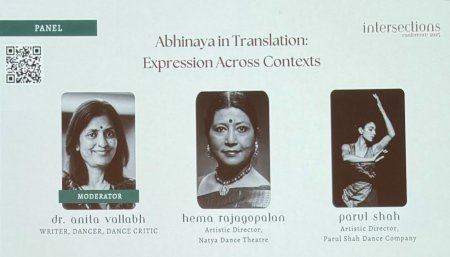 Panel: Abhinaya in Translation The indepth thought and research that practitioners put into for every work they do is mostly eclipsed by the grandeur of the artistic output that they produce at the end of it. This is one of the main impetus for the field of study that first started in UK and then in US called 'Practice as Research.' The Intersections conference created space for many panels and presentations where artistes shared the in-depth research behind their work in an organized manner. For instance, the second session on day 1 featured Sonali Skandan, Mesma Belsare, Neelambaree Prasad, Hema Rajagopalan, Parul Shah, moderated by Anita Vallabh in a panel titled, 'New Worlds, New Experiences.' The intergenerational nature of this panel was very generative as it helped attendees to observe the ways in which dancers have been experimenting with their traditional art to create new meaning. Each of these artistes showed portions of their work and elaborated on the research they had done to get there. This panel captured along with the said work in question the labor that these artistes have been putting in to create meaning in the diaspora over many years. 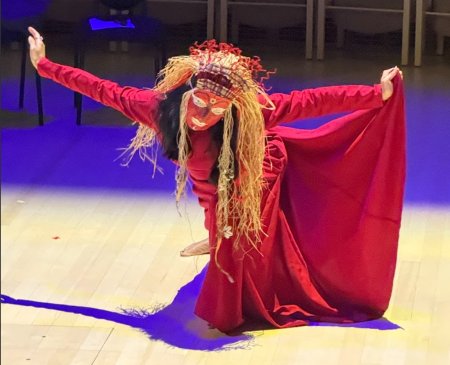 Mesma Belsare Mesma shared her journey in the diaspora space starting with sewing for Boston conservatory, then posing for artists, then moving on to dancing at night clubs and through all these experiences she was continuously gathering courage, resilience and more importantly vulnerability to express. She shared, "If your heart breaks and if you let it break a little you can include more..." She shared about her compelling works like 'Chinnamasta' and 'Siren' and did a brief but powerful demonstration from Siren where she moved as she held a dead baby while wearing a mask. Hema Rajagopalan, as a senior artiste, shared her lonely journey as a dancer before the Indian diaspora dance scene gained momentum and demonstrated few instances of work she had done. This panel centered on the artistic work that was used as a departure point to reflect on their entire artistic journey. This was once again timed and presented with the aid of a paper or a prepared presentation. It was evident that the panelists, and the curators had thought through the flow and had timed their presentations. Their practice was their research. The following panel was an extension of session 2 where presenters Shambavi Dandekar, Deepta Sheshadri, Sujata Srinivasan, Shefali Jain and Shivani Joshi either led with their research talk or their current work followed by a paper on the work. This was again a 'Practice as research' panel where we could see how the artistes experimented with music, narratives, movement to give form to their life and experiences. As an attendee, I was thrilled to see that the conferences had brought together thoughtful artistes from various parts of the country under one roof to share their work and their process. These sessions fed into the many engaging conversations that happened in the foyer both during the breaks between sessions and when we were invited to spend time in the foyer going through the many poster presentations made by artistes, community members, promoters, and teachers. These posters once again opened a large chasm of learning where presenters shared with interested attendees who came to their assigned spots to learn more about the presenter's chosen area of interest for their posters. The wide variety of topics ranging from pedagogy, women health, dance history, dance aesthetics, science in dance was inspiring and humbling to know the different ways in which artistes, practitioners and researchers constantly find purpose through dance. The session, 'Embodied inquiry' integrated dance, biomechanics and history by four artistes Kaustavi Sarkar, Keerthana Venkatesh, Chinmaya Vedantam, and Krithika Swaminathan. All four presented research papers so it was a step change from the panels before that were centered on an artistic output. Some of the topics discussed seamlessly merged into each other especially Keerthana's, Kaustavi's and Krithika's as all three discussed in some measure the biomechanics of dance using motion capturing technology. Chinmaya's talk on the Kapalam tradition in Kuchipudi was thus quite different from the others. It was a fascinating research and she bagged the best paper award at the conference.  Sonali Skandan The remaining two afternoon sessions prepped us for what was in store for day 2. We were veering more towards the true business of being an artiste - the sweat, the muscle, the training, the marketing, the funds, the economics of it all. We answered questions for ourselves with the panelists Sonali Skandan, Tanveer Alam, Arthanari, Shekar Viswanathan, Erik Holmgren, Kiran James and Lata Pada, who discussed from their life and experience on how to sustain a life in the arts as a choreographer, curator, promoter, researcher, art administrator. Panelists shared graphs, data driven research, quantitative demographic trends, real quotes from parents and students on the costs of sustaining the arts. Instead of the rambling and unstructured bemoaning of the state of the arts by different parties that we end up seeing in many Indian classical dance conferences, the reliance of this panel on numbers, trends and statistical research along with market research through public opinion was eye opening for many of the artistes-promoters like me who were able to map this research to our own geo-social contexts. This panel set the context for an engaging working group session organized by Vani Krishnamoorthy of Arts India US who led us through a brainstorming session where we tried to come up with many problems and issues that we as artistes experienced in our lives. This was a fun way to wrap this part of the conference where we introduced ourselves to fellow attendees and bonded on common issues that we encountered in the field. The options discussed by different groups left us energized and motivated to try them out for our artistic practice. 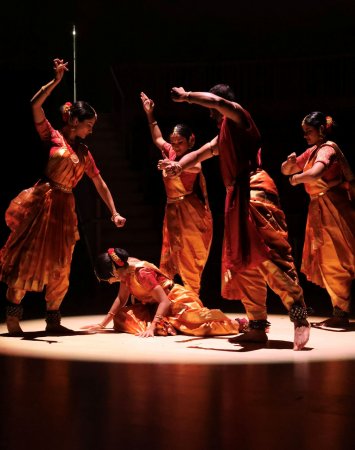 Explorations by Anubhava Dance Company (Photo: Meera Ratnagiri) The attendees reconvened after a break for the evening performances of Anubhava Dance Company's 'Explorations' and Priyadarsini Govind's 'Yavanika.' It was a packed hall and was a fitting finale to the day's events as both presentations were thematically aligned. 'Explorations' was arranged on core emotions like Fear, Joy, Humor, Hope, Love and Peace. Choreographers Shriya Srinivasan and Joshua George, juxtaposed narratives from mythology and our contemporary lived realities to highlight how these emotions constantly define human life for generations. Anubhava Dance Company features second generation immigrant dancers, many of whom have been trained in classical music and dance. As a teacher and founder of a non-profit invested in motivating young student dancers in the Indian diaspora in the United States to organize and find their original voice through dance, Anubhava's work is close to my heart. As youngsters both in college and straight out of college, I have seen them organize themselves and grow over the years. Presenting a whole evening length work that is thoughtful and original is commendable by these young professionals who balance a full time corporate job in addition to their passion in dance. Following their act was Priyadarsini Govind's 'Yavanika'. It speaks of the veil that obscures our understanding of reality as it stands. This is a very philosophical exploration about the state of being, drawing from different ideologies within the Indian ethos. The presentation used spoken word, props, and interesting blocking to elaborate its layered message. Similar to 'Explorations', 'Yavanika' worked with human failings and appealed to aspire to a higher, detached state of being as elaborated by many eastern philosophies. While 'Explorations' featured dancers who were from the Indian diaspora, 'Yavanika' featured visiting professional dancers from India. This immersion in different geopolitical contexts altered their aesthetic sensibilities, in my read. 'Yavanika' more than 'Explorations' was more esoteric and needed a more initiated and engaged audience to follow through the narrative and grasp the overall message of the production. But to analyze these two performances in detail is beyond what I set out for myself in this report/review. It was a long day with a large amount of artistic and intellectual stimulation starting as early as 8am and it was quite demanding on attendees to keep their attention till as late as 11pm when day 1 drew to a close. Day 2, to me, was the most exciting part of the conference as it brought together a survival toolkit for dancers spanning topics concerning health, pedagogy, financial acumen, marketing, profile building, fund generation and market expansion. All topics were presented with practical tips and immediate takeaways. All the sessions ignited robust audience participation. Kuchipudi dancer and physician, Pranamya Suri, opened the morning session where she used models, diagrams and movement to explain the human anatomy and its relevance to dancers concentrating specifically on the spine. Her hour long paper was meticulously thought out and spurred lot of engagement from the audience. Shriya Srinivasan's short presentation was about the effect of impact when striking the feet on the joints and once again offered practical tips for reducing injury. The third session was formatted more like a workshop where Anugraha through a brief movement sequence made us all try out how a narrative takes shape in Bharatanrityam's movement philosophy. 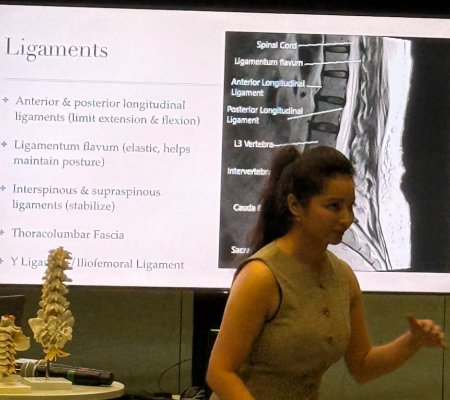 Pranamya Suri 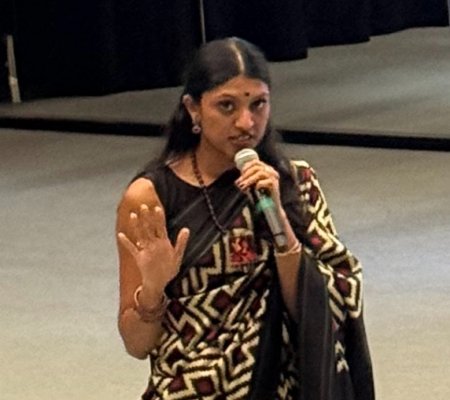 Navya Maitri Konda The second and third session of Day 2 were focussed on economic sustainability of artistes. Lavanya Rajagopalan, Director of Silambam, Houston, shared important pointers for writing and securing grants. Navya Maitri Konda shared her ingenious ways of using AI to build our profile and expand our reach both through social media and outside of it. Manasa Jayanthi egged us to be fearless in creating our professional brand and claiming our price. Vaibhu Mohan, a multi-faceted artiste, shared ideas for collaboration with diverse artistes and moving beyond the cultural milieus of temples and sabhas that Indian, classically trained dancers usually end up performing. This session was power packed and in my conversations with several attendees after the end of day 2, I gathered that, like me, they felt motivated and resolved to invest time and effort in shaping their artistic profiles, and branding. We posed and clicked several photos, exchanged contacts, started following each other on our social media handles and resolved to meet at the next Intersections conference. This was a very well executed conference that covered lot of ground and did it with painstaking planning. I could write more about the way Shriya Srinivasan and Joshua George shaped the contents of the conference, the preliminary questionnaires they sent out to gauge areas of interest, the low entry fee that helped many to attend the conference, the collaborative marketing they did with Global Indian Artist founded by Anita Vallabh to create visibility but in the interest of the reader, I am wrapping this sharing here. I look forward to the different versions of this conference in the years to come.  Dr. Deepa Mahadevan is a research practitioner. Through her non-profit, Matrusena, she is invested in encouraging critical thinking and inculcating an appreciation of diverse aesthetics among dance practitioners and the community at large. She is a bi-coastal artiste and functions as a dance director of Tiruchitrambalam school of dance in both New Jersey and the Bay Area, California. |
