
|     |
|
| |

 From edifice to energy: 'Vivarta' and the birth of a performance space- Bijoy Shivrame-mail: bijoyshivram@gmail.com Photos: Nitin Sawant - The Open Space December 20, 2025 In recent years, Ahmedabad's cultural landscape has been quietly but decisively reshaping itself. Beyond grand auditoria and proscenium stages, there is a growing recognition of the need for performance spaces that listen as much as they present - spaces that allow dance, music, theatre and interdisciplinary practices to breathe, adapt and converse with their surroundings. Black boxes, amphitheaters and flexible venues are increasingly redefining how art is encountered, fostering intimacy and immediacy between performer, space and spectator. When two like-minded architects come together, creativity inevitably finds form. Sandeep Patel and Jayashree Nair, who met while studying architecture at NIT Calicut, shared a deep affinity for the arts; Jayashree, introduced to dance during her school years, returned to the performing arts after marriage and motherhood, encouraged by her sons Nandaj Patel and Madhav Patel, both creatively inclined. A brief engagement with contemporary dance rekindled her artistic journey and revealed the need for a space where artistes and audiences could spend unhurried hours together, immersed in performance. Shaped by Jayashree's vision, enriched by the ideas of Nandaj and Madhav, supported by Sandeep Patel's commitment, Evoke - Centre for the Arts came into being as a seamless confluence of architecture, imagination and artistic life. Located in Ahmedabad's rapidly developing western corridor, the newly inaugurated amphitheater announces itself not merely as a physical structure, but as a proposition - of dialogue, discovery and sustained artistic inquiry. Though the space is still in the process of being fully realised, its opening evening carried a prophetic charge. One sensed, almost instinctively, that Evoke will in time pulse with creative energy, becoming a vital and responsive node in the city's cultural map. 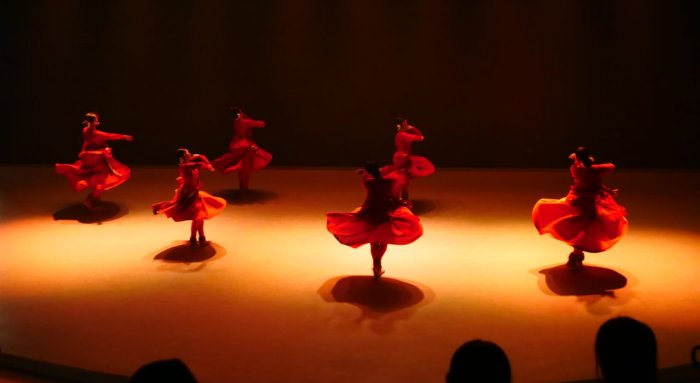 Sanjukta Sinha Dance Company Fittingly, the inaugural evening unfolded through two choreographic works of striking contrast and complementary depth, together articulating the philosophical and aesthetic ethos with which the space comes into being. The evening opened with 'Noor', a contemporary dance work by Sanjukta Sinha Dance Company, that approached light not as external illumination but as an inner force - one that pierces silence, shadow and the uncharted terrains of the self. Inspired by the evocative thought that "some infinities are larger than others," 'Noor' traced a journey of seeking, losing and rediscovering the radiance that resides within each of us. Light here existed in paradox - as stillness and momentum, fragility and power, revelation and surrender. In a world saturated with noise yet impoverished of authentic voice, 'Noor' emerged as a quiet streak of luminosity, breaking the waiting silence. It urged introspection: to listen inward, to confront what we habitually overlook and to recognise the beloved within the self. Unmistakably stamped with Sanjukta Sinha's choreographic voice, the work unfolded as a compelling study in corporeal geometry and spatial intelligence. Performed by Krutika Ghanekar, Bhakti Shah, Tirtha Juvatkar, Radhika Chauthaiwale, Riya Patel, Nandini Jani, Pankaj Sihag, Hiren Gajjar, Vihanga Rukshan and Shantanu Gosavia, the ensemble demonstrated an organic strength that blurred distinctions between masculine and feminine energy. Grace did not negate power; rather, it became power refined. 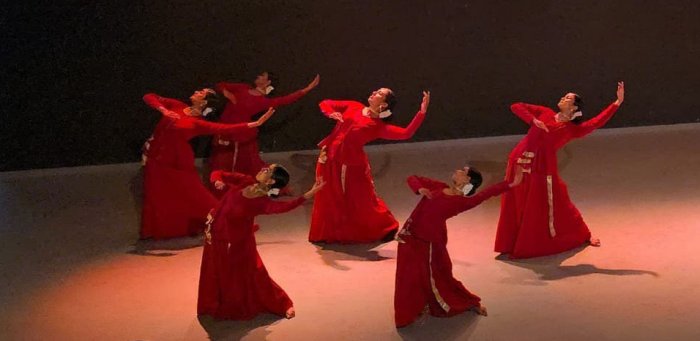 Sanjukta Sinha Dance Company True to Sanjukta's aesthetic, the choreography privileged the architecture of the body - its curves, extensions, suspensions and sudden emphatic shifts. The dancers moved as a cohesive organism while allowing individual kinetic voices to surface within the collective. Particularly striking was the sensitive engagement with the amphitheater itself. Verticalities, diagonals and negative space were activated with intention, transforming the architecture into an extension of the choreography. Under Sanjukta Sinha's concept, choreography and artistic direction, 'Noor' emerged as a visceral, resolutely physical exploration of movement - setting a robust and thoughtful tone for the evening. 'Vivarta' The second half of the evening transported the audience into the vast mythic and philosophical universe of the Dashavatara, presented by Sampradaya Dance Creations, Canada. Titled 'Vivarta' - a term that connotes transformation, evolution and change - the work was originally choreographed in 2005 by Lata Pada, Founder and Artistic Director Emerita of Sampradaya. Revived after many years, this re-envisioned production formed part of Sampradaya's ongoing India tour, with Ahmedabad marking its penultimate presentation - lending the evening a sense of quiet anticipation rather than closure. 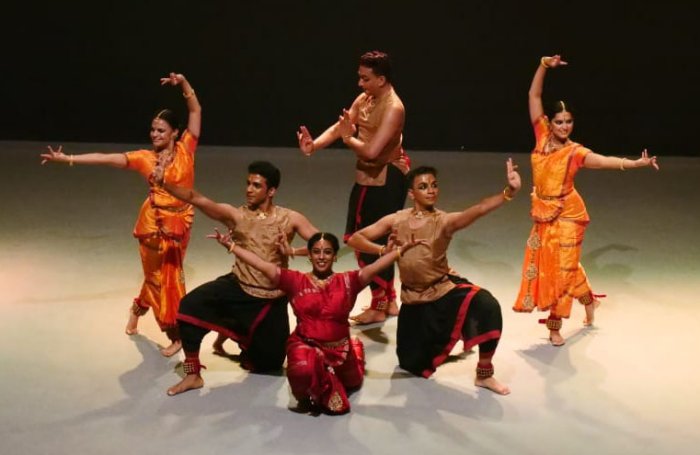 Vivarta Rooted in the classical grammar of Bharatanatyam yet resonant with contemporary sensibilities, 'Vivarta' celebrated the form in its full expressive range - where rhythm, gesture and narrative converge to reflect cosmic order, dharma and continual transformation. Under the artistic stewardship of Suma Suresh, with Jasmine Sawant as Executive Director, the revival retained the imaginative clarity and choreographic restraint that have long defined Lata Pada's work. While the theme of the ten incarnations of Vishnu has been explored innumerable times, 'Vivarta' distinguished itself through its discerning aesthetic intelligence - knowing precisely what to articulate, what to suggest and what to leave unsaid. Performed with remarkable conviction by Rachana Joshi, Harikishan S. Nair, Atri Nundy, Suvin Prasad, Arun Sreekumar and Purawai Vyas, the work seamlessly integrated classical dance idioms with elements of yoga, martial forms and contemporary movement language. The synthesis was neither eclectic nor excessive; it felt deeply organic and considered. From the economy of gesture in Matsya, to the visually arresting emergence of Kurma, restoring Mount Mandara to balance; from Varaha's rescue of the Earth from Hiranyaksha to the ferocious, tripartite embodiment of Narasimha, tearing through Hiranyakashipu - each avatara was rendered with precision and dramatic clarity. The progression continued through Vamana, humbling Bali Raja; Parashurama, charged with righteous fury; and the richly layered narrative of Rama. Moments such as the abhinaya-laden exchanges during Sita Swayamvara, Jatayu's valiant confrontation with Ravana and his poignant death in Rama's arms resonated with deep emotional gravity. The creation of Setu Bandhan by the vanara sena and the eventual vanquishing of Ravana unfolded with narrative coherence and visual strength. 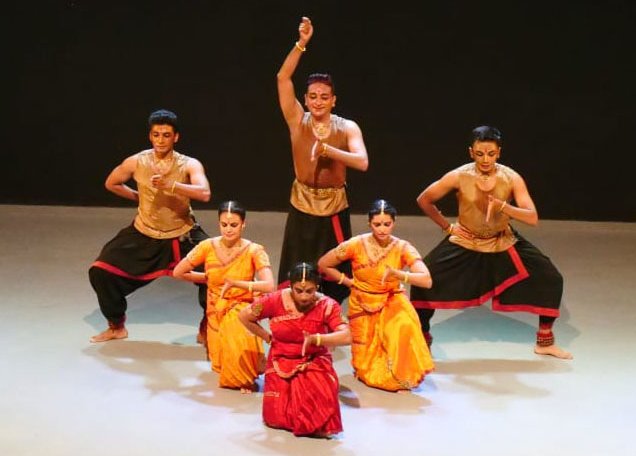 Vivarta The eighth avatara introduced a lyrical shift - Krishna, seen through playful interactions with the gopis, his role as Arjuna's charioteer and the profound stillness of the Geetopadesha. This segued seamlessly into Buddha, where Siddhartha's awakening to suffering, impermanence and compassion was rendered with meditative restraint. The work culminated in Kalki, marked by vigorous nritta and kinetic urgency, suggesting renewal through dissolution. Praveen Rao's evocative music score, Harish Upadhyay's sensitive lighting design and the seamless backstage coordination by Bharat Vyas (Stage Manager & Technical Support) and Nitin Sawant (Production Manager) elevated the production into a cohesive and immersive dance-theatre experience. With just a simple ceremonial inauguration by Jayshree Nair and her family, the space came into being. 'Vivarta' articulated the philosophical foundation upon which Evoke - Centre for the Arts enters Ahmedabad's cultural consciousness. By foregrounding choreographic depth, artistic rigour and thoughtful engagement over spectacle, the space asserted a clear commitment to meaningful artistic practice. Anchored in discernment rather than display, the opening evening suggested a future where Evoke will nurture rigorous exploration, sustained dialogue and evolving creative expression - allowing the edifice to transform, over time, into living energy. 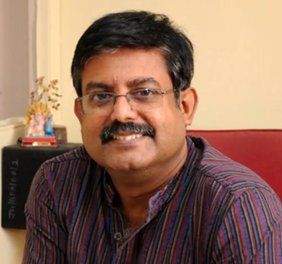 Son of journalists K Shivram and Amni Shivram, the first Malayali woman English journalist, Bijoy Shivram is an accomplished Indian classical dancer trained in Bharatanatyam and Kuchipudi. A passionate promoter of the arts and a skilled graphic designer, he currently serves as the Vice Principal of JG College of Performing Arts and the Assistant Director (Operations) overseeing 17 JG colleges. He is also the founder of Preksha, an organization dedicated to the promotion of art and culture in Ahmedabad. Since 2020, Bijoy has curated the YouTube series 'Gurudakshina - An Ode to our Gurus,' celebrating the legacy of mentorship and tradition. |
