
|     |
|
| |

 Sanchari 3.0: Came, Saw, Conquered!- Jayanthi Balachandrane-mail: sun.arts.initiative@gmail.com Photos: Pratibimb Creative December 16, 2025 A group of accomplished, senior and high caliber artistes from the Bay area, California dazzled audiences with their artistry and communicative expertise for a program focused entirely on abhinaya or expressive dance. This event was the brainchild of well-known dancer, scholar, musician/composer and teacher Snigdha Venkataramani and dancer, scholar and top-notch choreographer Ganesh Vasudeva. All the pieces chosen for exposition were thoughtfully and knowledgably curated by Snigdha and Ganesh. Both also provided the entire research and lyrics for all nine dancers to work on. They chose pieces which suited different classical dance styles such as Kuchipudi, Odissi, Mohiniattam and Bharatanatyam. Like the icing on a cake, Snigdha herself sang all the songs in the different languages. In addition, she embarked upon getting all the songs professionally recorded for the program, in various languages and ragams, making for a musical treat for the soul. This was no meager achievement and completely altruistically motivated for other artistes. On a personal note, Snigdha and Ganesh are extremely warm and respectful in all their interactions with people. This made for a positive experience, in that they also generously and patiently put in their time and effort to explain and educate anyone who showed interest in the program. It was clear, that their heart was truly in the right place - the unearthing of a treasure chest of rare songs and its dissemination to one and all. Snigdha's and Ganesh's magnanimous spirit to stage other artistes and give them a spotlight to shine on their own merit was a yeoman service to the arts. Their wish is to continue exploring the pieces long after the program is done, as it'll evolve with different dancers bringing their unique "voice" to the song. This program was in and of itself a rare occurrence, as pure expression laden programs are few and far between nowadays. This is largely due to abhinaya inherently carrying finesse and deeper meanings, requiring a more discerning and involved presence by the audience. To be open to and able to receive the richness of abhinaya pieces, rasikas are required to devote their full attention to the dance itself, apart from marveling at the dancers' abilities. We live in a fast-paced world. Audiences often juggle various commitments to afford the luxury of time to not only attend but immerse in the world of human emotions through music and dance. This was one such rare opportunity to soak in the art of abhinaya - where feelings and perspectives were the mainstay. In the program, the dancers embodied completely different characters through dance, which is no small feat. The dances themselves unfolded in an unhurried pace, making for an evening of aural and visual delight for the senses. It was poetry brought alive through the visceral world of dance. Abhinaya requires a degree of vulnerability to portray characters and often becomes "raw" under the glare of stage lights. Pieces were handed to dancers after some thought on which pieces would be best suited for the style of dance and emotions. It was a personal quest for individuality and creativity. Some questions needed to be borne in mind by the audience as they were watching the pieces - what role(s) is the dancer portraying and to whom is the piece being addressed? Was it life imitating art, or art imitating life? A spectrum of composers, their thought process and hallmark usage of language within the poems were showcased. This put the spotlight on the variety of expressions through a language in a song. Some composers chose sophistication and others preferred more colloquial writing. Layers and complexities of expressions unfurled its many hues and shades through the course of the entire program. All this then became the "search", as all the nine senior artistes explored a kaleidoscope of emotions and situations experienced by the nayika in varying degrees, thus highlighting the very essence of this program - "Sanchari" or "exploration"! 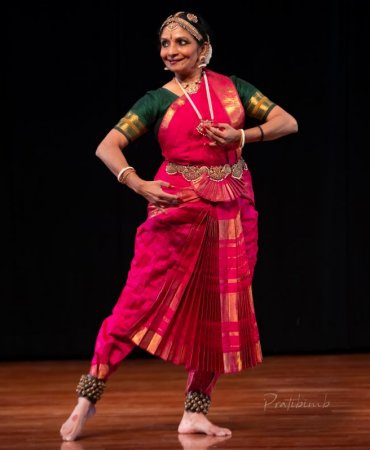 Nirupama Vaidyanathan Nirupama Vaidyanathan, a versatile artiste in her own right, commenced the program with her performance of a thought-provoking and wisdom-laden piece titled "Iccina Mancide", composed by Sarangapani, in Dhanyasi ragam and misra chapu talam. She is an accomplished dancer, writer, scholar and speaker, who is involved in researching classical Tamil poetry. "Why are you in such turmoil as Venugopala has come to your doorstep today? Is it right to treat him differently? Having wads of money in one moment and none in another moment, are like two pots that one constantly balances - there is never steadiness in wealth. The rising sun sets in the evening; the blooming flowers wither away - there is no constant around us", writes the composer. Nirupama's presence on stage was one of dignity and gravitas, holding her own in her inimitable style and setting a high bar for the entire program. Her commanding stance coupled with clarity in the depictions of characters in the piece drew admiration. She conceived this poem as a conversation between an older woman advising a younger, impatient woman over matters of the heart. However, it was Nirupama's ease and command over the subtlety of abhinaya, which paved the way for an elevated start to the evening. The philosophical juxtaposition with the artistic delivery of the piece made for a truly thought-provoking and memorable moment. 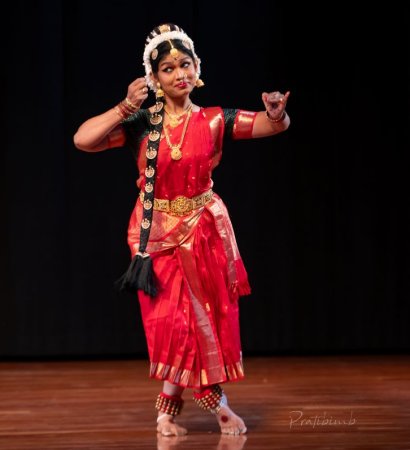 Samidha Satyam The next presentation was liltingly choreographed in Kuchipudi by Samidha Satyam, titled "Balimi ela balamani", in Thodi ragam, adi talam, composed by Pattabhiramayya. The crux of the song is about a woman who is excessively fond of a man, despite the caution and advice from others. Samidha plays the role of a friend in a cautionary role. She warns the heroine in the Telugu javali - "Why are you showing him so much affection? What of dignity and honor? Why are you brooding about the Lord of Talavana?" A highly energetic and creative dancer, Samidha brought buoyancy to the questioning elements of the sakhi's dialogue with the nayika. There was a strong and direct approach in her body language, making for a dynamic and purposeful presentation. There was an effortless synergy between her dancing and the pace of the song itself. It was like she was intentionally shaking her friend out of a reverie, which was obviously consuming her friend's life. She vividly brought out the often authentic and straightforward exchanges between very close friends, as they inadvertently look out for each other through ups and downs in life. Samidha's dancing has a vibrant approach with her outstanding rhythmic elements adding fervor to her expressional prowess. 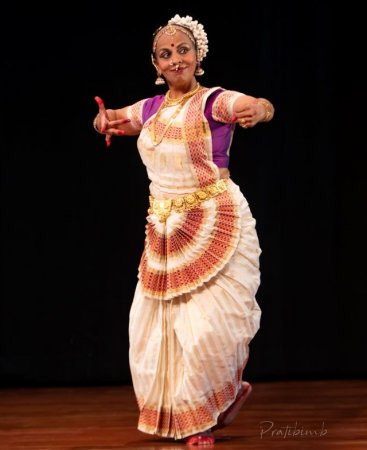 Shobha Subramanian Shobha Subramanian, a well-versed Mohiniattam and Bharatanatyam artiste, was the next to present her piece in Mohiniattam with grace and elegance. She is a dancer, teacher and singer all rolled into one, making for a holistic presentation in her dancing. Titled "Valapu thaala vashama" in Telugu (a pleasantly surprising departure from Malayalam, which is traditionally used in Mohiniattam performances), this composition by Maharaja Swati Tirunal in Atana ragam, misra chapu talam, was a poignant outpouring of a nayika to her sakhi. She confesses that her lover, who is handsome like Manmatha, is now ignoring her. She reminisces about their youth when he used to be kind, generous and loving. "Is it justified for my lord to ignore me? Padmanabha who is equal to Manmatha, has today refused me. My heart once experienced happiness, but my fate is now like this, O Sakhi", laments the dancer. Shobha fluidly brought out the emotions of loss and yearning with comparable, languishing movements of the body. It appeared like a painter gently creating a beautiful picture with strokes of the brush in varying intensity. Her dance ebbed and flowed beautifully with the cadences of the song. The gentleness and detailed unfurling of her abhinaya lent pause, like a foil to the intensity of the pain in the lyrics. 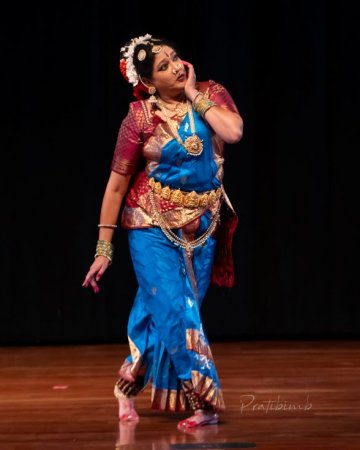 Sunita Pendekanti The fourth presentation for the evening was by effervescent and very respected Kuchipudi dancer Sunita Pendekanti. She performed a well-known Annamacharya kriti titled "Emoko chiguru tadharamuna" in Tilang ragam, rupaka talam. This popular song was also made famous by its inclusion in a movie titled "Annamacharya", starring a star actor Nagarjuna, in the main role. This romantic composition by Saint Annamacharya portrays the appearance of a lady, Padmavathi Devi, after her divine union with Lord Venkateswara. The song unfolds through a unique narrative style where the sakhis (friends of the heroine) observe her transformed appearance and engage in gentle banter, trying to uncover the reason behind her radiant state. It's a deep love poem which alternates between bhakthi (devotion) and sringara (love) states, almost as competing elements. This dichotomy of the piece was explored very delicately by Sunita, bringing out the competency of the artiste to handle a heavy piece such as this, with great elan. Sunita highlighted her grace as she weaved love and devotion into one creative "braid" of movements. She sensitively depicted the personalities of each character with thought, balance and chiseled interpretations. She did full artistic justice to a lyrical piece by a towering composer's writing, like a flower blossoming to reveal its innate fragrance and essence. 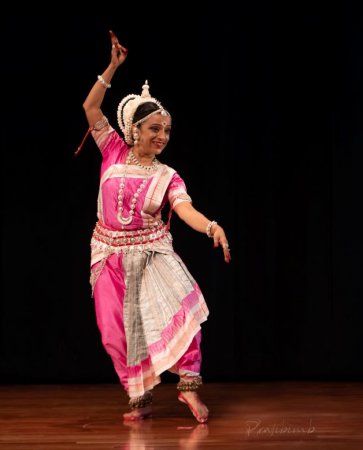 Gayatri Joshi The fifth performance was a rare piece and the oldest poem presented for the program. It was tuned and sung melodiously by Snigdha Venkatramani herself in the entrancing Desh ragam, adi talam and choreographed gracefully by accomplished Odissi dancer Gayatri Joshi. This piece is penned by the composer Vidyapati (1352 - 1448) from Mithila (currently known as Samastipur in Bihar), in the Mythili language. It describes Radha's love for Krishna. Gayatri's beautiful pink and white costume, coupled with her smiling countenance, elevated her soulful and heartwarming rendition. We enter the world of poet Vidyapati's timeless verse "E Sakhi pekhali ek aparoop" where Radha, lost in wonder, tells her friend, "O Sakhi, I have seen someone beyond compare!" Through her eyes, we glimpse Krishna - whose feet bloom like twin lotuses; whose dark form rises like a tamala tree draped in a golden lightning garment like a vine; whose eyes flutter like restless birds; whose curls crown him in peacock grace. A rhythmic jathi depicting a peacock, added to the lively descriptions of nature. This dance invited us to see everything through Radha's lens. It drew the audience in to pause and recognize the divine beauty that surrounds us every day, in art, in nature, and in each other. Imageries of birds and elements of nature filled the audience's hearts with serenity and joy. Gayatri's graceful movements beautifully and creatively brought out the spectrum of elements from nature. 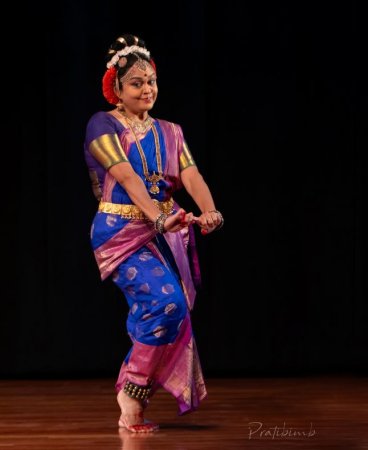 Madhuri Kishore Madhuri Kishore, an accomplished Kuchipudi dancer, presented the next piece as a javali, in a crisp and succinct manner. Tanjore Quartet songs are performed in Bharatanatyam, but this presentation was handed to a seasoned and dynamic Kuchipudi artiste such as Madhuri, to showcase a different dimension. The piece titled "Kopametula" in Kedaragowla, rupaka talam was composed by Tanjai Chinniah. The resident emotion of the piece was sarcasm. The interesting aspect was that the nayaka (hero) was angry, because the nayika did not open the door to him. The choreography and the lyrics portray the nayika (female protagonist) addressing her beloved with lines "kopa¬metula raka yuṇḍu¬nura komalaṅga nipai". "Don't carry anger, my delicate one". There is a subtle disapproval of the hero's behavior. The emotional tone oscillates between gentle pleading and restrained hurt - love remains, but she is aware of neglect or betrayal. Donning an elegant purple and pink costume, Madhuri's unapologetic portrayal was a perfect ode to a sarcastic and proud woman (strains of khandita nayika), who does not shy away from expressing her anger to her beloved. A dose of humor was also injected into the piece as she depicted subtle "jabs" at her Lord, evoking a laugh towards the end of the piece. 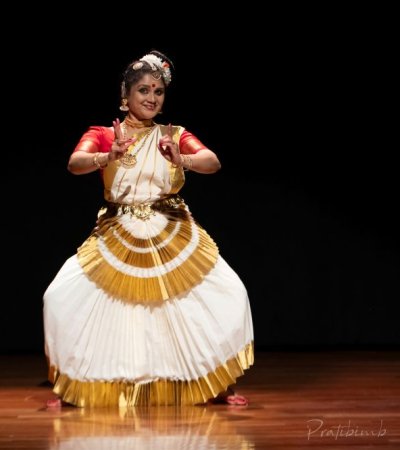 Bindu Pratap The next piece was a serene and lasya (grace) dominated presentation by Bindu Pratap, a well-known Mohiniattam exponent. Adorned in a traditional and aesthetic cream, gold and red color combination Mohiniattam costume, Bindu's expressive face came alive as the caring, observant and loving consort to her chosen Lord. The song titled "Theliviyalum mukham" in ragam Punnagavarali and misra chapu talam, a composition of Maharaja Swathi Thirunal, was a story told through the tender eyes of Goddess Lakshmi, as she beholds her beloved Lord Padmanabha. She arrives radiant and graceful, only to find his divine face, serene yet, shadowed by doubt, his eyes distant and questioning. With gentle affection, she wonders what could have stirred such unease. She tries to lift his spirits, reminding him that the world depends on his joy. An air of mystery as to what was weighing on Lord Padmanabha's mind, wrapped up her piece, as she left the audience with lingering questions in their minds. Bindu's calm aura and quiet confidence in an emotionally layered piece, enveloped the audience with her gentleness and artistry. Her expressive eyes were the proverbial window into her soul, taking the audience on a tale of wistfulness and longing. 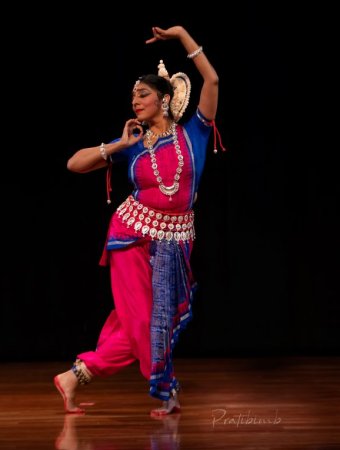 Niharika Mohanty Poet Jayadeva's ashtapadi "Radhika Tava Virahe Keshava" in Vaasanthi ragam, adi talam and tuned by the well-known musician Dr. M. Balamuralikrishna, was the next piece to be presented in the outstanding line up of artistes from the Bay area. It was fittingly choreographed by well-known Odissi exponent Niharika Mohanty. She held the sthayi bhava right from the beginning with a free flowing "viruttam", followed by the ashtapadi itself, managing to expertly sustain the heavy undertones throughout, proving her mettle beyond a doubt. The ninth song of the poem Gita Govindam written by Jayadeva, is a dramatic address delivered by Radha's sakhi (her female confidante) to Krishna, vividly detailing Radha's intense suffering from the pain of separation (viraha). Radha's beautiful, lotus-like eyes are constantly shedding copious amounts of tears, as she frantically searches every direction for a glimpse of Krishna, her vision blurred by water. Radha continuously chants the name "Hari! Hari!" with the desperate hope that if she dies from this separation, she may at least attain Him in her next life. The sakhi implores Krishna to go and save her and not delay. Niharika's command over various facets of Odissi and years of dedication was there in plain sight for all to witness in her dance. Her dancing bore the stamp of the (Kelucharan Babu, Ratikant and Sujatha) Mohapatra legacy. She turned an oft repeated ashtapadi into a living, pulsating rendition by pouring her signature movements into the piece, to render it anew. 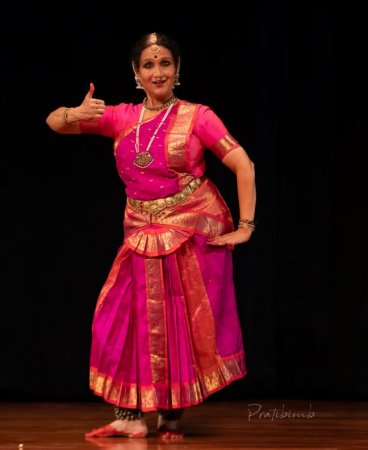 Indumathi Ganesh The final presentation of the evening of music and dance was a brilliant performance by the accomplished Bharatanatyam artiste Indumathi Ganesh. She effortlessly shone in her presentation of a Tamil padam "Sundari en soppanathil vandadaar solvaay", in the ragam Khamas, rupaka talam - a composition of Ramanathapuram CS Sankara Sivam (Carnatic vocalist Seshagopalan's guru). In this padam, the dancer portrays a young girl swept away by love. Turning to her friend, she sighs, "Oh beautiful friend! What a dream I had! Do you know who came to me last night? None other than Lord Muruga himself! He spoke of his six sacred abodes, offering me his home in Palani - the very one he claimed after losing the race for the mango to Lord Ganesha. He told me of Thiruchendur, where he vanquished the demon Surapadman." Blushing, the nayika adds, "My dear friend, I also dreamt that he tied the sacred Mangalsutra around my neck. Can you not see it gleaming here? He is my wedded lord - the radiant son of Shiva, the handsome Muruga - who came to me in a dream." Dressed in a resplendent pink costume and looking every bit as the young character she portrayed in the dance; Indumathi transformed into an innocent young girl beseeched by her Lord. She weaved in and out of the various characters she was playing with sophistication, and the audience was transported into her world - that of a love struck girl, describing her sweet dreams to her confidante. Setting aside the seniority, she was a shy and smitten girl with a twinkle in her eye in one minute, then the valiant Muruga the next, all in a seamless manner. She ended with the "dreaming" pose, bringing it full circle to the beginning stance of the dancer in a reclining pose. The piece brought out her innate expressional artistry with joy and abandon. A nuanced artiste with decades of creative work to her credit, Indumathi cemented her standing as a highly regarded dancer. As the program drew to a close, her dance had become a "prayer" both physically and emotionally, leaving the audience to take in her spiritual sentiments and portrayals in their heart. A sell-out program for good reason, the event was brimming over with an excited, engaged audience with a host of students, teachers, scholars and connoisseurs. Esteemed teachers from the Bay area brought out a treasure trove of songs and expressions, which went beyond mere technique. It was a resounding victory for the nuanced art of abhinaya - where the dances were leading the audience towards the "experience" of emotions and rasa, culminating with the exhilarating effects of "rasanubhava".  Jayanthi Balachandran is an ardent arts enthusiast. |
